
Eighty-eight years of living fully, studying and writing… and now to say something in a final kind of way.
I started this project upon reaching the 87th anniversary of my birth, intending to complete my Report no later than my 90th. I vowed to issue the Report in two pages, but this is unrealistic.
I started by gathering scores of books and other reading materials, many garnered through the Internet, and plunged into a months-long bout of reading and note-taking.
I soon realized that I am at disadvantage in that I must use words to report whatever it is that these years of living and studying have revealed to me. So, I begin with two essays, or chapters, in the first section of the Report on Words.
Note: In recent months I have been using ChatGPT.com to help me evaluate the materials I have made notes from. These first two chapters on Words were the result of my detailed queries to ChatGPT and its response.
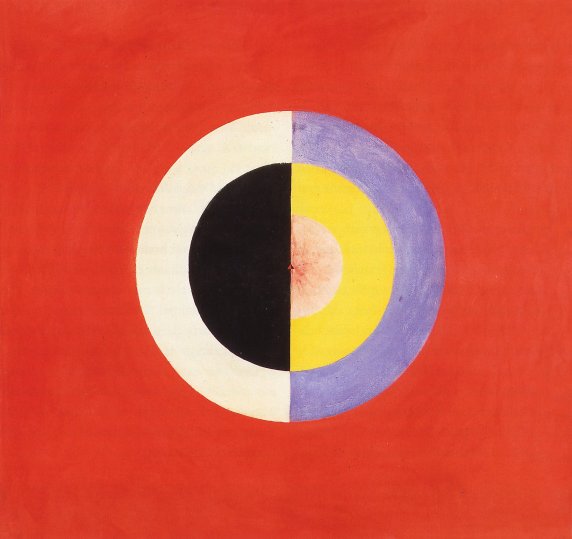
Hilma af Klint: No. 17, Group IX, Series SUW 1914-15
—
I. “The Word Is Not the Thing”: Reflections on Language Across the Ages
Words are the primary medium through which we think, speak, and connect. Yet throughout history, some of the wisest thinkers—from Confucius to Krishnamurti—have reminded us that words are not the things they represent. They are symbols, often elegant and powerful, but ultimately limited. They shape and shade meaning, and sometimes obscure it altogether.
What follows is a collection of reflections from sages, philosophers, and poets who have wrestled with the nature of language and its role in human understanding. These voices remind us that beneath and beyond words lies something deeper—the lived experience, the direct perception, the truth that cannot be spoken.
Confucius (c. 551–479 BCE, China)
“If language is not correct, then what is said is not what is meant; if what is said is not what is meant, then what ought to be done remains undone.”
(*The Analects, Book 13*)
Laozi (6th century BCE, China)
“The Tao that can be spoken is not the eternal Tao; the name that can be named is not the eternal name.”
(*Tao Te Ching, Chapter 1*)
The Buddha (c. 5th century BCE, India)
“Words are but symbols for the relations of things to one another and to us; nowhere do they touch upon absolute truth.”
Plato (c. 428–348 BCE, Greece)
“Wise men speak because they have something to say; fools because they have to say something.”
Folk Wisdom (Global)
“Actions speak louder than words.”
“Talk doesn’t cook rice.”
“Fine words butter no parsnips.”
“Empty drums make the most noise.”
Rumi (1207–1273, Persia)
“Words are a pretext. It is the inner bond that draws one person to another, not words.”
Ludwig Wittgenstein (1889–1951, Austria/England)
“Whereof one cannot speak, thereof one must be silent.”
(*Tractatus Logico-Philosophicus*)
Martin Heidegger (1889–1976, Germany)
“Language is the house of Being. In its home man dwells.”
George Orwell (1903–1950, England)
“But if thought corrupts language, language can also corrupt thought.”
Marshall McLuhan (1911–1980, Canada)
“The medium is the message.”
Jiddu Krishnamurti (1895–1986, India)
“The word is not the thing. The description is not the described.”
Closing Reflection
In reflecting on these voices, a theme emerges: words are useful, even essential, but they are not reality itself. They are tools for pointing, hinting, and approximating—but never fully capturing.
In an age of hyper-communication—where we are flooded with texts, tweets, and talking heads—this wisdom is more relevant than ever. We would do well to remember: the most meaningful things in life—love, presence, beauty, truth—often resist verbal expression. They must be lived, felt, and shared in silence, action, and presence.
Perhaps the task, then, is not to abandon language, but to use words with humility, always aware of their limits—and always attentive to the truths they cannot reach.
—
II. Beyond Words: The Limits of Language and the Search for Deeper Meaning
Language is perhaps humanity’s most extraordinary invention—an architecture of sounds and symbols that enables us to share thoughts, ideas, and emotions across time and space. But as powerful as words are, they are ultimately abstractions. They are not the things they represent. The word tree is not a tree. The word love is not love. Each word is a symbol, a placeholder, a shorthand for something richer, more complex, and more deeply felt.
And therein lies the problem: words can never fully capture the experience, the nuance, the reality of the events or emotions they describe. This gap between word and meaning complicates communication, especially when we are trying to express something profound—between individuals, across cultures, and over the generations.

Hilma af Klint: Swans
Language as Abstraction
Every act of verbal communication passes through a filter:
- We perceive an event or an emotion.
- We conceptualize it through thought.
- Then we translate it into words.
But in doing so, we compress and flatten that experience. Consider the word grief. No single word could ever encapsulate the full depth of personal loss. Language enables communication, but it also introduces ambiguity, distortion, and sometimes even deception. A word’s meaning depends on context, history, tone, and shared assumptions—none of which are guaranteed to be the same for speaker and listener.
We’ve all experienced this: speaking honestly and being misunderstood; reading something written centuries ago and finding it puzzling or irrelevant. Language evolves, and meaning slips.
Alternatives to Words
If words are limited, what other tools do we have to express ourselves—tools that might supplement or even surpass language in certain respects?
Here are a few alternatives that humans have developed and used, often with great success:
1. Images and Symbols
Visual art often communicates more directly than language. A painting can convey emotion, space, and story without a single word. Symbols—whether ancient hieroglyphs or modern logos—often carry layers of meaning that transcend linguistic boundaries.
Maps, diagrams, and architectural drawings similarly convey relationships and structures that would be cumbersome to explain verbally.
2. Mathematics and Logic
In science and philosophy, mathematics offers precision that language cannot. A mathematical equation or logical proof remains stable over centuries. While this method isn’t suitable for poetry or personal feelings, it excels in clarity and universality when describing the physical world or abstract relationships.
3. Music and Gesture
Music bypasses the conceptual mind and speaks directly to emotion and rhythm. A melody can express longing, joy, or grief in ways that resonate across cultures and times.
Gestures, facial expressions, and body language also carry meaning that can often be understood without translation—though these too have cultural limits. Rituals and dances carry encoded traditions and shared emotions that are experienced communally and physically.
4. Practice and Tradition
As philosopher Alasdair MacIntyre has argued, shared practices and moral traditions are also ways of communicating meaning—especially across time. We don’t need to define “integrity” if we can point to a life lived with integrity. Communities remember and transmit values not just through writing, but through ritual, example, and embodied repetition.
This kind of communication isn’t abstract; it’s lived. It carries weight and coherence over generations—something modern verbal discourse often lacks.
A Path Forward: Multimodal Communication
So where does that leave us?
The future of meaningful communication may lie not in abandoning words, but in complementing them—by weaving together image, sound, gesture, and story into multimodal expression. We already see this in digital culture: visual storytelling, multimedia art, podcasts, and rituals that blend music, text, and movement.
And perhaps most importantly, we can revive the intentionality of tradition: living in such a way that our actions speak clearly, even when words fail.
Conclusion
Words are indispensable—but they are not the thing itself. They are always one step removed. When we accept this, we become more careful, more creative, and more humble in how we communicate.
To transmit meaning across the fragile bridge between minds—and even more so across the gulf of generations—we must learn to speak not just in words, but in symbols, gestures, music, ritual, and example. That is how we speak most deeply, and that is how we may yet be understood.
—

Hilma af Klint

 The Pavellas Perspective
Thank you, Ron.
A wonderful collection of words!
LikeLike
Hello John,
Thanks for your response, friendly and appropriately ironic.☺
LikeLike
And some say a picture speaks a thousand words so I looked up this cliche in Google AI to see the origins. It is interesting to see how even this cliche has morphed and been misrepresented by words to gain credibility as an depiction of meaning. Again, pictures are another way to share emotions, perceived events, ideas, beauty, but I have learned that pictures may speak a thousand words but 999 of them are “lies”. Pictures cannot truly represent what is actually being seen in each individual’s eyes. I have stated multiple times as I have taken pictures of mountains or river bottoms how this just doesn’t do it justice. Can it ever?
Sent from my iPhone
LikeLike
Hi Greg,
Thanks for the comment. I know you’ve seen this poem before, but you comment evoked it:
“Picture, Word, Number”
I arrive at a place of great beauty
I wish to capture it, to keep it
I draw a picture of this place
I observe a sweet child
I wish always to have her cherubic face to view
I photograph her
I am transported by emotion
I want to remember this moment forever
I write a poem
I accumulate some money and goods
I want to know its value
I put it all in numbers so I can perceive my wealth
Yet the pictures, the words, the numbers
Are not enough
They are not the things they represent
I cannot recreate and keep the beauty I’ve seen
I cannot capture and keep the sweet smile of the child
I cannot regenerate the emotion I wrote of
The numbers representing my wealth fail to satisfy
Why, then, do I persist
In drawing,
In photographing,
In writing,
In numbering?
This is grasping, clinging
To a ghost of a moment
Yet these moments define me,
Don’t they?
LikeLike
Agree!
LikeLike