
The stimulus for this article comes from a distant familial connection with a man in the Republic of South Africa. Through DNA matching we learned that we have at least one ancestor in common, apparently from the village of Velanidia in the Peloponnesus of Greece. We started to correspond and have struck up a friendship. He has told me of the economic, political and social convulsions currently experienced by his home country–that is, The Republic of South Africa. His family were migrants to this country several generations ago. These troubles will be detailed further below after he and I offer some information about the whole region of which the Republic of South Africa is a major part and player.
(Most of the remainder of this article is written by my relative in South Africa. My few comments are noted ‘R.P.’)
Southern Africa is a diverse geographic region, shaped by two oceans and various inland features. The east coast is washed by the Indian ocean with its warm Agulhas current and the west coast by the Atlantic with its cold Benguela current, the two oceans meeting at the southern tip of the African continent, Cape Agulhas. Moving clockwise from the upper east coast:
- the east coast is sub-tropical, changing to more temperate the further south one goes;
- the southern tip and adjacent areas to the west have a Mediterranean winter rainfall climate;
- further up the west coast, and inland, the land becomes arid and water scarce.
Most of the inland area consists of a high plateau. From the east coast the land rises steeply to the Drakensberg mountains with peaks of 3000m within 150 km from the coast. The reverse, inland slope of the Drakensberg drops to a high plateau of around 1500m, known as the highveld. This plateau drops off steeply to the north to form the lowveld. The highveld and lowveld are summer rainfall regions.
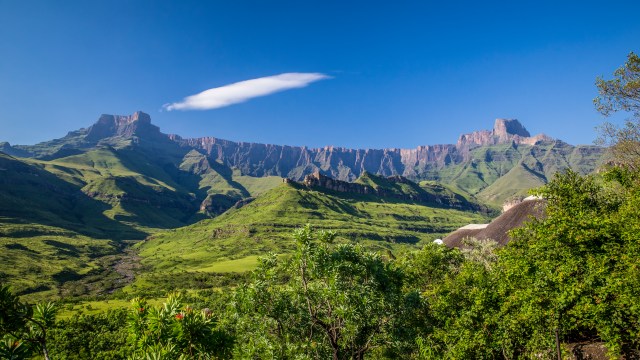
Drakensberg peaks
[The ten countries included in the grouping ‘Southern Africa’ are: Angola, Botswana, Eswatini (Swaziland), Lesotho, Malawi, Mozambique, Namibia, South Africa, Zambia, and Zimbabwe. Notes: Lesotho is enclaved within South Africa; Eswatini is around half the size of Lesotho and can be located at the bottom left tip of Mozambique. To perceive the scale of this map, the ten countries of Southern Africa are as large as two-thirds (67%) of the 48 contiguous continental states of the United States; The Republic of South Arica is as large as the combined territories of Germany, Italy, the United Kingdom and Ireland.–RP]

Credit: asiapacific.anu.edu.au
Southern Africa has ethnically diverse inhabitants too. The basic groupings are:
- The indigenous populations which trace their history to early man evolving in Southern Africa (150 000 thousand years ago);
- Bantu pastoral migrants who immigrated from central Africa (800s-1800s);
- Dutch and British colonisers who arrived during the 1600s-to-1800s, and later economic migrants from many European countries (1900s);
- Indentured labourers from India and, to lesser extent, China (1800s);
- Migrant Bantu labourers from pre- and post- colonial neighbouring southern African countries (1900s);
- Most recently, refugees from other African countries (post 1994)
The World Factbook of the CIA identities the indigenous populations as :
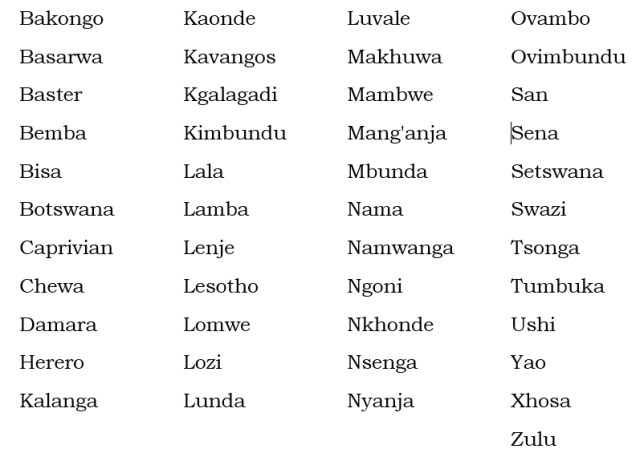
Compiled by R.P.
Despite various artificial restrictions outlawing inter-marriage between certain ethnic groups (the most significant being South Africa’s ‘Apartheid’ laws of 1948-1994), intermarriage has added to the diversity of the sub-continent’s inhabitants, including those from Europe and Asia, primarily India.

The early indigenous inhabitants of Southern Africa are referred to as the Khoisan. The San are small in stature, hunter gatherers and adapted to conditions in the central, southern, and western deserts as well as the Drakensberg mountains. There are remnants throughout the desert areas of southern Africa. Their ancient rock art is scattered throughout the region. The Khoi were larger in stature and lived mainly in the southwest coastal area. They were pastoralists, but I’m not sure which animals they domesticated; I’m also not aware of any surviving Khoi communities within South Africa.
Portuguese explorers were the first Europeans to navigate around Southern Africa, searching for a sea route to the East. They left behind stone crosses at various points where they landed in the mid-1400s, giving these places names, but never established settlements. They did, much later, establish colonies on the upper east and upper west coasts, known as Portuguese East Africa and Portuguese West Africa, becoming the Portuguese modern colonies of Mozambique and Angola, and eventually the independent states of the same names in the 1980s following wars of independence against Portugal and much longer civil wars. The Angolan civil war, in particular, attracted cold war meddlers: Soviet and Eastern Bloc advisers and equipment and Cuban foot soldiers supporting the MPLA, and South Africa and the US supporting the FNLA and UNITA.
The Dutch followed the Portuguese mariners in the mid 1600s. Operating as the Dutch East India Company, they established a settlement on the Southern tip in 1652 naming it the Cape of Good Hope, the location of modern-day Cape Town. This settlement supplied the Dutch ships with water and fresh produce on their journeys between Holland and the East. Dutch settlers sponsored by the Dutch East India Company were followed by smaller numbers of German, French and low country families, not state sponsored, but travelling independently, often fleeing religious persecution by Catholic states. The settlers interacted with local Khoisan (mainly Khoi) around the settlement, traded with them and clashed with them, mainly over theft of livestock. The indigenous locals’ social and military organisation did not extend beyond clans, and they were easily repulsed by the firepower and better organisation of the settlers. The Dutch East India Company built fortifications in the shape of a pentagon, called Die Kasteel (Dutch for The Castle). It was built close to the seashore but, given modern day land reclamation, is now several kilometres inland.
The British annexed the Cape in the early 1800s as part of the expansion of the British Empire. The original Dutch settlers, now established as farmers and calling themselves Boers (Dutch for farmer), not wanting to live under British rule, migrated inland and up the east coast. They were stateless people, deeply religious Christians and were led in their trek into the interior by elected leaders. The Dutch they spoke evolved into a new language called Afrikaans and they were also known as Afrikaners. These treks consisted of trains of ox wagons carrying women and children, men on horseback, slaves and servants on foot and herds of domestic animals. The Boers were slave-owners and the British ban of slavery added to the number of Boer families trekking inland to escape British rule.
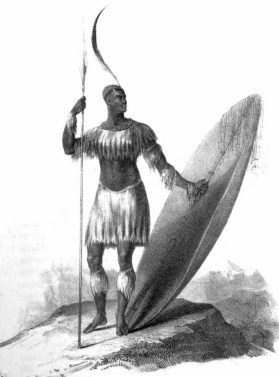
King Shaka of the Zulu Nation (1787 – 1828): reigned 1816 – 1828
Bantu tribes migrated south from central Africa from the 800s onwards. By the 1800s they had formed a number of nation states on the East coast and interior. These included the kingdom of the Zulu (east coast), Swazi (northeast interior), the Basotho (central interior), the Tswana (north central interior) and the Xhosa (southeast coast). The Bantu descendants were herdsmen, and their migration was driven by grazing needs and population growth. Before their southern migration bumped up against the northern migration of the Boers, they occasionally clashed with each other, sometimes seriously, before merging tribes into nations and settling into their territories. The Bantu migrants also clashed with the indigenous Khoi and San who, as pastoralists and hunter gatherers respectively, found the Bantu’s cattle tempting targets. As the less numerous and organised group, the indigenous Khoisan people were never a threat to the Bantu migrants.
The first interactions between Boer and Bantu in southern Africa included frequent clashes at the frontiers of the European settlements and the occasional negotiated purchase of land by Boers. A typical example of this is the meeting of a Boer leader named Piet Retief of inland-destined trekkers who negotiated with the Zulu King Dingaan, surviving half-brother of the more famous founder of the Zulu nation King Shaka, for land to settle his followers on. Retief ostensibly negotiated a written agreement with the illiterate King Dingaan, pocketed it, and was promptly massacred together with his small contingent. Retief’s fate was impalement. The Boers exacted their revenge at the later Battle of Blood River where, fighting from a small circle of wagons, they inflicted a heavy defeat on the Zulus. This battle is a milestone in Boer, later Afrikaner, history. It includes in its many facets the famous Covenant between the Boers and their God, celebrated annually on 16 December in the old South Africa as the Day of the Vow, and retained today in the democratic era as the Day of Reconciliation. The bodies of Retief’s party were recovered and, miraculously or perhaps incredulously, the signed treaty awarding land to the Boers was recovered from Retief’s pouch, legitimising the Boer claim to land in Natal.
While the Boers were trekking through the interior with some putting down roots along the way on land negotiated or expropriated from the Bantu tribes, the British clashed with the Xhosa nation on the eastern border. The British set up a programme to increase the Cape Colony’s population by encouraging immigrants from Britain. This was known as the 1820 Settler program and these settlers were granted land to farm and form a buffer between the Xhosa and the rest of the Cape Colony. The British increased their concentration of troops on the Eastern border and engaged in several frontier wars with the Xhosa which spanned several years, culminating in the pacification of the border area.


(R.P.)
At around the same time the British annexed the port of Natal on the east coast, named by Portuguese mariners centuries earlier in commemoration of Christmas day, the modern-day Durban. The British expanded into the interior, bumping up against the Boers to the west (inland) and the Zulus to the north. This British initiative evolved to become the British Colony of Natal. The Boers had by this stage established themselves into 2 Boer Republics: the Free State and the Transvaal. With the discovery of diamonds in the Boer-Brit disputed area of Kimberley the British annexed Kimberley and added it to the Cape Colony. Further British expansion led to war against the Transvaal Republic in 1880 which the Boers won.
Despite this set back, the British nevertheless continued with their master plan to colonise the whole of Southern Africa. Cecil John Rhodes, a politically ambitious entrepreneur and his British South Africa Company played a key role in this plan. They advanced from their base of the Cape Colony, bypassed the Boer republics and established British territories in what is modern day Botswana, Zimbabwe and Zambia. On the east coast they manipulated circumstances to declare war on the Zulu Kingdom in 1879. After a few catastrophic defeats, Britain prevailed and split the Zulu kingdom into 13 territories, each under the control of a Zulu chief, in turn accountable to a British administrator. The dethroned, defeated and exiled Zulu king Cetshwayo made his way to London to appeal to Queen Victoria for the return of his Kingdom. He cut a dignified figure in London, impressed many who saw and met him, had tea with the queen and returned home as king, but to a divided country. He stayed somewhere near Brompton Road and in my trips to London I always tried to visit Brompton Road to spare a thought for him there.
Southern Africa ended the 19th century in an uneasy calm of two British colonies (Cape and Natal), two Boer republics (Transvaal and Orange Free State), two Portuguese colonies (Portuguese East and West Africa), and two tiny independent Kingdoms: Swazi (now Eswatini) and Basotho (now Lesotho). The Afrikaans-speaking European settlers were spread across all regions, but most numerous in the two Republics where they were known as Boers and in the Cape Colony where they were known as the Cape Dutch.

Emily Hobhouse (1860 – 1926)
Gold was discovered in the highveld of the Transvaal, which heretofore had been a primitive farming community. The second Anglo Boer war commenced in 1899. It ended in 1902 in the defeat of both Boer republics. After early victories by the Boers, superior British numbers and the capture of Boer towns meant the Boers (a citizen, non-professional army) resorted to a guerrilla war of men in the field leaving their women and children on the farms. This in turn led to the British adopting a scorched earth policy: they established concentration camps to intern Boer women and children and destroyed the farms. Many Boer women and children died of starvation and illness. This tragedy was mitigated by the efforts of Emily Hobhouse, a British woman whose humanity extended to helping the Boer women. The two Boer republics were now governed by the British. In 1910 the Union of South Africa was formed, with 4 provinces: The Cape Province, Transvaal, Orange Free State and Natal.
A note on Germany in southern Africa: Germany colonised South West Africa and German East Africa, modern day Namibia and Tanzania/Rwanda/Burundi respectively as part of the European Scramble for Africa following the Berlin Conference of the late 1880s. Germany stands accused of genocide in Namibia in the early 1900s and the modern German state has recently engaged with Namibia to pay reparations.
South Africa fought on the side of the British in WW1 and took South West Africa from the Germans. The wounds of the Anglo Boer War had not healed and South Africa’s support for Britain was bitterly contested by many Afrikaners. Some say the wounds have still not healed.
The League of Nations mandated South Africa to govern South West Africa which responsibility it took on with enthusiasm. The Union of South Africa effectively acquired a fifth, sparsely populated ‘province’ and a useful buffer against Portuguese West Africa (Angola) which was tipping into civil war.

The *Homelands’
The South Africa of post WW2, especially the new Republic established in 1960, was a pariah state for its racial policies which, though only formalised by legislation in 1948 and applied with increasing cruelty since that date, were really built on a very solid foundation of much earlier European colonisation and exploitation of land and people. This South Africa was one of the minority of whites ruling the majority of non-whites through a simple mechanism of reserving the democratic vote and economic rights for white citizens. This was clearly unsustainable and the social engineers in the apartheid government experimented with two types of concessions, unashamedly racial in their application, but dressed up with words such as ‘separate development … separate but equal … self -determination’ The first was carving out a patchwork of homelands within South Africa where blacks had full political and economic rights; the second was creating 2 more parliaments within the rump of South Africa, one for citizens of Indian ancestry and the other for those of mixed race ancestry (in South Africa these were designated ‘Coloured’). Stripped of all political and social engineering rhetoric, South Africa had within it ten poor, unsustainable homelands spread over some 25 discrete locations whose independence was recognised only by the relatively wealthy rump of South Africa. This rump was under the control of a tricameral parliament, where the Indian and coloured houses were subservient to the white house.
During the 1980s and 1990s South Africa seemed destined for a period of civil conflict. On the one side were the Soviet- and Eastern Bloc- armed wings of banned liberation movements attacking almost exclusively civilian targets (with limited success) from bases in neighbouring countries. They were supported by internal structures allied to the banned liberation movements, embarking on rolling mass action to make the country ungovernable. They sought to liberate South Africa with boxes of matches. These matches were used to set fire to infrastructure (often community infrastructure) and to light tyres which had been placed around the necks of suspected collaborators – the infamous burning necklace. On the other hand was the militarily strong apartheid state with a cruel and effective security police which tortured, killed and neutralised fellow citizens, mostly disenfranchised blacks but also white activists.

Nelson Mandela (1894 – 1999)
Several external and internal factors combined to create a window for a peaceful settlement under a democratically elected, unified South Africa. The primary external factors were the collapse of the Soviet Union, which pulled the financial rug from under Cuba and the South African liberation movements. The Afrikaner governing elite saw the writing on the wall – collapse of the Soviet Union (good) offset by increased western pressure in terms of sanctions and isolation (bad). But it was arguably Nelson Mandela who, after decades in prison emerged as a sincere conciliatory figure rather than a revenge-seeking firebrand, was the key ingredient to the relatively peaceful outcome.
South Africa became a constitutional democracy in 1994, the four provinces were reconfigured to create nine; the designation of most of the new provincial borders defies logic. (Africa has a thing with illogical borders it seems). The African National Congress (ANC) won a landslide victory, but without the two thirds majority necessary to amend the recently adopted, negotiated constitution. The two official languages of English and Afrikaans were extended to 11 to include all the black/Bantu languages, but none of the indigenous language were accorded official status. A business friendly local and international environment followed, with most countries willing South Africa to succeed.
The ANC has a complex relationship with the Congress of South African Trade Unions and the South African Communist Party. The three are known as the Tripartite Alliance and the ANC consults with the two junior partners in this alliance on political strategy and governing policy; the Communist Party does not contest national, provincial or local elections but fields its candidates on the ANC list in an opaque and byzantine manner.
The Unfulfilled Promise of The Republic of South Africa, after Apartheid
The ANC had a huge task starting in 1994 to govern South Africa wisely for the benefit of all. It inherited pockets of advanced infrastructure, though arguably not with true national coverage, having been geared to serve the white minority. It also inherited the apartheid state’s debt, much of it wasted building a siege economy. Whilst some basic services have been delivered more equitably, including the provision of social grants to some 18 million people of a population of 60 million, the country’s financial resources have been squandered through corruption and inefficiency, and valuable human capital has been destroyed through emigration of skills and a failed education system. And the population keeps growing, both organically and as the result of an influx of economic and political refugees from the rest of Africa (it is estimated that there are up to 4 million (ex?) Zimbabweans living South Africa). The country has an official unemployment rate of mid 30%, increasing to an official mid 40% when discouraged workers are included, and the official rate for the under 25s is in the mid 70s.
The ANC has failed to transition from a liberation movement to a political movement in the 27 years it has been in power. Is this failure the result of ideological weakness? Incompetence? Poor leadership? Poor supporters? Evil intent? Does it matter?
The new South Africa established a Truth and Reconciliation Commission whose function was to uncover the truth of human rights abuses by all players during the country’s earlier history. It was armed with the power to grant amnesty to those who were fully transparent and whose actions were demonstrably politically motivated. Those perpetrators who were denied amnesty (a very small number) and those who avoided the process (the number will never be determined, but is likely to be large) were to be prosecuted by the new state. Such prosecutions have been rare. The TRC recommended reparations to victims or their surviving families. These have trickled through. Again, the question: incompetence or malice? Does it matter?
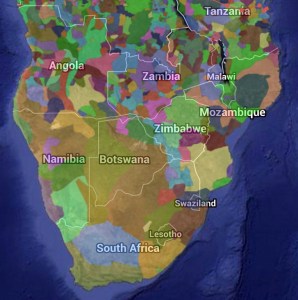
Each color represents an ethnic and/or language group
The All-Africa Peoples Conference (AAPC) was conceived in 1958 to include social groups, including ethnic communities and anti-colonial political parties and African organizations such as Labor Unions and other significant associations in the late 1950s and early 1960s both in Africa and the Diaspora such as Europe, North America and South America. The All-Africa Peoples Conference was conceived to represent the position that Africa should be returned to the peoples and groups, such as ethnic communities, from who it was grabbed by colonialism. (Emphasis Added–RP)
The conference was attended by delegates from 28 African countries and colonies. The number of delegates was more than 300, and the conference claimed that they represented more than 200 million people from all parts of Africa.
However the final document adopted by the Organization of African Unity stated:
BORDER DISPUTES AMONG AFRICAN STATES (July 1964)
The assembly of Heads of State and Government meeting in its First Ordinary Session in Cairo, UAR, from 17 to 21 July 1964, …
- SOLEMNLY REAFFIRMS the strict respect by all Member States of the
Organization for the principles laid down in paragraph 3 of Article III of the
Charter of the Organization of African Unity; - SOLEMNLY DECLARES that all Member States pledge themselves to
respect the borders existing on their achievement of national independence… (Emphasis added)
—
Hence, the carving up of Africa by the Berlin Conference of 1885, without respect to the ethnic and other social groupings of the people involved, remains, leaving Southern Africa with the overlapping profile of ethnic communities and national boundaries shown in the above map. (End comment by RP)
Some random Greek connections in acknowledgement of my Greek heritage:
John Papacostas (1868-1932) fought on the side of the Boers in the Second Anglo Boer War.
Federica, Queen of Greece,(1917-1981) was exiled with her family during WW2. They spent most of the war years in South Africa, guests of Jan Smuts, South African Prime Minister and Field Marshall member of Churchill’s War Cabinet. It is said that his wife Isie, disapproved of her husband’s friendship with the exiled queen.
Dimitri Tsafendas (1918-1999) was a parliamentary messenger who assassinated South African Prime Minister Hendrik Verwoerd in 1966; declared mentally insane by the apartheid courts, subsequent research shows him to have been a Communist with a deep social conscience. Verwoerd is considered a principal architect of Apartheid.
George Bizos (1927-2020) was a human rights lawyer who was part of ANC leader Nelson Mandela’s defence team when Mandela and others were charged with treason in 1963; he went on to become legal adviser to Mandela and was appointed join executor of Mandela’s estate. He was the principal force behind the establishment of the South African Hellenic and Educational Institute (SAHETI), an independent (non-state) school open to all but promoting the Greek culture and language.
Elita Georgiades had an affair with FW de Klerk in the mid 1990s and married FW de Klerk in 1998; at the time of the affair they were both married. Elita’s then husband, Tony Georgiades, was a European-based shipping magnate who is alleged to have assisted the apartheid government to overcome economic sanctions. FW De Klerk and Elita married in 1998. FW was the last President of the pre-democratic South Africa and in that capacity unbanned the African National Congress and Nelson Mandela, helping to set South Africa’s opponents on the path to a negotiated settlement.
 One percent of Swedish GNP is devoted every year to international aid. The agency responsible finances hundreds of aid projects around the globe. A condition placed on those who receive aid grants is to send in a final report from their projects. These reports contain, at best, information on the operations carried out, how the money assigned has been used and what has been achieved in relation to specific goals. As such they should provide valuable information for the follow up and evaluation of projects. One of my colleagues asked the aid agency:
 Sending staff on courses and workshops to “hone their skills” is a conventional method of importing knowledge into the organisation. Naturally staff, appreciating time away from the office, willingly put their names down for courses in statistics, languages, computer programmes and the like. But of course, teaching doesn’t always lead to people learning. In one of his cartoons Charlie Brown is standing by the dog kennel, where Snoopy Dog is stretched out on the roof, fast asleep as usual. Charlie is boasting to his sister: “I taught Snoopy to fetch the ball.” She throws the ball and calls out “ball Snoopy”. There is no response from the kennel roof. “He didn’t fetch it!” she says. “Nope,” said Charlie, “I said I had taught him, not that he learned how to.”
 One spring morning, when I was about six years old, he decided to dig over the vegetable patch and spread manure from the hens. I still remember the cold, damp air. We shivered as we marched down the garden path, Dad with spade over his shoulder like a rifle. I marched along behind, swinging my arms. The vegetable patch was covered in wet foot-high grass, after the mild damp winter. Dad started in one corner of the square plot of land. I can see his boot resting on the spade, the sharp edge glistening in the pale morning sun. Dad leaned over on his right boot and the spade sliced quickly through the turf and down into the soil. He bent and pushed the spade handle down, lifted the sod, and turned it over in one smooth movement. The soil was black and shiny, looking almost naked against the green grass. Fat worms were writhing where the spade had cut through the turf.
 The Pavellas Perspective
