
The quote in the title is from the poem that is the preface to Lewis Carroll’s Through the Looking Glass, and What Alice found There, the sequel to Alice’s Adventures in Wonderland.
I was around 11 years old when my father read the first several lines of the poem to me, but I laughed at the phrase “Child of the pure unclouded brow,” thinking it a joke of some type, along the lines of the humorous poems I read in the first book, such as “You Are Old Father William,” which I mostly understood and thoroughly enjoyed. I finally understood the phrase and my father’s reason for reading it to me upon later observing the wonderments of the world through my own children’s eyes.
What brought the poem to mind was my reading of the preface to Nine-Headed Dragon River, Zen Journals 1969-1982, by Peter Matthiessen. I had read the book around 15 years ago but lost it in transit to Stockholm when I moved here from San Jose, California. I kept the lost book in the back of my mind and found the opportunity to replace it by coming upon another copy while browsing the shelves of BookBuyers during a recent visit to the San Jose area.
I offer, for this week’s column and without further comment, an excerpt from the preface to Matthiessen’s book in juxtaposition with Lewis Carroll’s full poem.
| Zen has been called “the religion before religion,” which is to say that anyone can practice, including those committed to another faith. And the phrase evokes that natural religion of our early childhood, when heaven and a splendorous earth were one. But soon the child’s clear eye is clouded over by ideas and opinions, preconceptions and abstractions. Simple free being becomes encrusted with the burdensome armor of the ego. Not until years later does an instinct come that a vital sense of mystery has been withdrawn. The sun glints through the pines, and the heart is pierced in a moment of beauty and strange pain, like a memory of paradise.After that day, at the bottom of each breath, there is a hollow place that is filled with longing. We become seekers without knowing that we seek, and at first, we long for something “greater” than ourselves, something apart and far away. It is not childhood, for childhood is not a truly enlightened state. Yet to seek one’s own true nature is, as one Zen master has said, “a way to lead you to your long-lost home.” | Child of the pure unclouded brow And dreaming eyes of wonder! Though time be fleet, and I and thou Are half a life asunder, Thy loving smile will surely hail The love-gift of a fairy-tale. I have not seen thy sunny face, Nor heard thy silver laughter; No thought of me shall find a place In thy young life’s hereafter – Enough that now thou wilt not fail To listen to my fairy-tale. A tale begun in other days, When summer suns were glowing – A simple chime, that served to time The rhythm of our rowing – Whose echoes live in memory yet, Though envious years would say ‘forget’. Come, hearken then, ere voice of dread, With bitter tidings laden, Shall summon to unwelcome bed A melancholy maiden! We are but older children, dear, Who fret to find our bedtime near.’ Without, the frost, the blinding snow, The storm-wind’s moody madness- Within, the firelight’s ruddy glow, And childhood’s nest of gladness. The magic words shall hold thee fast: Thou shalt not heed the raving blast. And though the shadow of a sigh May tremble through the story, For ‘happy summer days’ gone by, And vanish’d summer glory – It shall not touch with breath of bale The pleasance of our fairy-tale. |
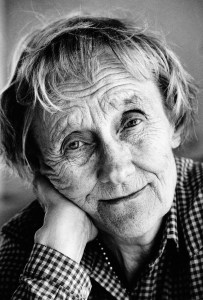 ASTRID LINDGREN
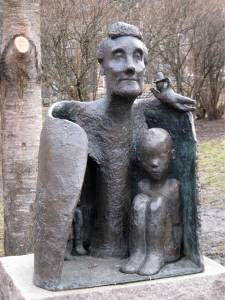 Astrid is depicted as a storyteller surrounded by several of her figures, including Peter and Petra, Göran and Mr. Liljonkvast, Ylva-Li and others. The sculpture stands under a cherry tree – a setting that accentuates the fairy tale mood, especially when the tree is in bloom. [
