
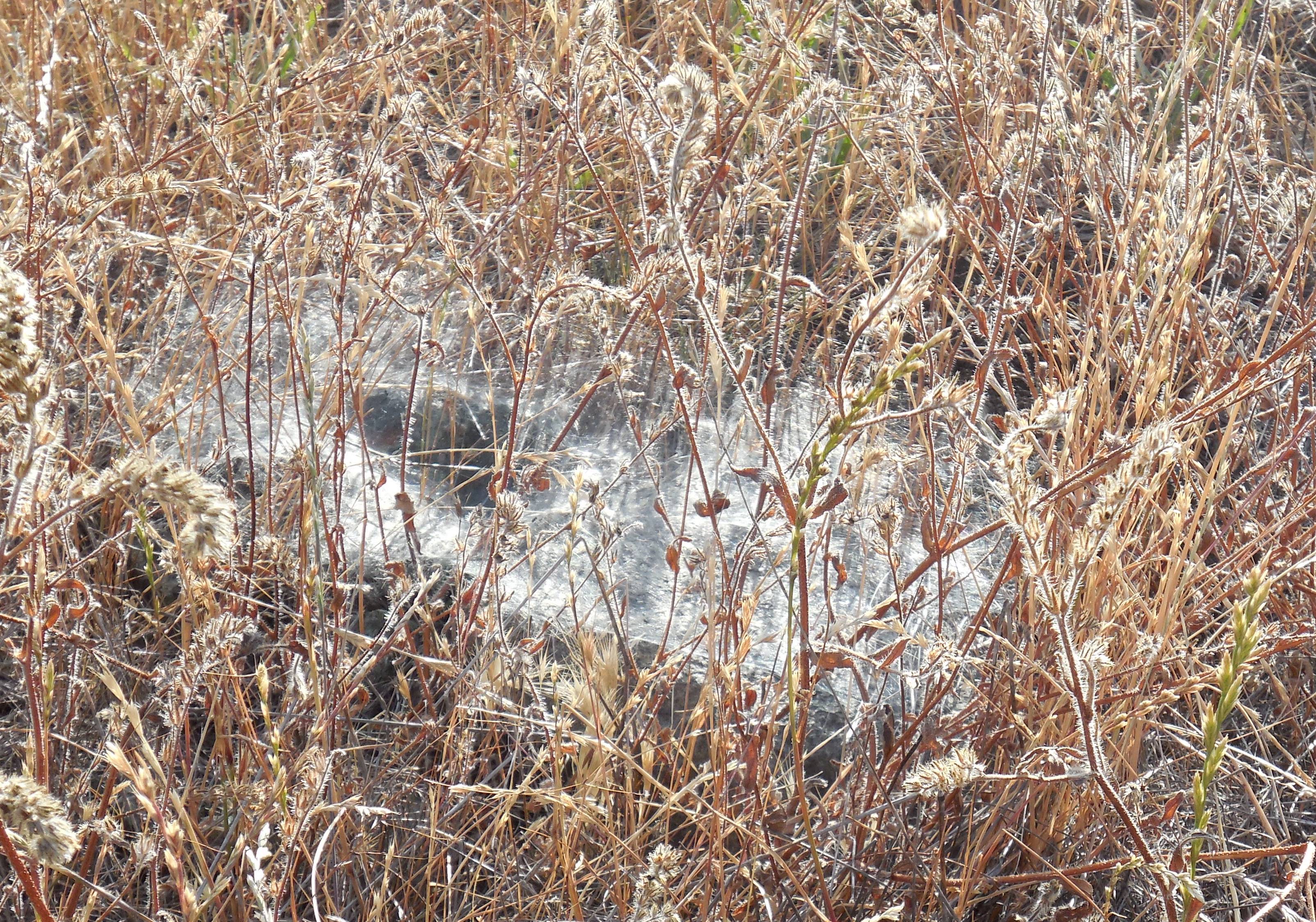
low sunlight reveals
arachne’s glimmering shroud
blanketing parched ground
old oaks on hilltop
thrive among the dry grasses
during this year’s drought

modest blue flower
reminds us of many lives
hidden by the grass

The words in the heading for this article are those of President Woodrow Wilson, given to an audience in Portland, Oregon, 1919, referencing the USA’s role in the establishment of the League of Nations after the end of World War One, “the war to end war.”
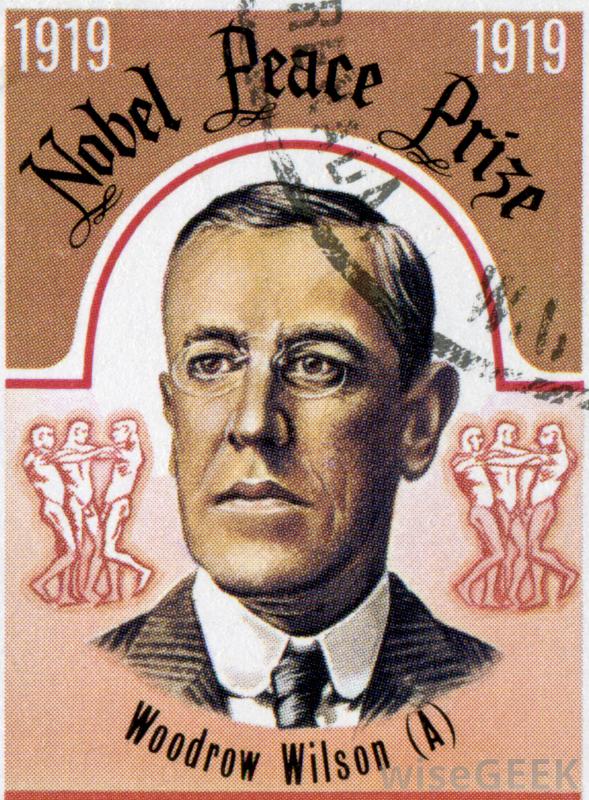 On April 2, 1917, President Woodrow Wilson went before a joint session of Congress to seek a Declaration of War against Germany in order that the world “be made safe for democracy.” Four days later, Congress voted to declare war… By the time the war ended a year and a half later, an entire generation was decimated—France alone lost half its men between the ages of twenty and thirty-two. The maimed bodies of millions of European men who survived bore mute testimony to the war’s savagery. (Source)
The Treaty of Versailles, 28 June 1919
After four years of warfare, the conflict ended in Versailles in 1919. It was “peace” for one side, but a “diktat” for the other side. The treaty contained the germ of the causes of a second world war 20 years later.
The negotiations had been difficult. A peace conference had met in Paris since 18 January to prepare the treaty. The Allies alone took part in the debates. But they were not in agreement. France wanted to remove the German danger definitively and bring Germany to its knees. Great Britain, in contrast, wanted to let Germany keep its rank. The United States looked forward to a world pacified with the Society of Nations. Italy wanted the territories promised to it in 1915. The treaty was finally submitted to Germany on 7 May. All Germany’s counter-proposals were rejected and it refused to sign the treaty. On 17 June, the Allies gave it 5 days to decide. Germany finally accepted this “diktat.”
Germany lost 68,000 km² of its territory, including Alsace and Lorraine annexed in 1870, and 8 million inhabitants. Part of eastern Prussia was dismantled to the benefit of Poland which gained access to the sea via the “Danzig corridor”. Germany had to pay 20 billion gold marks in reparation to France. It lost most of its mineral resources and agricultural production. Its colonies were confiscated and its military power was annihilated. Humiliated, Germany aspired for revenge. A new war, which the Allies thought they were avoiding, was soon to be prepared.
After the Versailles conference Wilson claimed that “at last the world knows America as the savior of the world!” [ President Woodrow Wilson speaking on the League of Nations to a luncheon audience in Portland OR. 66th Cong., 1st sess. Senate Documents: Addresses of President Wilson (May–November 1919), vol.11, no. 120, p.206.] (Source)
…
Almost 100 years later, the USA is still trying make, or at least encourage, the world to be “democratic,” while not explicitly advocating that it be “safe for democracy,” as President Wilson enunciated.
The US Department of State has the job of encouraging the spread of democracy. Immediately below are excerpts from the official sites of the department, all accessible at http://www.state.gov/. I warn the reader that he or she will encounter the turgid bureaucratic language of large organizations, of which our government is certainly one, and plead with you not to be discouraged by it. Bland and abstract words and phrases contain obscured meaning. If you are a citizen of the USA, this is your government talking to the rest of the world. If you are not a citizen of the USA, this is America talking to your government and the people of your country. (I color with red font all words in the body of State Department articles which are derivatives of the word ‘democracy’).

Department Mission Statement
“Shape and sustain a peaceful, prosperous, just, and democratic world and foster conditions for stability and progress for the benefit of the American people and people everywhere.” –From the FY 2013 Agency Financial Report, released December 2013
Bureau of Democracy, Human Rights, and Labor
The Bureau of Democracy, Human Rights and Labor leads the U.S. efforts to promote democracy, protect human rights and international religious freedom, and advance labor rights globally.
Democracy
Democracy and respect for human rights have long been central components of U.S. foreign policy. Supporting democracy not only promotes such fundamental American values as religious freedom and worker rights, but also helps create a more secure, stable, and prosperous global arena in which the United States can advance its national interests. In addition, democracy is the one national interest that helps to secure all the others. Democratically governed nations are more likely to secure the peace, deter aggression, expand open markets, promote economic development, protect American citizens, combat international terrorism and crime, uphold human and worker rights, avoid humanitarian crises and refugee flows, improve the global environment, and protect human health.
With these goals in mind, the United States seeks to:
The Bureau of Democracy, Human Rights, and Labor (DRL) is committed to supporting and promoting democracy programs throughout the world. As the nation’s primary democracy advocate, DRL is responsible for overseeing the Human Rights and Democracy Fund (HRDF), which was established in 1998 to address human rights and democratization emergencies. DRL uses resources from the HRDF, as well as those allocated to Regional Democracy Funds, to support democratization programs such as election monitoring and parliamentary development.
Over the past quarter-century, a large number of nations have made a successful transition to democracy. Many more are at various stages of the transition. When historians write about U.S. foreign policy at the end of the 20th century, they will identify the growth of democracy–from 30 countries in 1974 to 117 today–as one of the United States’ greatest legacies. The United States remains committed to expanding upon this legacy until all the citizens of the world have the fundamental right to choose those who govern them through an ongoing civil process that includes free, fair, and transparent elections.
Advancing Freedom and Democracy
“We look forward to working with all who embrace genuine and inclusive democracy. What we will oppose is an attempt by any group to restrict the rights of others, and to hold power through coercion and not consent. Because democracy depends not only on elections, but also strong and accountable institutions, and the respect for the rights of minorities.” – President Barack Obama
The Advancing Freedom and Democracy Report describes efforts by the U.S. Government to support democracy and human rights in nondemocratic countries and countries undergoing democratic transitions worldwide. The U.S. Department of State submits this report in accordance with the ADVANCE Democracy Act of 2007.
Senior Advisor to the Secretary for Civil Society and Emerging Democracies
Tomicah Tillemann was appointed as the Senior Advisor for Civil Society and Emerging Democracies in October 2010. In collaboration with department bureaus, Dr. Tillemann and his staff are responsible for helping to develop and operationalize the civil society agenda and strengthen emerging democracies.
One of S/SACSED’s key initiatives is the Strategic Dialogue with Civil Society. The office also orchestrates engagement with the Community of Democracies and generates strategic partnerships to advance democracy abroad.
Goals
— (End excerpts from the US Department of State web pages) —
I infer that the USA initiated the formation of “Community of Democracies” to further the mission and goals of the US State Department. Here is about this organization:
…
Our vision – The Warsaw Declaration
 According to the Declaration, these are the core principles and practices that the member states of the Community of Democracies agree to uphold:
 The Warsaw Declaration acknowledges that democratic development is a process, in which each country is at a different stage- no country has reached perfection, and all should work together to meet these objectives, supporting each other while respecting each other’s sovereignty. The best way to help strengthening these democratic institutions and principles is by promoting discussion, exchanging experiences and identifying best practices, together. This is what makes us a community- we cooperate, learn together, focus on the common values, and encourage each other to uphold these values.
On a practical note, the Warsaw Declaration suggests the ways to achieve these goals: to promote civic education, including education for democracy; to support civil society and independent media; to work with relevant institutions and international organizations; to assist each other in economic and social development, including eradication of poverty; and to collaborate and form coalitions in existing international and regional institutions aimed at the promotion of democratic governance. All these, says the Warsaw Declaration, will help to create an environment conducive to democratic development.
Our mission
The Mission Statement of the Community of Democracies is built upon the democratic values agreed in the Warsaw Declaration (of 2000). The Community seeks to support democratic transition and consolidation worldwide and help bridge the gap between principles of democracy and universal human rights and their practice by assisting societies in the development and strengthening of democratic institutions and values, identifying, alerting and responding to threats to democracy so as to assist states to remain on the path to democracy, supporting and defending civil society in all countries, advancing broad-based participation in democratic governance, and giving a voice to those working peacefully for democracy in all countries. (Source).
Countries not included in the Warsaw Declaration of the Community of Democracies (Several small island states are not included in this list):

In researching the countries not included in the Warsaw Declaration, the French Republic stood out as unexpected. Here are France’s objections, as reported by the Associated Press, Wednesday, June 28, 2000:
WARSAW, Poland – Upsetting the celebratory mood at a global democracy conference, France excluded itself from a newly formed “community of democracies” Tuesday after skewering other Western powers for evangelizing.
France stunned the other 107 participants by refusing to join them in endorsing a declaration setting universal standards by which mature and developing countries alike can measure their progress – an effort to consolidate the dramatic gains democracy made in the 20th century.
The dispute was largely philosophical and centered on French criticism that the conference was a prod to get non-democratic nations to adopt democracy – a policy French Foreign Minister Hubert Vedrine on Monday said usually backfires. He cited ineffective sanctions against Yugoslavia and Iraq.
“The bottom line is that in Western countries the thinking is that democracy is like religion and that all you have to do is convert people,” Vedrine told reporters in Warsaw on Monday…
France said it didn’t back the document because it amounts “to a diplomatic pledge for the democratic states to act as a group.” In particular, France objected to general agreement at the conference to convene a caucus of democratic states, possibly at the next meeting of the U.N. General Assembly in the fall.
Such a caucus creates a new bloc, in effect replicating the Cold War divisions by excluding nations who have not yet achieved democracy, said the French ambassador to Poland, Benoit d’Aboville… (Source–has disappeared from the Internet)
Questions for myself and the reader

 The Pavellas Perspective