
Summer Reading

 While walking around Prague during Eva’s and my vacation last month, I couldn’t resist buying an English language book at a Barnes & Noble-type store (in Sweden, like Akademibokhandeln). I cannot account for my reason then to have bought Nothing to be Frightened Of, by Julian Barnes, but I imagine now that it was because it was small (easy to pack and carry back to Stockholm) and it was written by the author of Arthur & George, which my book discussion group recently read and enjoyed. The book is “dark” if you feel the subject of death is taboo or depressing or somehow not a fit subject for an entertainment, which I find this book to be. I admit to not ever having dwelt much on the subject, despite my having been present at my father’s death in year 2000 and my mother having died within the last year. The author, however, has obsessed (my word) and worried and thought about death from his earliest days. He lets it all out in this book, with a great flow of well-chosen words, anecdotes, remembrances and quotes of other writers and philosophers, most often Jules Renard. Nothing also offers insights to the ways of successful writers of fiction:
Fiction is made by a process which combines total freedom and utter control, which balances precise observation with the free play of the imagination, which uses lies to tell the truth and truth to tell lies. It is both centripetal and centrifugal. I wants to tell all stories, in all their contrariness, contradiction and irresolvability, at the same time it wants to tell the one true story, the one that smelts and refines and resolves all the other stories. The novelist is both bloody…cynic and lyric poet, drawing on Wittgenstein’s austere insistence—speak only of that which you can truly know—and Stendhal’s larky shamelessness.
 I read, concurrently with Nothing, a fascinating book my friend Eric lent me, a fiction based in two facts in the author’s life: the gradual but significant loss of his hearing, and his father’s death. Deaf Sentence is a poignant and witty romp, written by Emeritus Professor of English at the University of Birmingham, and prolific author David Lodge. I use the word poignant, above, as described here: “3. affecting or moving the emotions“. I am in a similar stage of hearing loss as the author and, as the author was with his father, I was with my father in the last few years of his life and also saw him deteriorate from an illness. Next in the “dark” category is a famous book I hadn’t yet read, Cancer Ward by Alexander Solzhenitsyn. I bought it, used, for 10 Swedish crowns (around $1.42) at Arholma Handel while on a writing retreat on Arholma Island last week. I am part-way through it and find it compelling and repelling at the same time, but I will certainly finish it. Not only is it well written, even in translation (by Nicholas Bethell and David Burg) but it soulfully recounts an important era, the Soviet rule in Russia and other “Socialist Republics,” and the human cost of a failed idea and regime. Finally in the dark realm, I have just finished, very quickly, for it is a short book and is easy to read, The Reluctant Fundamentalist by Mohsin Hamid. Since this book will be discussed in my book group on 8 September, I will wait for the reaction of the others before I say any more about it. I recommend it, nonetheless. As for the “thriller,” I garnered The Quiet Girl during Eva’s and my trip to Prague last month. It’s by the author of two books I have read, The Woman and The Ape and Smilla’s Feeling for Snow (on which a popular movie was made), Peter Høeg. I can’t get enough of this author. ‘Nuff said? My “light,” or “lighter,” reading includes these two candidates for the appellation:
- Sylvia Beach and the Lost Generation, written by Noël Riley Fitch
-
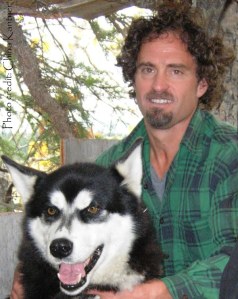
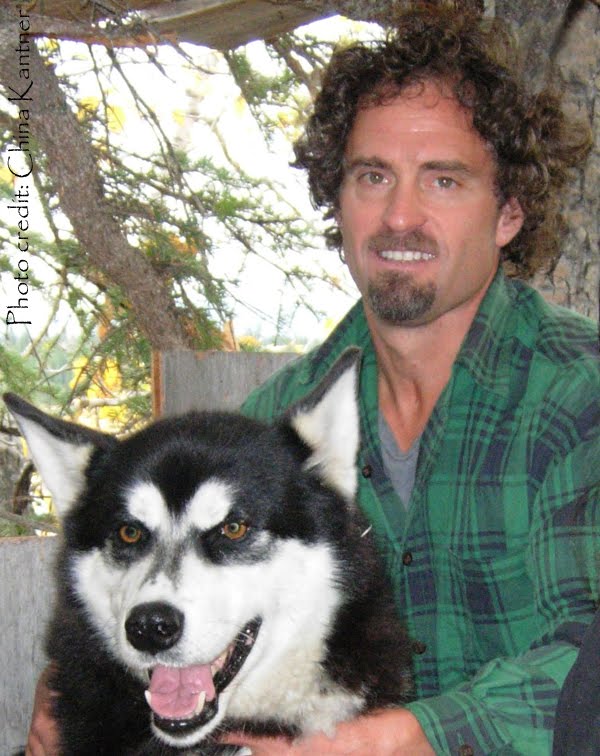
Seth Kantner
Ordinary Wolves, written by Seth Kantner The Beach book was a follow-through on my recent article, Hemingway in Paris. A writer friend of mine is quite partial to the history and literature of that era and offered, after reading my article, to lend me Fitch’s book. I was part-way through it when I realized I wanted a copy for my permanent collection. I bought one. Now I can review at my leisure the passages that appeal to me about certain musicians who were connected with the writers in and around Paris in the 1920s, and to build a more complete view of the characters Hemingway portrayed in his book. Kantner’s book was lent to me by yet another writer friend. We both have lived in Alaska and we sometimes share our nostalgia for it. She had just read this book and insisted I read it, and so I did, with great pleasure. Of the four books I have read, including this one, which dwell exclusively on Alaska, I count this one as the best.That’s saying a lot, because two of the other three books are by James Michener and John McPhee. The third book is Going to Extremes, by Joe McGinniss. I didn’t like McGinniss’s book, although it was entertaining, because it seemed to exaggerate for effect the various peculiarities of the characters he commented on. It was more of a cartoon than a good look at Alaska and Alaskans. Michener’s Alaska was excellent for a deeply historical look at the state, up until the very last part that included a time I was familiar with. It seemed he was in a hurry to finish and just slapped some last minute stuff together without giving it much thought. John McPhee’s wonderful book, Coming into the Country, has been a favorite of mine and remains so. I keep a copy. Now the complicated reading. Oxford University Press is a high quality publisher of esoteric and scholarly books. I get their online notices for special sales and I often can’t resist buying some heavily discounted items. This time there were four. Here are two of them:
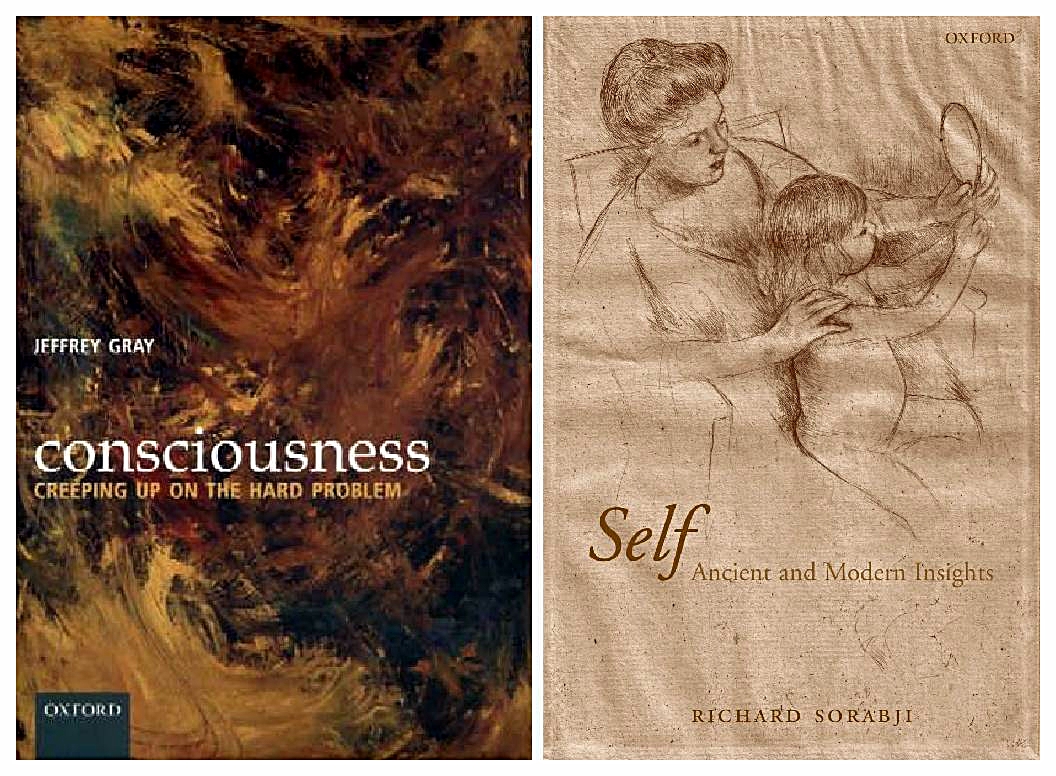
- Consciousness: Creeping up on the Hard Problem, by psychologist Jeffrey Gray
- Self: Ancient and Modern Insights about Individuality, Life and Death by Philosopher Richard Sorabji
In Consciousness the author suggests, first thing, that the reader go to the 20th and last chapter, Overview, if he wants to “see in advance where this exploration will take us.” After reading the first chapter, through page 6, I did just that. I may read other parts of the book when I have great leisure to make notes and digest some very unfamiliar terminology (I won’t call it jargon because it is not meant to hide or confuse).
Here is what I get from the first chapter: the previous generally accepted model of consciousness falls in the realm of “mind-brain identity theory.” The current model is labeled “functionalism,” where…
States of consciousness can be identified with sets of functional (input-output) relationships that hold [exist] between a behaving organism and the environment in which it behaves.
The author states that this model is “too easy.” We need to face all the ancient and current issues “squarely” in any attempt to fit consciousness into the framework of natural science where it properly belongs. In order to get there, as I perceive the author’s argument in chapter 20, we have to consider as a basic unit of consciousness, quale (plural, qualia); that is, “the elemental components of perceptual experience (the colour red, an itch, the smell of jasmine, and so on).” This is as far as I wish to, or confidently can, take you into the author’s argument in favor of his view. I felt that a book on the self would correlate with or properly complement a book on consciousness, which is the reason I bought the second book. I haven’t yet opened it. I feel now that I will, for a long time, have two books to fall back to when I feel I have “nothing to read”. But that’s not all! I have books “on deck.” (for Swedish and other non-American readers, this is a baseball metaphor. The man “on deck” is the next batter, awaiting his turn).

Two more from Oxford University, from the same batch as the two above:
- Thomas Paine, in the “VIP” (Very Interesting People) series, by Mark Philip
- How not to say what you mean: A Dictionary of Euphemisms, by R. W. Holder
And, two books with “Zen” in the title:
- Zen in the Art of Writing: Releasing the Creative Genius Within You, by Ray Bradbury
- Zen and the Beat Way, one of the few books of Alan Watts I had not yet read.
I have read many of the books by Colin Wilson, but had never read his first published book which rocketed him to fame: The Outsider. I felt recently I had to “go back” and do it. It awaits me.  And, finally, two books I happened across while looking for a Marcus Garvey book at Alfa Antikvariat, street address Olof Palmes Gata 20B, where many English titles can be found among the tens of thousands of books in this vast, clean and orderly used book shop:
- The Iron Wolf by Richard Adams, the author of the popular Watership Down
- The Art of Love, by Publius Ovidius Naso (“Ovid“)
These last two books caught my eye because of the quality of their printing and their wonderful illustrations. They represent the kind of book that I remember from my earliest days, the ones that lasted, physically, for generations and had pictures one could lose one’s young self in. You can get a glimpse of the illustrations in Iron Wolf by clicking the above link, or here. So many books; so little time.


