
Homo sapiens have been on earth, as far we know, for no more than 200 thousand years. But this a blink of the eye compared to the Dinosaurs who appeared on Earth 250 Million years ago and populated the planet for almost 200 million years. But they disappeared as a species.
Consider, then, the extant cockroach who co-existed with the dinosaurs, appearing 200 million years ago, and which is still with us!
So, perhaps the fact that the humble dandelion (Taraxacum) has been on Earth only 30 million years should not impress us. But, this ubiquitous plant has lasted 150 times longer on Earth than Homo Sapiens. Would you agree that we have yet to prove ourselves as a successful life form?
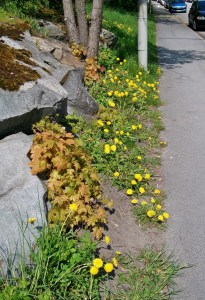 I took this picture on my walk from home to the Alvik Metro Station on a recent morning, being impressed by the brilliance of these irrepressible yellow flowers. (click on all images for a larger view).
Eva and I have started our third spring as gardeners in a 65-square-meter (700 square feet) plot of land we are allowed to cultivate in Johannelunds Koloni near our apartment building in Minneberg. We spend much of the first few weeks of the gardening season in removing the deeply-rooted dandelions from the grass paths before they bloom, along with other unwanted plants from the garden such as ground elder, club moss, and grass which has invaded from the paths. We always miss a good many dandelion plants, but they later reveal themselves by their bright blooms. So, we undertake the second and subsequent rounds of removal. Most of our neighbors are not so fastidious in removing dandelions, so when the beautiful seed heads appear around us we know we’ll be repeating our spring removal ritual.

A visiting family member from Malmö, with a carpet of dandelion blooms at her feet
Because I admire the pretty yellow flowers everywhere along the paths, roads and highways, and in uncultivated and unused lots, I have misgivings about removing them every spring from our garden. But we don’t want these blooms to detract from the many others we are cultivating, along with food plants.
Ruderal species
The dandelion is a ruderal species, a plant which grows in poor soil and that is first to colonize disturbed lands. Ruderal means rubble. Dandelion’s affinity for grass is due to our habit of clipping it short enough for the seeds to take root, and for the leaves and stems of the flowers to reach sunlight.
Success Factors
As in many ruderal species, the dandelion succeeds because of: 1) Massive seed production; 2) modest seedling nutritional requirements; 3) Fast-growing roots; and, 4) independence from mycorrhizae, a beneficial symbiotic association between a fungus (mycor) and the roots (rhiza) which most vascular plants need. (Source).
Dandelion Seed
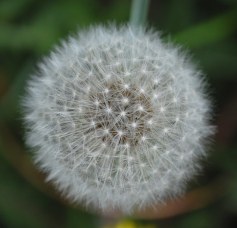
Dandelion Seeds
(4.bp.blogspot.com/)
The dandelion provides its seeds with a complex flying apparatus, a tiny disc of radiating threads that form a parachute. A dandelion presents these seeds to the wind hoisted on the top of a stem and arranged as a fragile elegant globe. (Source).
Dandelion has a strong taproot capable of penetrating the soil to a depth of 10 to 15 feet, but it is most commonly 6 to 18 inches deep. (Source). Dandelion is rich in beta-carotene and potassium. In herbal medicine, dandelion is typically used for its appetite-stimulating, digestion-aiding, and laxative effects. Some studies suggest that dandelion used as an herb may help lessen inflammation and kill bacteria. (Source).
Dandelion leaves
One of my favorite childhood memories is of my two maternal aunts, Angie and Bea, harvesting dandelion leaves in what were then swampy lands around Newport Beach, California, where Bea and her husband Tommy lived. We had the leaves for dinner, boiled as we did with greens such as spinach or mustard greens which our family loved–with olive oil and lemon.
Dandelion leaf is a natural diuretic, and is commonly used to help remove excess water and toxins from the body. Dandelion Leaf helps promote bile excretion from the liver so the body can more efficiently process foods and liquids while also purging harmful toxins. (Source).
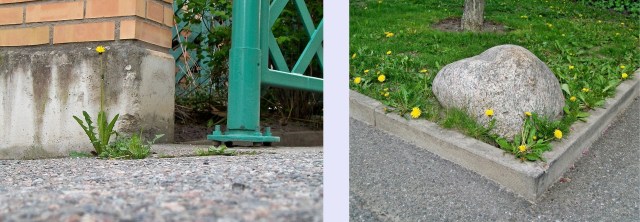
Don’t Be Fooled by False Dandelions
Dandelions are so similar to catsears (Hypochaeris) that catsears are also known as “false dandelions”. Both plants carry similar flowers, which form into windborne seeds. However, dandelion flowers are borne singly on unbranched, hairless and leafless, hollow stems, while catsear flowering stems are branched, solid and carry bracts. Both plants have a basal rosette of leaves and a central taproot. However, the leaves of dandelions are smooth or glabrous, whereas those of catsears are coarsely hairy. Hawksbeard (Crepis) flower heads and ripe seeds also are sometimes confused with dandelions. (Source).
History
Dandelions are thought to have evolved about thirty million years ago in Eurasia. They have been used by humans for food and as an herb for much of recorded history. They were introduced to North America by early European immigrants. (Source). This information surprised me because I thought dandelions grow throughout the northern hemisphere. I came to this incorrect notion because when I lived in Alaska, at the same latitude as Stockholm, dandelions were everywhere large and healthy throughout the sunny months.
Final Thoughts
I had reason to drive around the city today with Eva, and noticed dandelion flowers everywhere. Since she has lived here all her life I asked Eva if there were more flowers than usual. She thought not and suggested I was attuned to them more because of my current obsession with them. I am enjoying them so much (but not in my garden) I hope I can retain this obsession.

—
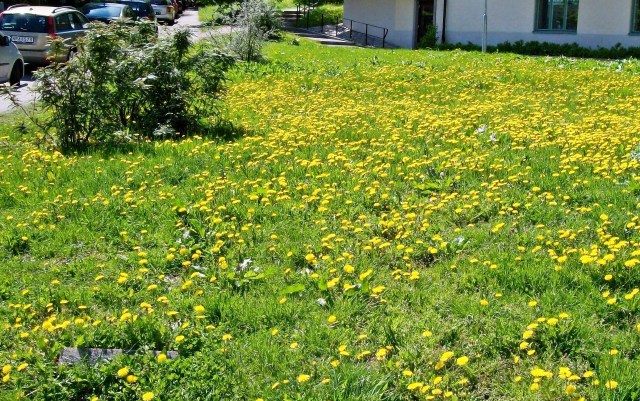
Post-publication addendum: I can’t resist adding another photo taken several days after first publishing this article:
 The Pavellas Perspective
Reading List of President Harry S. Truman, and Wisdom from his Secretary of State, Dean Acheson
Long ago, upon reading Plain Speaking by Merle Miller, an oral biography of then former President Harry Truman, I made notes from the book for later reference. I offer then here:
Truman’s most-read books
Plutarch’s Lives
Caesar’s Commentaries
Benjamin Franklin’s Autobiography
Gibbons’ Decline and Fall of the Roman Empire
Bunker Bean by Harry Leon Wilson
Missouri’s Struggle for Statehood, 1804-1821, by Floyd Calvin Shoemaker
Bible (King James Version)
Plato’s Republic
William Shakespeare, all writings especially:
Complete works of Robert Burns
Complete works of Lord Byron (George Gordon), especially Childe Harold
Edward Shepherd Creasy’s Fifteen Decisive Battles Of The World: From Marathon To Waterloo
Charles Beard’s An Economic Interpretation of the Constitution
Quoting Dean Acheson
Dean Acheson, Secretary of State under Truman, made a speech to the Associated Harvard Clubs of Boston on June 4, 1946 when he was Under-secretary of State:
Dean Acheson
For a long time we have gone along with some well-tested principles of conduct: that it was better to tell the truth than falsehoods; that a half-truth was no truth at all; that duties were older than and as fundamental as rights; that, as Justice Holmes put it, the mode by which the inevitable came to pass was effort; that to perpetuate a harm was always wrong, no matter how many joined in it, but to perpetuate it on a weaker person was particularly detestable… Our institutions are founded on the assumption that most people will follow these principles most of the time because they want to, and the institutions work pretty well when this assumption is true.
It seems to me the path of hope is toward the concrete, the manageable… But it is a long and tough job, and one for which we as a people are not particularly suited. We believe that any problem can be solved with a little ingenuity and without inconvenience to the folks at large…
And our name for problems is significant. We call them headaches. You take a powder and they are gone. These pains about which we have been talking are not like that. They are like the pain of earning a living. They will stay with us until death. We have got to understand that all our lives the danger, the uncertainty, the need for alertness, for effort, for discipline will be upon us. It will be hard for us. But we are in for it, and the only question is whether we shall know it soon enough.
=
Quoting Dean Acheson again:
… The manner in which one endured what must be endured is more important than the thing that must be endured, I am inclined to agree with Sir Francis Bacon that: “the good things that belong to prosperity are to be wished, but the good things which belong to adversity are to be admired”.