

Washington as colonel of the Virginia Regiment, painted by Charles Willson Peale, 1772
… that made him “the indispensible man,” as described by historian James Thomas Flexner?
And what was it about him that elicited these encomiums from his contemporaries upon his death?
- “First in war, first in peace, and first in the hearts of his countrymen”, from a eulogy for George Washington adopted by Congress immediately after Washington’s death, written by Henry Lee, a soldier and political leader from Washington’s home state of Virginia.
- “His example is now complete, and it will teach wisdom and virtue to magistrates, citizens, and men, not only in the present age, but in future generations as long as our history shall be read.” (President John Adams, in a letter to the US Senate, December 23, 1799, on the death of George Washington.)
- “To us he has been the sympathising friend and tender father. He has watched over us, and viewed our degraded and afflicted state with compassion and pity—his heart was not insensible to our sufferings. Unbiased by the popular opinion of the state in which is the memorable Mount Vernon—he dared to do his duty, and wipe off the only stain with which man could ever reproach him… “ (H)e who ventured his life in battles… did not fight for that liberty which he desired to withhold from others—the bread of oppression was not sweet to his taste, and he “let the oppressed go free… he provided lands and comfortable accommodations for them when he kept this “acceptable fast to the Lord”—that those who had been slaves might rejoice in the day of their deliverance.” From the eulogy by Rev. Richard Allen, founder in 1816 of the African Methodist Episcopal (AME), the first independent black denomination in the United States.
The basis for this article is my reading, primarily, of His Excellency: George Washington, by Joseph J. Ellis. In addition, A Patriot’s History of the United States: From Columbus’s Great Discovery to the War on Terror by Larry Schweikart and Michael Patrick Allen, provides additional color and verifies the Ellis book, despite its tendency toward the polemical.
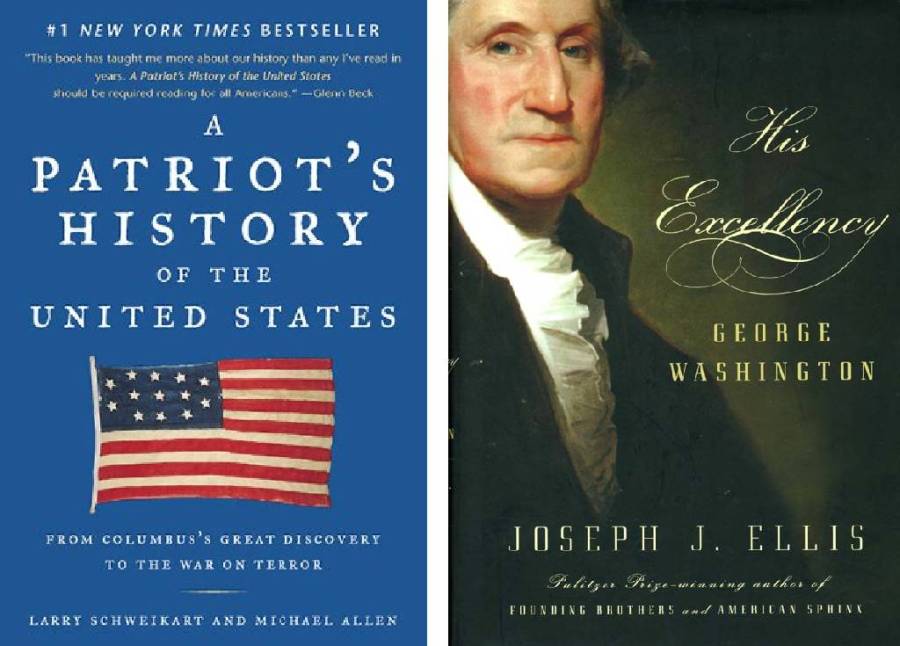
George Washington, the man
George Washington was not a revolutionary, a great orator, or an idealist. He was a leader through example, publicly silent and fearless, always ready but never publicly eager for promotion or elevation to high office, and with enormous self-discipline. He was also land hungry (he owned over 50,000 acres upon his death), socially ambitious, sensitive to slights by English officialdom and society, proud, and with his emotions under such great control, sometimes explosive in temper.
George Washington was physically large, held himself erect, and dressed impeccably, appropriate to a landed aristocrat and military officer. He exemplified, almost universally among his contemporaries, what an American leader should be. Thus, he was always chosen during the uncertain and formative years of the republic to lead and to guide the nascent nation.
Winning the revolutionary war did not assure that the colonialists, now free from their masters, could form and maintain a nation. Washington saw it as the highest priority to form a strong nation, with all other considerations, including slavery which he saw as odious and pernicious, being secondary. His personal motivations can be attributed to his hunger for land, especially in the Ohio River Valley, which was forbidden by the British Royal Proclamation of 1763. Even before a revolution was thought of, however, Washington ignored this edict.
Whatever personal motivation he may have had for attaining all his assignments and offices, his vision of a unified nation, combined with a certain few principles he held as essential, were necessary for it to survive after the founders declared it born. These included the primacy of the civilian over the military and the idea that the position of president was important, most of the time, as a symbolic role rather than as a decision-making role.
He invented the cabinet system for running the executive branch of the government and delegated much authority and responsibility to his subordinates, intervening only when critically necessary, as it sometimes was between Secretary of State Jefferson and Secretary of The Treasury Hamilton, for example.
He respected the Indian nations:
He did not view Native Americans As exotic savages, but as familiar and formidable adversaries fighting for their own independence: in effect, behaving pretty much as he would in their place. Moreover, the letters the new president received from several tribal chiefs provided poignant testimony that they now regarded him as their personal protector. (His Excellency, p. 212)
He held idealism in low regard. This ultimately brought him to grief with Jefferson who was ever the idealist. Nonetheless, Jefferson revered Washington, as can be seen in the eulogy Jefferson wrote 14 years after his death:
Perhaps the strongest feature in [Washington’s] character was prudence, never acting until every circumstance, every consideration, was maturely weighed; refraining if he saw a doubt, but, when once decided, going through with his purpose, whatever obstacles opposed. His integrity was most pure, his justice the most inflexible I have ever known, no motives of interest or consanguinity, of friendship or hatred, being able to bias his decision. He was, indeed, in every sense of the words, a wise, a good, and a great man. His temper was naturally high toned; but reflection and resolution had obtained a firm and habitual ascendancy over it. If ever, however, it broke its bonds, he was most tremendous in his wrath. In his expenses he was honorable, but exact; liberal in contributions to whatever promised utility; but frowning and unyielding on all visionary projects and all unworthy calls on his charity…His person, you know, was fine, his stature exactly what one would wish, his deportment easy, erect and noble; the best horseman of his age, and the most graceful figure that could be seen on horseback…
On the whole, his character was, in its mass, perfect, in nothing bad, in few points indifferent; and it may truly be said, that never did nature and fortune combine more perfectly to make a man great, and to place him in the same constellation with whatever worthies have merited from man an everlasting remembrance. For his was the singular destiny and merit, of leading the armies of his country successfully through an arduous war, for the establishment of its independence; of conducting its councils through the birth of a government, new in its forms and principles, until it had settled down into a quiet and orderly train; and of scrupulously obeying the laws through the whole of his career, civil and military, of which the history of the world furnishes no other example…
These are my opinions of General Washington, which I would vouch at the judgment seat of God, having been formed on an acquaintance of thirty years…
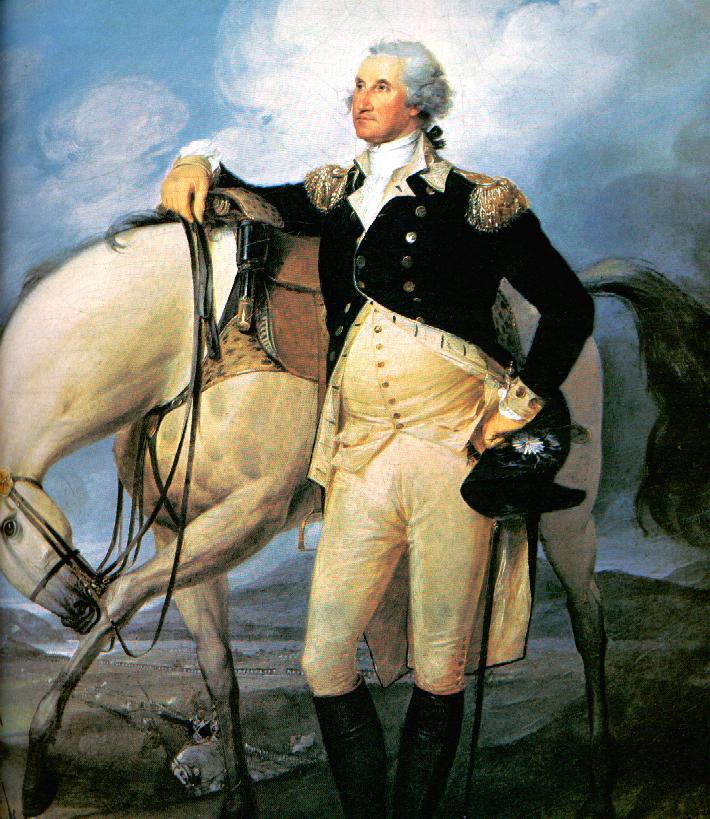
1732-1758
Born in 1732, a fourth generation, landed American colonial, he was appointed at age 21 as major in the British Army’s Virginia Regiment to assess the strength of the French in the Ohio Valley. The French and Indian War had been ongoing for two years and would last another five years. He was actively engaged in this conflict and emerged, in 1758, as a lieutenant general at age 26.
1758-1774
Failing to be permanently appointed as a British Army officer, he returned to civilian life as a planter and politician in the Virginia colony. He married a wealthy widow, Martha Dandridge Custis and took her two children into his household. Washington had no known issue of his own. It was later rumored that he had a brief romantic relationship with the wife of a neighboring plantation owner, but no such scandal was ever publicly aired.
1774-1783
Washington entered the wider political arena as a Virginia delegate to the First Continental Congress, and in 1775 was appointed general and commander-in-chief of the new Continental Army after “the shot heard ‘round the world” at Lexington and Concord amalgamated the delegates against the British. He didn’t sign the Declaration of Independence due to his resignation from the Virginia delegation upon his appointment. He led the Continental Army to victory over the British by 1883, despite being greatly disadvantaged in manpower and matériel against the professional army of Great Britain.
1783-1787
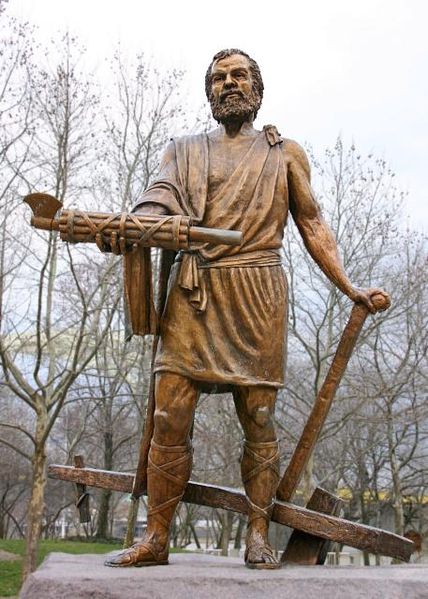
Lucius Quinctius Cincinnatus (519 BC–438 BC), an aristocrat and political figure of the Roman Republic, with whom George Washington is often and favorably compared
He resigned his military commission and returned to civilian life, again, in the manner some see as that of Cincinnatus to whom he has been often likened. He was recalled to duty in 1787 as president of the Constitutional Convention in Philadelphia.
1788-1797
George Washington was elected first President of the United States of America. Against his publicly-stated desires to return to his plantation after four years in office, he was unanimously reelected once, but refused to stand for a third election. He gave his historic Farewell Address, wherein he extolled the benefits of the federal government, warned against the party system, stressed the importance of religion and morality, urged a policy of stable public credit, and warned against permanent foreign alliances and an over-powerful military establishment.
1797-1799
He returned to civilian life, during which period he was commissioned as lieutenant general and Commander-in-Chief of the United States Army to serve as a warning to France, with which war seemed imminent. December 14, he died at Mount Vernon at the age of 67. He arranged for his slaves to be freed in his last will and testament.


 The Pavellas Perspective