
…what and where is The Caucasus?
When I was young I learned that the word “Caucasian” somehow applied to me and my family as types of humans who were “white,” or at least not “Negro” or “Oriental,” but that was all. I never thought of myself as “white,” or any color, but identified with the ethnicity of the three of my grandparents who emigrated from Greece to San Francisco in the early 1900s. I didn’t know I was “white” until I joined the US Navy in 1954 at age 17.
Previous to this, “white” was reserved in my mind for “White, Anglo-Saxon Protestants,” or WASPs. Dad had explained what Anglo-Saxon meant, but I could never retain the history of the various invasions which Western and Northern European peoples visited upon each other in ancient times. And further, I couldn’t understand what Dad or anyone could tell me about the origin of the word “Caucasian,” other than it came from people living in a remote in-between place in Europe or Asia.
I haven’t thought of myself as “Caucasian” or “white” for quite a while now, just considering myself a human with roots in Europe in the short-term (20,000-40,000 years ago) and recognizing that all humans are rooted in Africa from around 130,000 to 200,000 years ago.
What took me back to thinking about “Caucasian” was my reading of a new book, The Ghost of Freedom: A History of the Caucasus, by the historian Charles King.
King’s book clarified for me the origin, use, and misuse of the concept of “Caucasian Race,” and about the complicated and terrible history of the original peoples who have inhabited the region named “The Caucasus.” In writing this article I also used Russia: A History, edited by Gregory L. Freeze. Additional resources are under the links listed throughout the article.
“Caucasian” as a “Race”
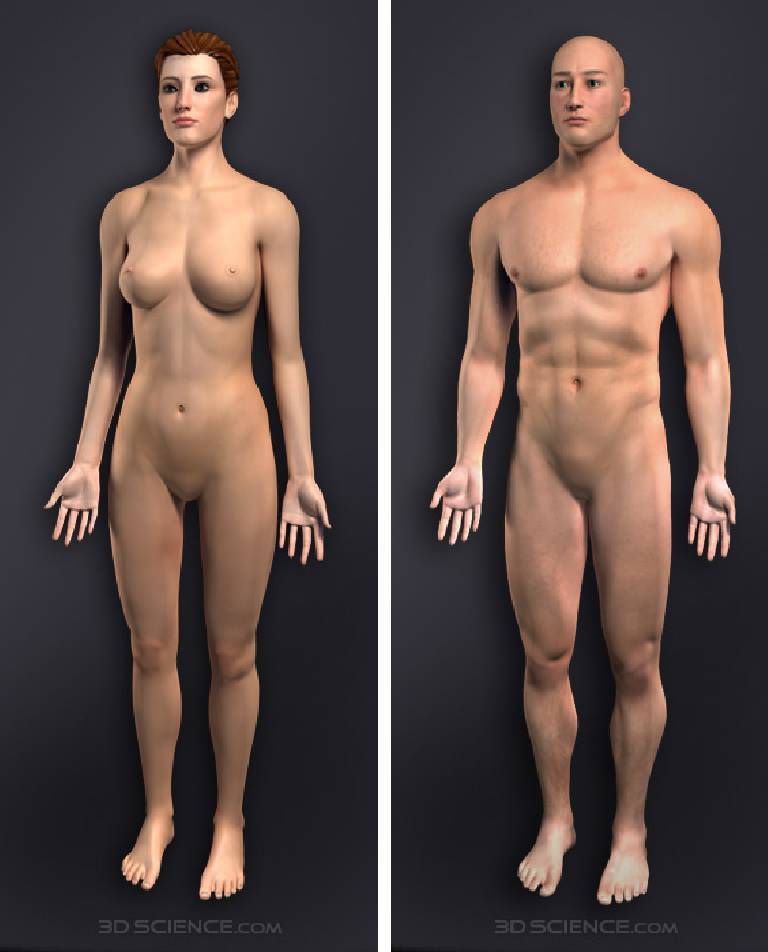
Female and Male “Caucasian Bodies” (©2010 Zygote Media Group. Inc.)
The concept of a Caucasian race was developed around 1800 by Johann Friedrich Blumenbach, a German scientist and anthropologist. Blumenbach named it after the peoples of the Caucasus region, whom he considered to be the archetype for the grouping. He based his classification of the Caucasian race primarily on craniology. Blumenbach wrote: “Caucasian variety—I have taken the name of this variety from Mount Caucasus, both because its neighborhood, and especially its southern slope, produces the most beautiful race of men, I mean the Georgian; and because all physiological reasons converge to this, that in that region, if anywhere, it seems we ought with the greatest probability to place the autochthones (birth place) of mankind.”
Blumenbach’s… ideas lead to the widely(-held) conclusion that the purest and most beautiful whites were the Circassians, one tribe of the Caucasian region of Russia, a mountainous area on the Black Sea close to Turkey…
In the United States, the term Caucasian has been mainly used to describe a group commonly called White Americans, as defined by the government and Census Bureau. (Source: Wikipedia).
“Caucasian,” as applied to a “race” of people, is clearly based in discredited anthropological notions and in racist tendencies which are slowly, but certainly, being recognized and addressed. Caucasian, now no longer appearing here between quotation marks, is properly applied to those people, past and present, living in the region designated The Caucasus.
The Caucasus Region
For perspective, here is a chart showing the relationship of size and population of the Caucasus Region to the US State of California and the Kingdom of Sweden.
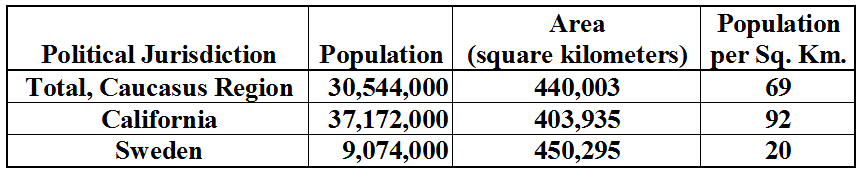
Click on image for greater clarity
The Caucasus Region is divided geographically, and for the most part politically, north and south with respect to the crest of the Greater Caucasus Mountains, as can be seen in the map immediately below. All the territory north of the crest is in Russia, divided among a number of political entities. The population in both the North and South Caucasus is roughly equal, with the North containing nearly 60% of the total area of the Region.
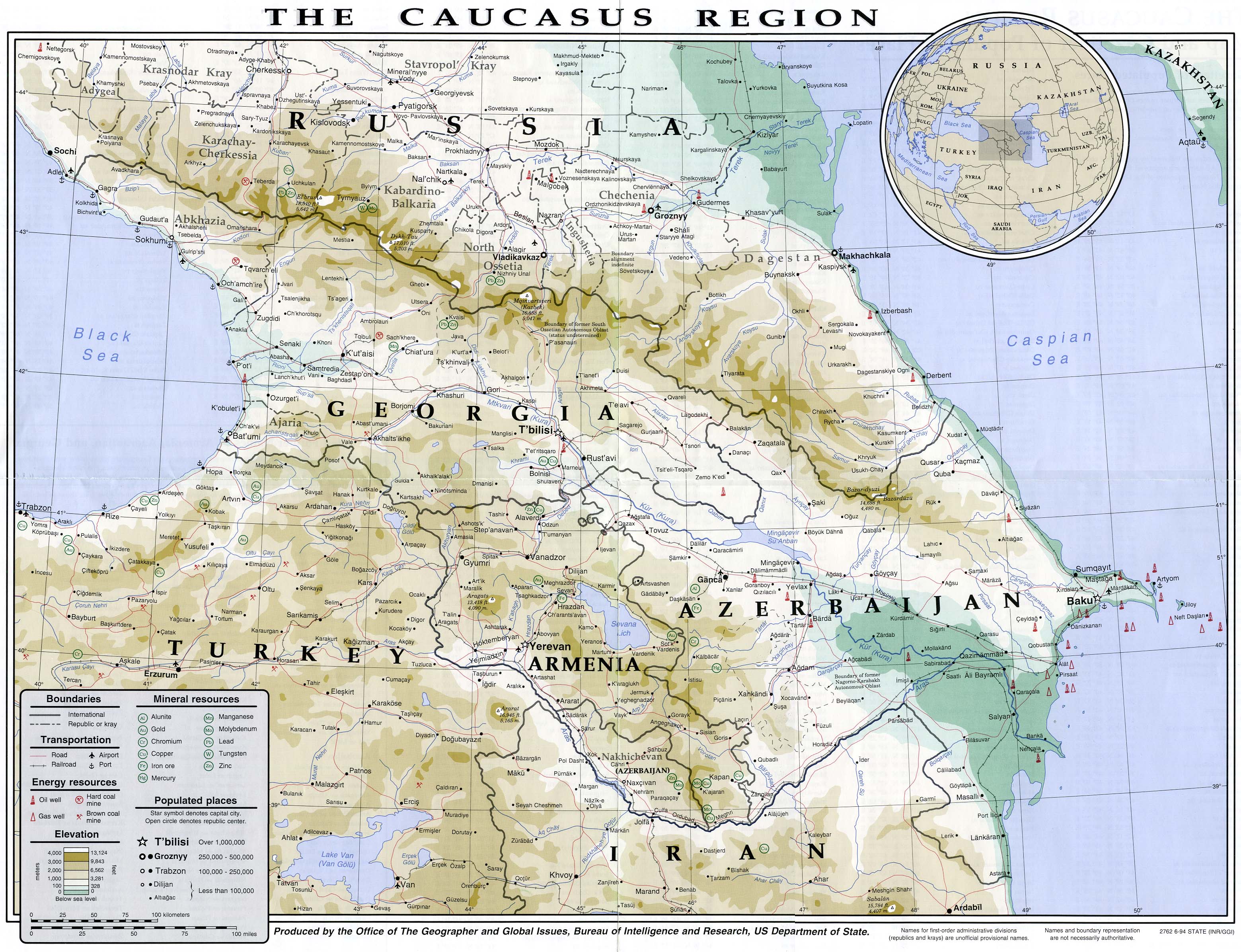
Caucasus Region, 1994 (Bureau of Intelligence and Research, U.S. Dept. of State) Click on the map for detail.
All Caucasia, which embraces not only the Great Mountains of Caucasus proper but also the country to the north and to the south of the Great Caucasian Range, is… designated by the common term “Caucasus.” This is a Latinized form of the ancient Greek name for this region “Kaukasos,” (which)… may in turn be traced back to Old Iranian “kap kah” (or) “Big Mountain.” Ancient Greeks made the Great Mountain Range the scene of the mythical sufferings of Prometheus, and (of) the Argonauts (who) sought the Golden Fleece in the mysterious land of Colchis on the Black Sea coast, south of the Range. Thus, geographically, the term “Caucasus” represents a definite territory located between the Black and Caspian Seas, a wide isthmus separating these seas and divided by the Great Caucasus Mountain Range into two parts — North Caucasus and South Caucasus. (Source)
The Northern Caucasus
What cannot readily be seen, even if you click twice on the above map for greater detail, is that there are now nine Russian Provinces, Russian Republics and Russian Territories (Krais) along the northern borders of Georgia and Azerbaijan. Before there were names for these polities and their predecessors, the original people of the Caucasus lived throughout the mountains (including the “Lesser Caucasus” to the south), their foothills, valleys and plains.
These northern political jurisdictions are, from the Black Sea to the Caspian Sea:
Stavropol Krai
Krasnodar Krai
Adygea
Karachay-Cherkessia
Kabardino-Balkaria
North Ossetia-Alania
Ingushetia
Chechnya
Dagestan
Altogether, these nine political entities have a population of 14,672,000 and comprise an area of 254,000 square kilometers, for a population density of around 58 people per square kilometer.
The Mountains—Greater Caucasian Mountain Range
They stretch for about 1200 km from west-northwest to east-southeast, between the Taman Peninsula of the Black Sea to the Absheron Peninsula of the Caspian Sea: from the Western Caucasus in the vicinity of Sochi on the northeastern shore of the Black Sea and reaching nearly to Baku on the Caspian.
The range is traditionally separated into three parts:
- Western Caucasus, from the Black Sea to Mount Elbrus
- Central Caucasus, from Mount Elbrus to Mount Kazbek
- Eastern Caucasus, from Mount Kazbek to the Caspian Sea (Source)
Here is a map of the area surrounding the highest peak in the Caucasus and, therefore in Europe (because this region is in Europe, not Asia), Mount Elbrus (Elbruz in the map) which straddles the common border of the Russian Republics Karachay-Cherkessia and Kabardino-Balkaria :
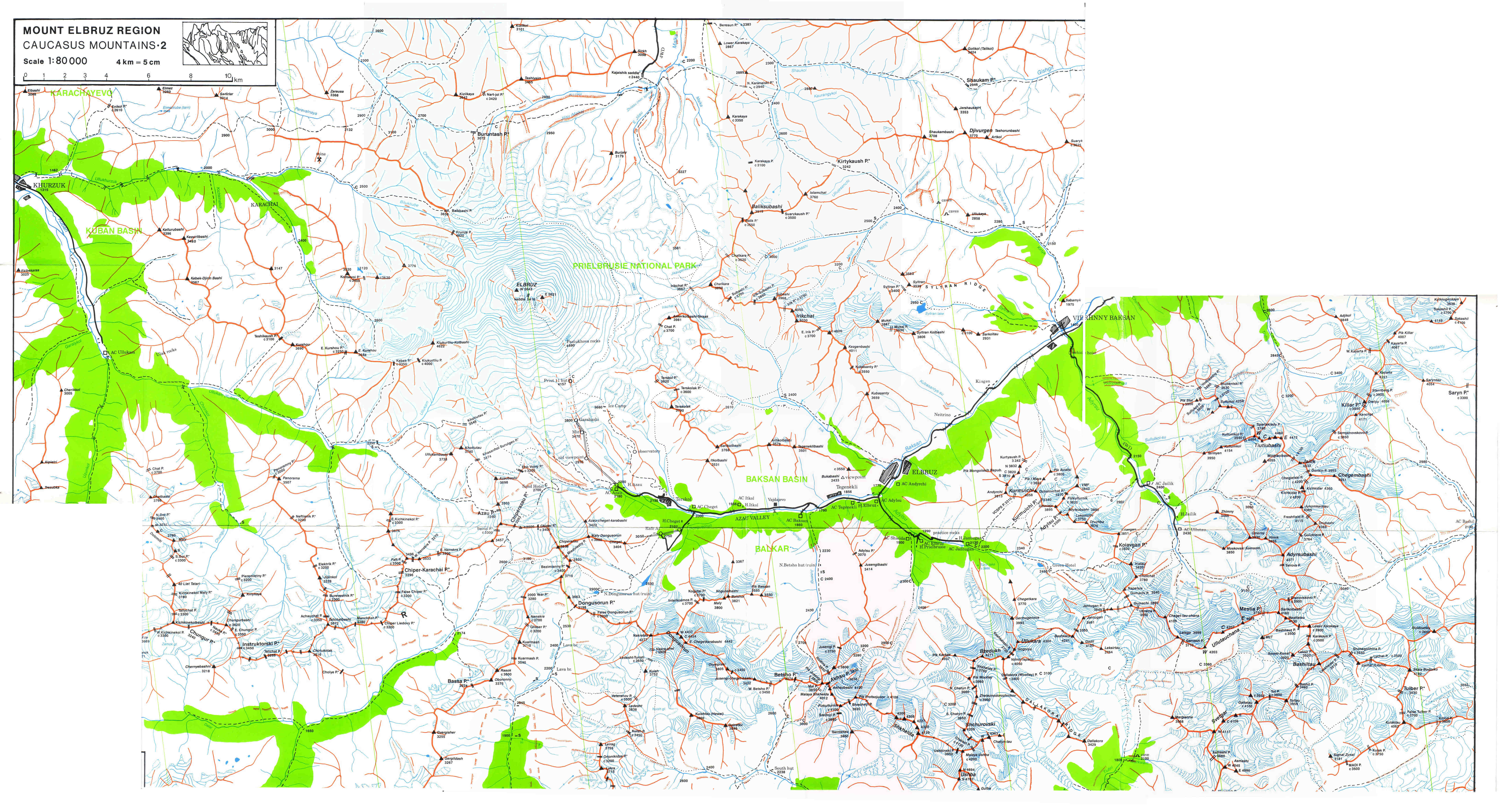
Mt. Elbrus (“Elbruz”) Region of Mountains (Click twice on image for largest size)
The Mountains—Lesser Caucasian Mountain Range
The Lesser Caucasus Mountains are shared by Georgia, Armenia, and Azerbaijan. They lie south of the Greater Caucasus and run parallel to that range. The Lesser Caucasus Mountains extend about 350 miles (565 km) from near the mouth of the Rioni River on the Black Sea to near Azerbaijan’s border with Iran. The range is less rugged than the Greater Caucasus. Peaks rarely exceed 10,000 feet (3,050 m).
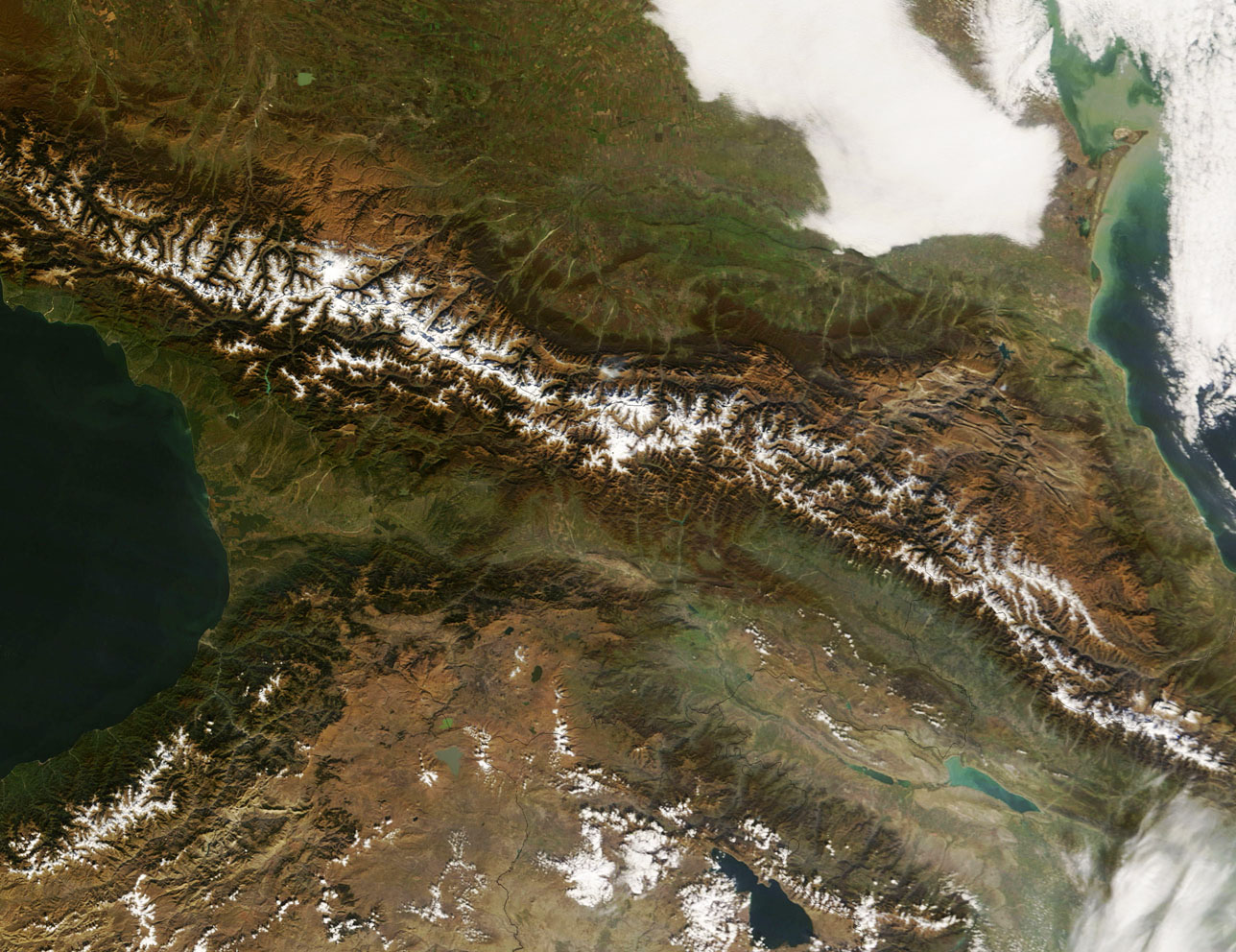
The Greater Caucasus Range runs diagonally from upper left to lower right. The Lesser range runs from the lower left corner, curving up toward the center then back toward the lower right. The Kura River Valley lies between them.
The River Valley Between the Greater and Lesser Caucasus Ranges
Starting in north-eastern Turkey, the Kura River flows through Turkey to Georgia, then to Azerbaijan, where it receives the Aras River as a right tributary, and enters the Caspian Sea. The total length of the river is 1,515 kilometres (941 mi).
People have inhabited the Caucasus region for thousands of years, and first established agriculture in the Kura Valley over 4,500 years ago. Large, complex civilizations eventually grew up on the river, but by 1200 CE, most were reduced to ruin by natural disasters and foreign invaders. The increasing human use, and eventual damage, of the watershed’s forests and grasslands contributed to a rising intensity of floods through the 20th century. In the 1950s, the Soviets started building many dams and canals on the river. Previously navigable up to Tbilisi in Georgia, it is now much slower and shallower, as its power has been harnessed by hydroelectricity stations. The river is now moderately polluted by major industrial centers like Tbilisi and Rustavi in Georgia. (Source)
A Brief History of the Caucasian Peoples
I now quote excerpts, extensively, from Charles King’s Book.
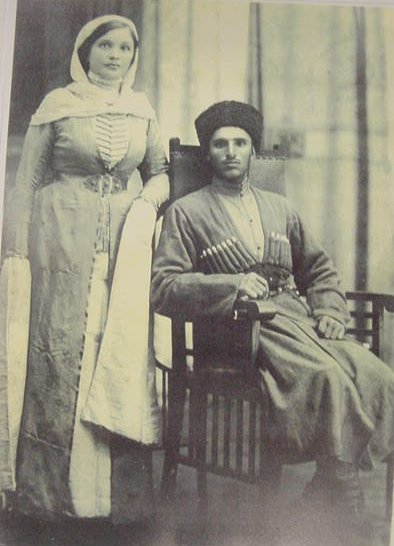
‘Circassian wife and husband, 1860s – during Russian & Ottoman perpetrated holocaust’ (thejunsui.wordpress.com)
In the Russian Empire (1721 – 1917) the generic term “highlander” or “mountaineer” was applied to any indigenous person living anywhere except on the steppe (prairie) or in lowland river valleys, people we might now classify as Chechens, Avars, Lezgins or Georgians. The equivalent term in English was “Circassian.” In its narrowest sense, however, Circassian specifically refers to speakers of Adyga languages, the major linguistic group of the northwest Caucasus…
By the time the Russian Empire finally conquered the last of the highlanders, another process of appropriation was already underway: the conceptualization of the Caucasus as a distinct place by generations of Russian and foreign writers, artists, and travelers. The mountains became metaphors for both love of liberty and unspeakable barbarism. Tribal allegiances were evidence of both inchoate national feeling and the inherent primitivism of local societies. The Caucasus was cast as either the fount of civilization (and of its highest representative, the “Caucasian Race”) or the antithesis of civilization itself. Today these visions still play a powerful role in politics, foreign relations, and communal interactions. National self-conceptions are wrapped up in them. Rights to territory are justified by reference to them. Notions of alien, friend and enemy, flow logically from them…
Classifying people—whether based on race, language, culture, or any other criterion—is always more complicated that it might seem. Words signify different things in different contexts. The English term “Caucasian,” for example, today denotes a racial category developed by an eighteenth-century German anatomist to identify the allegedly primordial form of mankind, with light skin and round eyes. Yet the equivalent term in Russian refers to a person having family ties to the Caucasus, with perhaps dark hair and olive skin. Virtually any other identification that might have currency today—Georgian, Chechen, Muslim, Sufi—was imbued with different meanings in the past. The collective categories that would eventually come to be used for ethnic groups, nationalities, and religions in the Caucasus were not present, fully formed when the Russians arrived. They were products of the imperial system itself—negotiated, reworked, and in some cases wholly invented as part of the process of imperial absorption and administration…
Throughout the nineteenth century, as more and more Europeans became familiar with the Caucasus they were fascinated by the physical appearance of the Circassians. The men were said to be tall, dark, and lithe. Their long mustaches, silver-studded weaponry, and close-fitting clothing…enhanced their noble, war-like mien.
South Caucasus Countries
These three countries, Georgia, Azerbaijan and Armenia, are readily discerned in the first map displayed above.
What is not seen is that the borders and internal areas are not yet settled as to legitimacy, at least according to certain ethnic minorities, and by Russia and a few of its political allies.

Please click on the image for greater clarity
In addition, there are five small Azerbaijani exclaves within Armenia that appeared following the disintegration of the USSR in 1991. Their present status is unclear since the Armenian-Azerbaijani dispute in 1992-94 over the region of Nagorno-Karabakh. At this time they were unilaterally annexed by Armenia. Their economies are primarily based upon agriculture.
Four enclaves are found in north-eastern Armenia near the town of Kazakh.
- Upper Askipara begins 1 km west of the Armenian village of Voskepar.
- Azatamut begins about 1 km from the Azerbaijan border near the Kazakh to Idshevan highway.
- The other two enclaves are tiny pieces of farmland southwest of the Azerbaijani town of Tatly . They cover 0.12 and 0.06 km².
- Karki is found north of the Nakhichevan area about 4.5 km northeast of the town of Sadarak. It covers about 7 km².
In 1994 Nagorno-Karabakh declared itself an independent republic. [Post-publication update, 2020 February 12: The Nagorno-Karabakh War: Advantage Hindsight: A View)
Pausing for a deep breath
For you who have read this far, this seems quite a lot to digest about The Caucasus to me as well. But I can’t finish this article until I point out that there is rich history among all the many peoples currently and formerly living in this area that is not quite the size of Sweden. Much of this history will be found under the many links, above. To provide a glimpse into this history, please consider this final chart I created to show the major ethnic and linguistic groups currently found in the Russian (northern) part of the Caucasus. Please click on it to see the detail more clearly, or view it here:

Chechnya as a Current Example
Many parts of the Region remain unsettled, with intermittent guerrilla warfare in some parts, notably Chechnya after the collapse of the Soviet Union in 1989.
Islamic fundamentalism… posed a growing threat not only to the newly independent states of central Asia, but also to the Caucasus (above all, Chechnya)…
… (T)he Chechen conflict enabled (prime minister and candidate for President of Russia) Putin to demonstrate his mettle in an all-out military campaign to establish control over Chechnya and eradicate terrorism… (A)fter relentless artillery bombardment, Russian forces stormed the Chechen capital of Groznyi–from which they had been so ignominiously expelled earlier—and launched search-and-destroy operations against pockets of guerrilla resistance…
The ongoing war in Chechnya, which initially raised Putin’s popularity, began to arouse mounting criticism, especially from Western governments and human rights organizations. Although Russian forces established some semblance of control, they failed to crush all resistance or to end devastating terrorist attacks. And the war took a heavy toll—on the Russian military (around 20,000 casualties), insurgents (around 13,000) and civilians (between 30,000 and 40,000). This carnage eroded popular support in Russia itself [note: year 2005]… impelling the Kremlin to “Chechenize” the conflict by putting pro-Moscow Chechens in charge and relying on Chechen, not Russian, forces. Moscow arranged for Ramzan Kadyrov to succeed his father (killed in a terrorist attack) as the president of Chechnya.; the young Kadyrov quickly earned a reputation for brutality and the ‘disappearances’ of 2,000 to 3,000 fellow Chechens. The repression in Chechnya, even if provoked by criminal acts of terrorism, elicited sharp criticism in Western circles and reinforced criticism of Putin for ‘authoritarian’ tendencies. (Source).
Location, Location, Location
Unfortunately for the settled peoples in the Caucasian isthmus, this great strip of land linking, historically and currently, the empires of the north and east and south—Russia, The Ottomans, Persia, The Mongols, among others—is a place to go to, or through, in search of new places or new opportunities, or through which to attack competing empires. As a result of various ambitions, the people of The Caucasus have been uprooted, dispersed, tortured, raped, slain and forcibly converted to other religions or ‘nationalities’ over the centuries. For example, there are very few real Circassians left anywhere in The Caucasus, although there are a great many who identify themselves as Circassian throughout the world. The same can be said for other population groups. Note, in the chart immediately above, that in many “republics” there are more Russians than original people, or the Russians are the largest minority. Only in Chechnya, Dagestan and Ingushetia are there a large majority of people who can rightfully be called, generically, Caucasian.
I have not written here anything substantive about those Caucasians who identify themselves as Georgian. The Georgians are a whole story unto themselves and I encourage those with an interest to look at these links for further information:
History of the Georgian People (WikiPedia)
Republic of Georgia, by Georgi Kokochashvili
[NOTE: Click on this link to read a review in the British newspaper, The Independent, of the book Let Our Fame Be Great: Journeys among the defiant people of the Caucasus, By Oliver Bullough.]
 The most recent English translation of this work is by the Reverend Hubert Nearman, O.B.C., who performed the translation at the request of the late
  The Pavellas Perspective