

Photo: Geophysical Journal International, Volume 201, Issue 3, June 2015
In reading, some years ago, the fascinating book Underworld: The Mysterious Origins of Civilizations, by Graham Hancock, I came across this on page 71:
At the time of Shaw’s third great flood[i] around 8,000 years ago… the stresses and earthquakes became so severe that immense waves were formed in the ground. One of these, in northern Sweden, is 150 kilometers long and 10 meters high and has been described as a ‘rock tsunami’[ii] that can only have been caused by earthquakes of unbelievable magnitude. (See endnotes).
This elicited a memory of my visit to the visitor’s lodge at Storulvån in western Jämtland, from which point Eva and I hiked for three days in a triangle of pathways, staying in two lodges along the way (including the last day at Blåhammaren). The lodge has (or had) a display of the great quake in some detail. I was too rushed to drink it all in, but the image stayed with me all these years. I have now collected more than enough references to the event to present it to you.
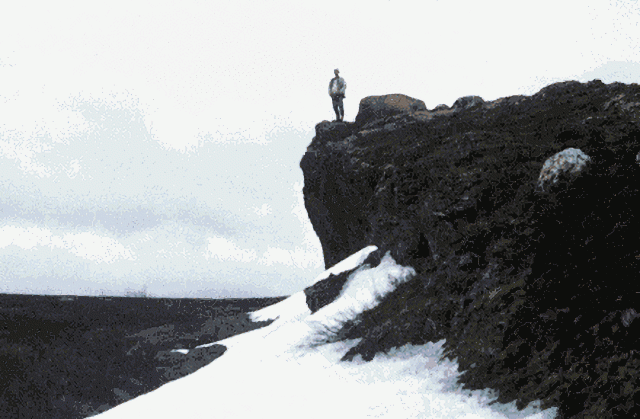
Photo: SCIENCE, 1 Nov 1996 Vol 274
Showing the current height of the land’s displacement due to the “wave of earth”
There is… compelling evidence for many gigantic ancient floods where glacial ice dams failed time and again: At the end of the last glaciation, some 10,000 years ago, giant ice-dammed lakes in Eurasia and North America repeatedly produced huge floods. (Discover Magazine, Jul-Aug 2006)
—
Pärvie Fault (Swedish: Pärvieförkastningen) is a large geological fault located in Northwestern Sweden. The fault is about 155 km long and is the longest known postglacial fault in the world. The fault had a major period of seismic activity following the deglaciation of Fennoscandia about 10,000 years ago. (Wikipedia)
—
Evidence from northern Sweden suggests that this area may have unleashed monster earthquakes when the ice age ended, only a short geologic span ago, says Ronald Arvidsson, a seismologist at Uppsala University in Sweden. The uncharacteristic quakes within a tectonic plate occurred because the land sprang up after the heavy European ice sheet melted away, he reports in the Nov. 1 Science.
—
Arvidsson studied a series of northern Scandinavian faults that formed 9,000 years ago, just after the disappearance of the ice sheet there. He (calculated) the size of the earthquakes that ripped the crust long ago. The largest postglacial fault, the 160kmlong Pärvie fault, formed during a magnitude 8.2 earthquake, he estimates. The 50kmlong Lansjarv fault came to life in a shock with a magnitude of 7.8.” Author: Monastersky, Richard, Science News, Nov 2, 1996
—
At 155 km, the Pärvie fault is the world’s longest known endglacial fault (EGF). It is located in northernmost Sweden in a region where several kilometre-scale EGFs have been identified… (T)hese faults are inferred to have ruptured as large earthquakes when the latest ice sheet disappeared from the region, some 9500 years ago.
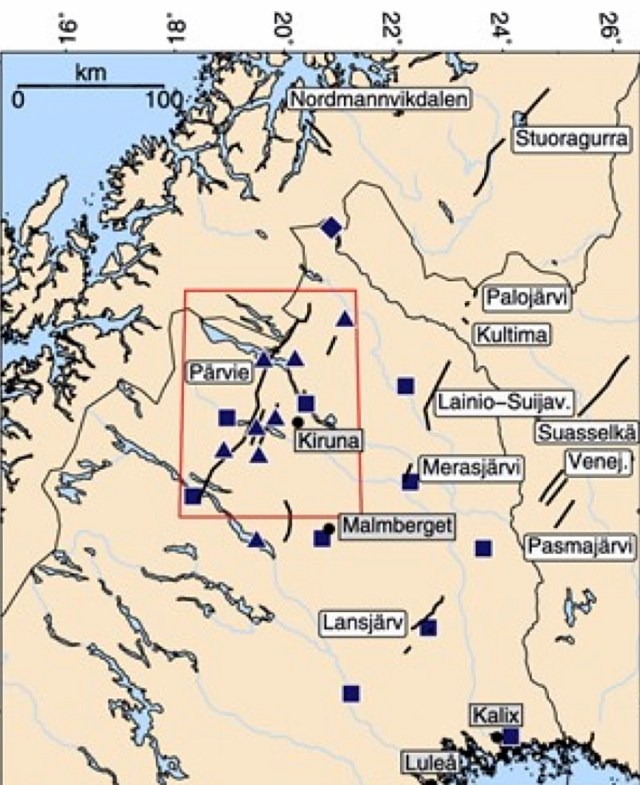
Geophysical Journal International, Volume 201, Issue 3, June 2015
[i] From Professor (of Earth Sciences at the University of Alberta) John Shaw’s findings that there were three episodes of post-glacial flooding: 15,000-14,000 years ago; 12,000-11,000 years ago; 8000-7000 years ago.
[ii] Arch C. Johnston, ‘A Wave in the Earth’, Science, vol. 274, 1 November 1996, 735.

 Then British Foreign Minister Anthony Eden…point(ed) to the diversion of large numbers of Wehrmacht and Luftwaffe forces into a two month campaign in the Balkans [including Greece], as a key reason for the Germans being ‘too late and too slow’ in

 The Pavellas Perspective
