It is to Weep…

I thought I had said all I had to say in this space, but a holiday trip I have just completed, and other concurrent experiences, provided me with energy for what I offer below.

The first experience was to find a book in the Copenhagen central railway station, Babel, or the Necessity of Violence, by R.F. Kuang.

It is a complex book, a fantasy involving the magic of translated words placed in juxtaposition on bars of silver. The setting of the fantasy presents a history of the slavery, oppressions and indignities visited upon subject peoples of the British Empire in the mid-19th Century, and upon the common people of Great Britain. Despite its large size, I finished the book before we reached our destination, Garda, Italy.

The book reminded me of the raw truths one learns as one ages; that the powerful are prone to act as gods and to treat others as lesser beings, even to torture and kill them with impunity. This ‘truth’ has been well formulated by Lord Acton:

Power tends to corrupt, and absolute power corrupts absolutely. Great men are almost always bad men, even when they exercise influence and not authority, still more when you superadd the tendency or the certainty of corruption by authority. (Source)

With this book and these thoughts operating in the back of my noggin, I was nonetheless open to the pleasant experiences Eva and I reasonably expected from our nine-day holiday, including four days travel by train from and returning to Stockholm by a company that offers group tours.

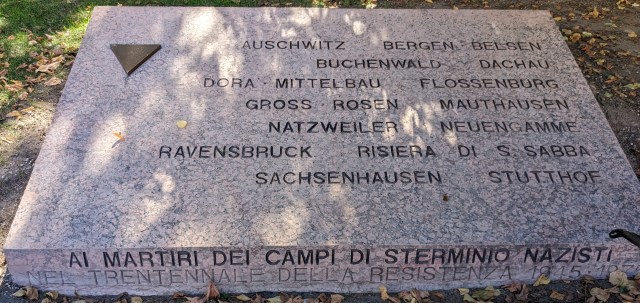
The first full day of the tour was dedicated to a bus trip to Verona, an ancient Roman town with an amphitheater at the central plaza. Also in the plaza was this monument over which I paused and pondered for several minutes:

I translate this as “To the martyrs of the Nazi extermination camps”.

This encounter receded to my mental background as the tour continued, through many enticements to spend and eat, to visit other ancient monuments and places.

At the noon lunch break, we found ourselves seated with a couple we had become friendly with and engaged in a lengthy, intimate conversation, sharing life experiences including personal tragedies. We paused at one point to quietly weep. We then recited our blessings, noting that many other lives in the world had suffered and were suffering more greatly and continuously than we have suffered.

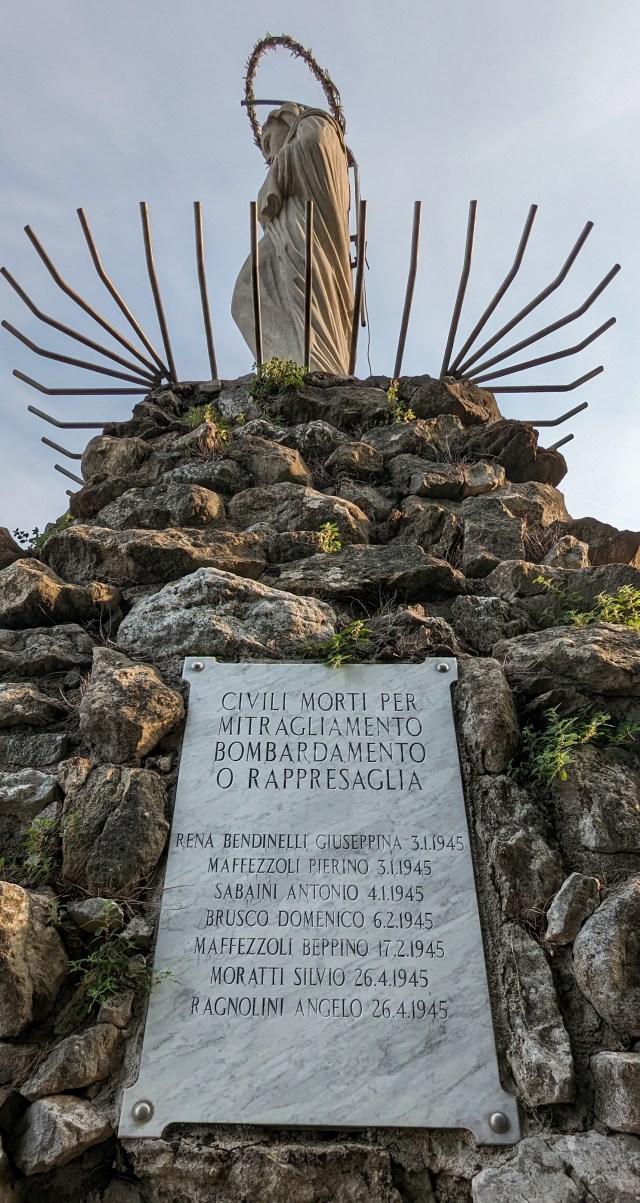
On the final day Eva and I wandered up the mountainous hill, at the foot of which our hotel perched, just to enjoy the exercise and the ambience of old, largely well-kept houses that overlook the large Lake Garda. We had been told by others to seek out ‘The Madonna’ as we ascended the steep path. We found her and learned that she was erected just after WWII to honor the fallen civilians and soldiers of the town of Garda.

Threatened by fire and sword in the Second World War, by virtue of a solemn vow, Garda, faithful to its promise, erects this sacred marble as a symbol of its faith and compassion so that the only Mother of the suffering humanity from above may watchfully protect and bless all her living and all her dead. (Translated)


I wept again.

This pleasant, peaceful, lakeside town, surrounded by dolomite mountains with vast vineyards sweeping through nearby valleys and up mountainsides, had its peaceful lives  interrupted and discarded by the ambitions of great men.

And it continues, throughout the world…

Ecclesiastes 4      

The Evil of Oppression

1 Again I looked, and I considered all the oppression taking place under the sun. I saw the tears of the oppressed, and they had no comforter; the power lay in the hands of their oppressors, and there was no comforter.

2 So I admired the dead, who had already died, above the living, who are still alive.

3 But better than both is he who has not yet existed, who has not seen the evil that is done under the sun.

https://biblehub.com/ecclesiastes/

Posted in Books & Literature, war | Tagged , , , , , , | 2 Comments

Before and After Human Consciousness, or The Voice of God vs. Auditory Hallucinations

Psychologist Julian Jaynes (1920 – 1997) asserted that humans were not fully conscious until around 4,000 or 3,000 years ago, the time when the two hemispheres of the cerebrum of our brain (left and right, physically connected by the Corpus Callosum) were unified through pressures of natural selection in newly “civilized” environments.

In his book The Origin of Consciousness in the Breakdown of the Bicameral Mind (1976), in which he argued that ancient peoples did not access consciousness (did not possess an introspective mind-space), but instead had their behavior directed by auditory hallucinations, which they interpreted as the voice of their chief, king, or the gods. Jaynes argued that the change from this mode of thinking (which he called the bicameral mind) to consciousness (construed as self-identification of interior mental states) occurred over a period of centuries about three thousand years ago and was based on the development of metaphorical language and the emergence of writing. (Source).

Jaynes’s theories and assertions are not universally accepted by the scientific community, but he has asked questions that need to be asked, according to one critic.

Jaynes never completed the second book he had intended to write, but he wrote lectures and essays which, together with commentary and essays by others since then, have culminated in a follow-up book which I have read: Reflections on the Dawn of Consciousness, edited by Marcel Kuijsten.

Reading this book stimulated me to explore related areas which I will discuss under the following headings, before finally returning to the question in this article’s title regarding auditory hallucinations and God.

The tangential areas I covered in my literature search were:

Jung’s Archetypes and the Collective Unconscious

Jung’s Conception of The Collective Unconscious (kheper.net/topics/Jung/)

Collective unconscious is a term of analytical psychology, coined by Carl Jung. It is a part of the unconscious mind, expressed in humanity and all life forms with nervous systems, and describes how the structure of the psyche autonomously organizes experience. Jung distinguished the collective unconscious from the personal unconscious, in that the personal unconscious is a personal reservoir of experience unique to each individual, while the Collective Unconscious collects and organizes those personal experiences in a similar way with each member of a particular species (emphasis added).

Jung stated in his book Archetypes and the Collective Unconscious:

…in addition to our immediate consciousness, which is of a thoroughly personal nature and which we believe to be the only empirical psyche (even if we tack on the personal unconscious as an appendix), there exists a second psychic system of a collective, universal, and impersonal nature which is identical in all individuals. This collective unconscious does not develop individually but is inherited. It consists of pre-existent forms, the archetypes, which can only become conscious secondarily and which give definite form to certain psychic contents. (Source)


Major Archetypes Discussed by C. G. Jung and Many Others


§  Mother
§  Mana
§ The maiden
§  The wise old man
§  Various family members
§  The child
§  The trickster
§  Everyman
§  God
§  The hero

 A Brief Look at the “Self:” Is There Such a Thing?

My main source of information in this realm is found in a scholarly book, Self: Ancient and Modern Insights about Individuality, Life and Death, by Richard Sorabji.

Plato started a tradition of doubt about whether self-knowledge is even possible. Doubts were further discussed by Aristotle, the sceptic Sextus and the neoplatonist Plotinus. Epictetus likened the self to prohairesis or, roughly, will, which provides the basis for choice and morals. Epictetus stated throughout his work that “We are our prohairesis.”

Trickster Archetype (crystalinks.com/trickster.html)

Persian physician and philosopher Avicenna (CE 980 – 1037) saw the “essence” or soul as independent of the body. Christian religionists, and philosophers raised in the Christian tradition, also saw the soul, not the body, as “I.” René Descartes stated, “I am distinct from my body and can exist without it.” It is Descartes who famously said: cogito ergo sum (“I think, therefore I am”).

A great many philosophers and religionists have addressed the question of the self, if any. Here are the main thinkers from antiquity through the 13th Century, listed in date order by Professor Sorabji in his book:

Chapter 1 of the book is titled: The Self: is there such a thing? It is 15 pages in length and summarizes major arguments made in more recent times, from Descartes (1596 – 1650) to the present. Some of the names will be familiar to the reader, even if he or she has not read their writings: Locke, Hume, Kant, Nietzsche, Wittgenstein, Elizabeth Anscombe, Norman Malcolm, Tony Kenny, Galen Strawson, Derek Parfit, and Daniel Dennett.

Professor Sorabji admits a bias toward the existence of a self but acknowledges difficulties in proof and cites those who disagree with him, at least in part. In any case I can find no scientific, experimental proof of a self or “The Self.”

Here is the simile that occurred to me as I read this book: each of us who refers to “I,” is like the fruiting body of a great mushroom, the mycelium of which lies deep and extensively in the earth and neighboring plants. When the mycelium reaches a certain stage of growth, it begins to produce spores  on hyphae (stalks), which are arranged into intricate structures called fruiting bodies (“mushrooms” that carry and distribute spores—seeds). (Source).

To carry the simile further, we each emerge like a common mushroom from the great mass of humanity that is the main body (God? The unconscious?) of the organism; we grow our seeds and eggs, some small portion of which will connect to form new tissue to add the main mass.

Whether or not my simile is apt, there continues to be argument among philosophers on the subject of the self. In the ending page of chapter 1, the author indicates the chapters wherein he will offer disproof of what some major thinkers have opined about the existence of a self: Immanuel Kant, the Buddhist Śântideva, the StoicsPlutarch, and Derek Parfit.

I cannot say there is, or is no “self,” especially as distinct from all other living things upon which the human race depends. What I perceive is that it is a word, an abstraction, that refers to something we consider real, at least for practical purposes and, possibly, for spiritual purposes (how can I connect with God if there is no “I”?).

I leave the topic here but will include in a final comment at the end of this essay.

The Subject of Consciousness, and of the Unconscious

In an article on consciousness in the online Stanford Encyclopedia of Philosophy, Professor Robert Van Gulick concludes:

A comprehensive understanding of consciousness will likely require theories of many types. One might usefully and without contradiction accept a diversity of models that each in their own way aim respectively to explain the physical, neural, cognitive, functional, representational and higher-order aspects of consciousness. There is unlikely to be any single theoretical perspective that suffices for explaining all the features of consciousness that we wish to understand. Thus, a synthetic and pluralistic approach may provide the best road to future progress.

In the book Consciousness: Creeping up on the Hard Problem, the author Jeffrey Gray concludes the first half of the book, thus:

The Hard Problem of consciousness can be stripped down to one (still Hard) but double-edged question: how does the unconscious brain create and inspect the display medium (qualia) of conscious perception? I call this one question rather than two because I suspect (but cannot demonstrate) that any scientifically acceptable account of how the brain creates qualia will at the same time constitute an account of how it inspects them… What is certain is that the first half of the question, ‘how does the brain create qualia?’, is enough to keep science going for a long time to come…

If the reader has followed me this far, he or she may see where I am headed: there is no absolute knowledge of consciousness. What has been shown is that the unconscious takes precedence over the conscious in our lives. In Jeffrey Gray’s book he states:

Unconscious mechanisms are responsible for the construction of the model of the external world that enters consciousness… Unconscious mechanisms are responsible also for the comparator process that either kicks of a motor program as ‘going according to plan’ or detects novelty and error…(and it is an open question whether) the correction of error by modification of the activities of the unconscious servomechanisms… is achieved in conscious or unconscious processing….

Likewise, the Clinical and Personality Psychology homepage of Uppsala University states in an article Concepts of the Unconscious:

… the present boundary between conscious and unconscious… hinges on… any percept or process that one cannot report being aware of at the time of its influence on behavior (including cognition, emotion, perception, etc.) is unconscious. This includes perception that has been conscious in the past but is not when its effects are produced.

Such scholarly texts are almost impenetrable to the layperson, but one can easily see the issues under the headings “self,” “consciousness” and “the unconscious” are not settled, either within a philosophical context or a biological context; and, that our lives are conducted more from what we call the unconscious than from the conscious. (I have not included more references to this latter assertion and invite the interested reader to do his and her own research, including the book by Kuijsten that started my journey through this inquiry).

Finally, About Auditory Hallucinations and the “Voice of God”

Clinical studies discussed in detail in the Kuijsten book (Reflections on the Dawn of Consciousness) show that in those persons, both “sane” and not, who have auditory hallucinations the voice comes from above and to the left of the person (indicating right hemisphere origin) and is always an authority figure, most often “God.” Current preliterate societies consider “hearing voices” a sacred (good, evil or benign) occurrence and take them seriously without labeling the hearer “crazy.”

Also, from “A Jungian Approach to Psychosis“:

Extensive research has been undertaken with respect to auditory hallucinations within psychiatric populations (e.g.: schizophrenia, bi-polar disorder, dementia, etc.). In the same vein, there has been some research conducted with non-psychiatric populations, thereby indicating that auditory hallucinations are not necessarily pathological phenomena, but part of the human experience.

Conclusion

Julian Jaynes has opened up a new and fascinating realm of inquiry into the human condition. I find it not unbelievable that normal, rational humans still hear voices, but suppress them because they are now considered to be unacceptably deviant. I strongly believe that we should listen to those who hear voices and interact with them politely, not as if they need drugs to be more “normal.” Maybe we can learn something from them. Maybe they are in more contact, than the “normal” we, with the great substance or spirit that lies beneath the human condition, perhaps the whole mammalian condition… perhaps God, or some of the ancient gods and archetypes?

This article was published in an expanded form on April 14, 2010 in my weblog: Cultivating the Corpus Callosum.


Posted in Archetypes, Consciousness, consciousness, Psychology, self, The Self | Tagged , , , | 5 Comments