
 Been away so long I hardly knew the place
Gee, it’s good to be back home
Leave it till tomorrow to unpack my case
Honey disconnect the phone
I’m back in the USSR
You don’t know how lucky you are, boy
Back in the US
Back in the US
Back in the USSR
(Lyrics by John Lennon & Paul McCartney)
© SONY BEATLES LTD; SONY/ATV TUNES LLC
The Union of Soviet Socialist Republics (USSR) dissolved 25 December 1991, almost 18 years ago. There were 15 “republics” in the union. What, now, are the names of these countries? How are they doing?
I asked myself these questions as I prepared to write an article on Uzbekistan, a former republic of the USSR.
 As for how the fifteen, individually, are “doing,” the answer has to be, in part: “compared to what?” I chose to compare a few demographic statistics with The World as the reference point. As I have so often in these pages, I went to the The World Factbook of the Central Intelligence Agency of the USA.
I chose seven demographic measures:
- Gross Domestic Product (GDP) per capita
- Life expectancy at birth for females
- Life expectancy at birth for males
- Net migration per 1000 population (number of immigrants minus number of emigrants)
- Infant mortality (usually within 30 days of birth) per 1000 live births
- Fertility rate (number of births per year, per the number of all women)
- The live birth rate per thousand population, minus the death rate per 1000
I arrayed these seven measures by country and compared each characteristic to that of the world, whether more, or less, favorable.

[Please click on the image for clearer detail]
I then gave a score to each country by subtracting the number of negative results, compared to world averages or ratios, from the number of positive results (a positive number shows a positive comparison to the world, and the converse for negative number):
- Countries Scoring “+3”: Belarus, Kyrgyzstan
- Countries Scoring “+1”: Armenia, Estonia, Georgia, Kazakhstan, Latvia, Lithuania, Moldova, Russia, Uzbekistan
- Countries Scoring “-1”: Turkmenistan
- Countries Scoring “-3”: Azerbaijan, Tajikistan, Ukraine
So what makes Belarus and Kyrgyzstan so special—at least with respect to world averages and ratios? (One must keep in mind that probably none of the readers of this article would care to live in an area where these demographics are at or near World averages and ratios; and, that the data aggregation agency, in this case the CIA, is at the mercy of the quality of data collection and reporting in each country).
Belarus
 Despite low fertility and high overall death rate, Belarus has high GDP per capita, low infant mortality, high life expectancy at birth for both females and males, and more people are entering the country than leaving it. So, the overall population is growing. It does seem counter-intuitive for the population to be growing despite low fertility and high death rate, but perhaps there is still some in-migration of ethnic Belarusians from the other former republics who were dispersed during the Soviet era.
“Since 1996, Belarus has been negotiating with Russia to unify into a single state called the Union of Russia and Belarus.” [Source]
In looking at the nature of Belarus’s government before and since the dissolution of the USSR (see under the “Belarus” link, above), there is much room to doubt the accuracy of information coming from, essentially, a totalitarian state in existence for 70 years.
 Kyrgyzstan
More people leave Kyrgyzstan than enter it, as residents, and GDP per capita is low, but all the life and health data are high. “Kyrgyzstan has undergone a pronounced change in its ethnic composition since independence [1991]. The percentage of ethnic Kyrgyz increased from around 50% in 1979 to nearly 70% in 2007, while the percentage of European ethnic groups (Russians, Ukrainians and Germans) as well as Tatars dropped from 35% to about 10%. The Kyrgyz have historically been semi-nomadic herders, living in round tents called yurts and tending sheep, horses and yaks. This nomadic tradition continues to function seasonally as herding families return to the high mountain pasture in the summer.” [Source]
Nine countries are scored “+1.” Rather than list and discuss them individually, I will present what they have in common.

Statue of Lenin in Tiraspol, Moldova
- The life expectancy at birth for females is higher than The World average.
- Other than for Kazakhstan and Russia, the life expectancy at birth for males is higher than the world average. Russia is lowest at 59.3 years, compared to the world average at 64.5 years. It is remarkable that the life of expectancy at birth for females in Russia is 73.2 years, almost 14 years more than for males.
- All, except Russia, have more people leaving than entering the country as residents. Note, again, that there has been a general migration of expatriates toward their countries of origin after the dissolution of the USSR.
- The infant death rate for all 15 countries is lower than the world average. The three Baltic countries (Estonia, Latvia and Lithuania) are lowest in this measure, by far (a good thing), between 6.5 and 8.8 deaths per thousand births. The world average is 40.9. Armenia, Uzbekistan and Kazakhstan are highest, at 20.2, 23.4 and 25.7 infant deaths per thousand births, respectively.
- The fertility rate of all 15 countries is well under the World average of 2.6 children per woman. A country needs around 2.1 live births per woman in order to maintain the country’s population at a given level.
- Except for Uzbekistan, the difference between the birth rate and the death rate (BR minus DR) is lower than the world average of 11.8 per thousand population (not good). Russia is lowest at a difference of (negative) 5.0 per thousand people.
 Turkmenistan (“-1”)
The only three positive factors for this country are life expectancy for males and females, and the birth rate minus the death rate. “The former Communist Party, now known as the Democratic Party of Turkmenistan, has been the only one effectively permitted to operate. Political gatherings are illegal unless government sanctioned. Turkmenistan is among the twenty countries in the world with the highest perceived level of corruption …” [Source]
Azerbaijan, Tajikistan, Ukraine at “-3” score
The GDP per capita of all three countries is below the World average of $10,400, with Tajikistan by far the lowest at $1,800. Life expectancy for males born today is less than the World average, for all three. Except for Ukraine (at 8.9) the infant death rate is above the world average of 40.9 deaths per thousand live births. The fertility rate for Azerbaijan and Tajikistan is well above the World average, but Ukraine is among the lowest countries at 1.3 births per woman. Similarly, the birth rate far exceeds the death rate in Azerbaijan and Tajikistan, but Ukraine is the lowest of all fifteen countries in this measure at (negative) 6.2; that is, the there are 6.2 more people dying than being born, per thousand population, in the current year.
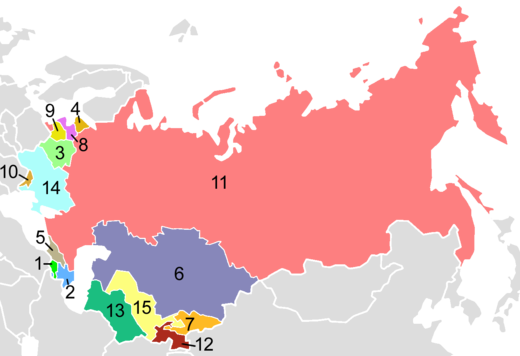
| 1 Armenia 2 Azerbaijan 3 Belarus 4 Estonia 5 Georgia 6 Kazakhstan 7 Kyrgyzstan 8 Latvia |
9 Lithuania 10 Moldova 11 Russia 12 Tajikistan 13 Turkmenistan 14 Ukraine 15 Uzbekistan |
There is hard living almost everywhere in the former USSR. Look at the averages of these seven measures for the 27 countries of the European Union vs. those of Russia, the largest country, by far, of the former SSRs, and the most dominant, politically and economically:
| European Union GDP per capita: $33,700 Life expectancy, female: 82.0 Life expectancy, male: 75.5 Net migration: 1.5 Infant death rate: 5.7 Fertility rate: 1.5 Birth rate minus death rate: -0.4 |
Russia GDP per capita: $16,100 Life expectancy, female: 73.2 Life expectancy, male: 59.3 Net migration: 0.3 Infant death rate: 10.6 Fertility rate: 1.4 Birth rate minus death rate: -5.0 |
I have been to two countries of the former USSR: Estonia and Latvia. Despite the obvious enthusiasm of the people for their freedom from totalitarianism, and the resultant social and economic progress, the ravages of the Soviet rule are still quite apparent.
With all respect to the poetry of Messrs. Lennon and McCartney, let’s not go back to the USSR.


 The Pavellas Perspective