
Centering on the Poet Rainer Maria Rilke, In Bohemia
Eva and I visited Prague as tourists for five days in late July this year. This was time enough to sample only a small part what this great city has to offer.
I knew already that Prague and the country of which it is the capital, the Czech Republic (formerly Bohemia, for the most part), were home to two great composers: Bedřich Smetana (1824-1884) and Antonín Dvořák (1841-1904). What I had failed to remember, if ever fully knew, was that two great writers also called Prague home: Franz Kafka (1883-1924) and Rainer Maria Rilke (1875-1926).
Before I go further in this vein, here is a little about the relationship between Bohemia and the Czech Republic to orient us historically:
Bohemia is a historical region in central Europe, occupying the western two-thirds of the traditional Czech Lands, currently the Czech Republic. In a broader meaning, it often refers to the entire Czech territory, including Moravia and Czech Silesia, especially in historical contexts, such as the Kingdom of Bohemia.
Bohemia has an area of 52,750 km² and 6.25 million of the Czech Republic’s 10.3 million inhabitants. It is bordered by Germany to the southwest, west, and northwest, Poland to the north-east, the Czech historical region of Moravia to the east, and Austria to the south. Bohemia’s borders are marked with mountain ranges such as the Bohemian Forest, the Ore Mountains, and the Krkonoše within the Sudeten mountains. [Source: Wikipedia]

The remainder of the present-day Czech Republic is within the area known historically as Moravia. which occupies most of the eastern third of the Czech Republic including the South Moravian Region and the Zlín Region, as well as parts of the Moravian-Silesian, Olomouc, Pardubice, Vysočina and South Bohemian regions.
In the north, Moravia borders Poland and Czech Silesia; in the east, Slovakia; in the south, Lower Austria; and in the west, Bohemia. [Source: Wikipedia]
Now to the “Cascading Connections.”
My father loved the writings of the German philosopher-poets Johann Wolfgang von Goethe (1749-1832), Friedrich Schiller (1759-1805), and especially the poetry of Rilke. At home he would recite snippets of their poetry in German when feeling expansive. As a college student at Berkeley in the mid 1930s, he joined the German Club in order to advance his studies in the German language and culture. He spoke Hochdeutsch, although there are no known German antecedents in our family. (Dad was in no way enamored of the rise of Hitler’s National Socialism in Germany at the time—quite the opposite).
So, at a young age I was introduced to the name of Rilke, but never knew him even though I never forgot his name and his influence on Dad.
Fast forward more than a half-century to 2009, Stockholm, where I now live. A writer friend, knowing I have an interest in writing poetry (an interest that happened upon me only within in the last dozen years) recommended to me Rilke’s “Letters to a Young Poet.” I found them, entire, on the Internet. I began reading the ten letters, some of them emanating from Sweden where Rilke went to recover from the pressures of life in what was then the Austro-Hungarian Empire, including Bohemia. I hadn’t yet finished my reading of the letters when I arrived Prague and saw Rilke’s name and image in various locations in the city, especially those catering to tourists. This is when I felt I had come full circle with Rilke.

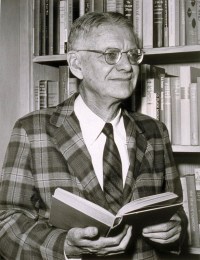
Conrad H. Pavellas, 1913 – 2000
I miss my father ever more as I age. He and I had conversations I could have with no one else due, in part, that he consciously educated me, not always successfully, to his ways and thoughts. We were different in important ways, yet much the same in intellectual interests and abilities. This journal (“blog”) is, in large part, an attempt to cover the historical and literary ground that my father urged me to travel but did only in small part during his lifetime. I was bound for the world of science and business and had little time for strictly intellectual pursuits that brought along no short-term material rewards.
So, in ending this essay I will now assure Dad, in absentia, and you, dear reader, that I have read Rilke, in translation to be sure. I hope you will find Rilke’s advice to the young poet as soulful and valuable as I do.
=



 The Pavellas Perspective