
I have been reading the Englishman John Stuart Mills’s essay On Liberty, first published in 1859. Here is a taste:

Johm Stuart Mill, 1806-1873
The struggle between Liberty and Authority is the most conspicuous feature in…history, particularly in that of Greece, Rome, and England. But in old times this contest was between subjects, or some classes of subjects, and the Government. By Liberty, was meant protection against the tyranny of the political rulers. The rulers were conceived…as in a necessarily antagonistic position to the people whom they ruled…The aim, therefore, of patriots was to set limits to the power which the ruler should be suffered to exercise over the community; and this limitation is what they meant by liberty.
A current definition of both freedom and liberty shows that freedom accrues to the individual while liberty, as Mill points out, accrues to the community or general population of a polity:
‘Freedom’ (is) an exemption from control by some other person, or from arbitrary restriction of specific defined rights like Worship, or Speech. ‘Liberty’ (is) the sum of the rights possessed in common by the people of a community/state/nation as they apply to its government, and/or the expectation that a nation’s people have of exemption from control by a foreign power. [Source]
Mill goes on to say: Some, whenever they see any good to be done, or evil to be remedied, would willingly instigate the government to undertake the business; while others prefer to bear almost any amount of social evil, rather than add one to the the departments of human interests amenable to government control.
This is exactly the observation I made to my late father in our sometimes heated political discussions. I drew a rough graph to illustrate my argument, then added a picture of a normal curve below it suggesting he mentally superimpose it on the graph:
 As with any ideal “normal” or “bell” curve, 68% of the things measured, in this case attitudes toward my asserted dichotomous “safety/freedom” spectrum, will fall within the first standard deviation. Within this zone around 1/3 of the people will slightly or somewhat prefer safety to freedom and another 1/3 of the people will slightly or somewhat prefer freedom to safety. These are the people who can still talk with each other, in a reasonable tone, about their differences in viewpoint on how much control the government should be allowed over our personal freedom to act and speak, in order to protect us from others.
Following along this line of argument, an additional 28% of the population will fall into the second standard deviation. The people whose attitudes in this realm tend toward one value or the other (safety vs freedom), will have stronger preferences and will make strong, usually emotionally-laden, defense of their respective positions. In this realm 14% of the population will argue heatedly (as dad did) for safety over freedom (although he didn’t see the dichotomy I see), and 14% will argue heatedly for freedom over safety, as I did.
 The remaining 4% of the population at the third standard deviation from the middle or mean, 2% at either end of the spectrum, are the outliers within whose ranks one may find the people who will resort to dangerous methods to assert their preference.
My basic point with dad was that these preferences, especially as one one deviates more from the middle of the normal curve, will not be reconciled among people who have opposing viewpoints. These values are too emotionally held to be altered by mere rational argument, on the one hand, or made more convincing by emotional appeal, on the other. It is ironic to me that dad often used to quote to me the following stanzas from William S. Gilbert‘s (of Gilbert & Sullivan) comic opera Iolanthe:
I often think it’s comical/How nature does contrive
That every boy and every gal/That’s born into the world alive
Is either a little Liberal/Or else a little Conservative
Taking an excursion into another realm to provide some blood for this wordy argument, I offer these:
Eleftheria i thanatos (Greek: “freedom or death”) is the motto of the Hellenic Republic. It arose during the Greek War of Independence in the 1820s, where it was a war cry for the Greeks who rebelled against Ottoman rule. It was adopted after the Greek War of Independence. It is still in use today, and is symbolically evoked by the use of nine stripes (for the nine syllables of the motto) in the Greek flag. The motto symbolized and still symbolizes the resolve of the people of Greece against Tyranny and oppression. [Source]
Among many other mysteries presented to the reader in The Magus, by John Fowles, is the problem of whether a man has the right even to enter into a contract that entails sacrificing some lives to spare others (even when the murder of three might save 80), which long and terrible scene ends with a Greek cry of “Eleftheria!” [Source]
The last words in today’s blog are from John Stuart Mill’s On Liberty:
…(T)he sole end for which mankind are (sic) warranted, individually or collectively, in interfering with the liberty of action of any other of their number, is self-protection. That the only purpose for which power can be rightfully exercised over any member of a civilized community, against his will, is to prevent harm to others. His own good, either physical or moral, is not a sufficient warrant. He cannot rightfully be compelled to do or forbear because it will be better for him to do so, because it will make him happier, because, in the opinion of others, to do so would be wise, or even right. These are good reasons for remonstrating with him, or reasoning with him, or persuading him, or entreating him, but not for compelling him, or visiting him with any evil in case he do otherwise. To justify that, the conduct from which it is desired to deter him must be calculated to produce evil to someone else. The only part of the conduct of any one, for which he is amenable to society, is that which concerns others. In the part which merely concerns himself, his independence is, of right, absolute. Over himself, over his own body and mind, the individual is sovereign.
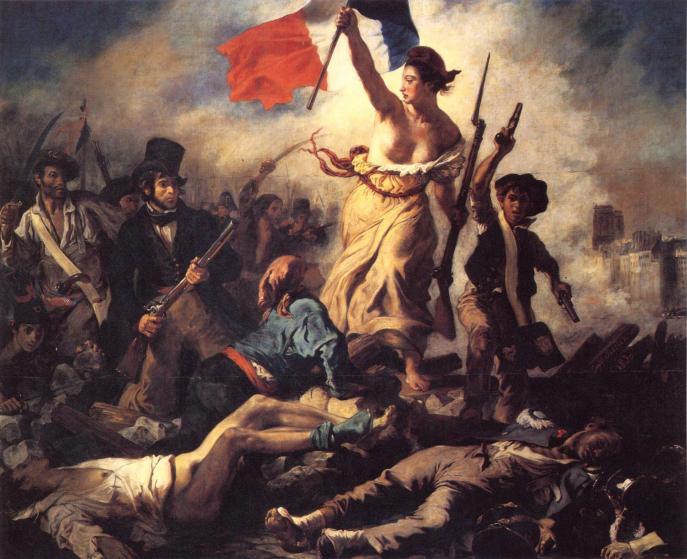
Liberty Leading the People – Eugène Delacroix


 The Pavellas Perspective