
The title of today’s entry is from an address made, April 29,1962, by President John F. Kennedy in welcoming a group of Nobel Prize winners to a dinner in their honor at The White House. The extended quote is: “I think this is the most extraordinary collection of talent, of human knowledge, that has ever been gathered together at the White House — with the possible exception of when Thomas Jefferson dined alone.”
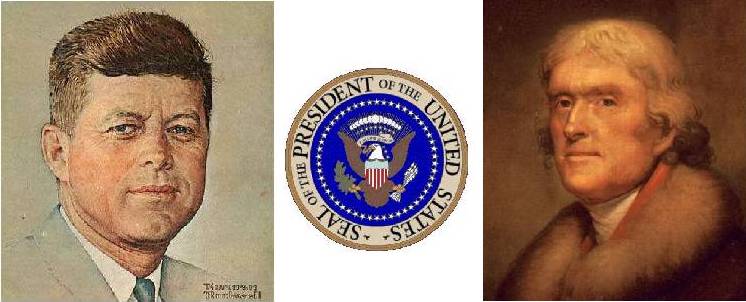
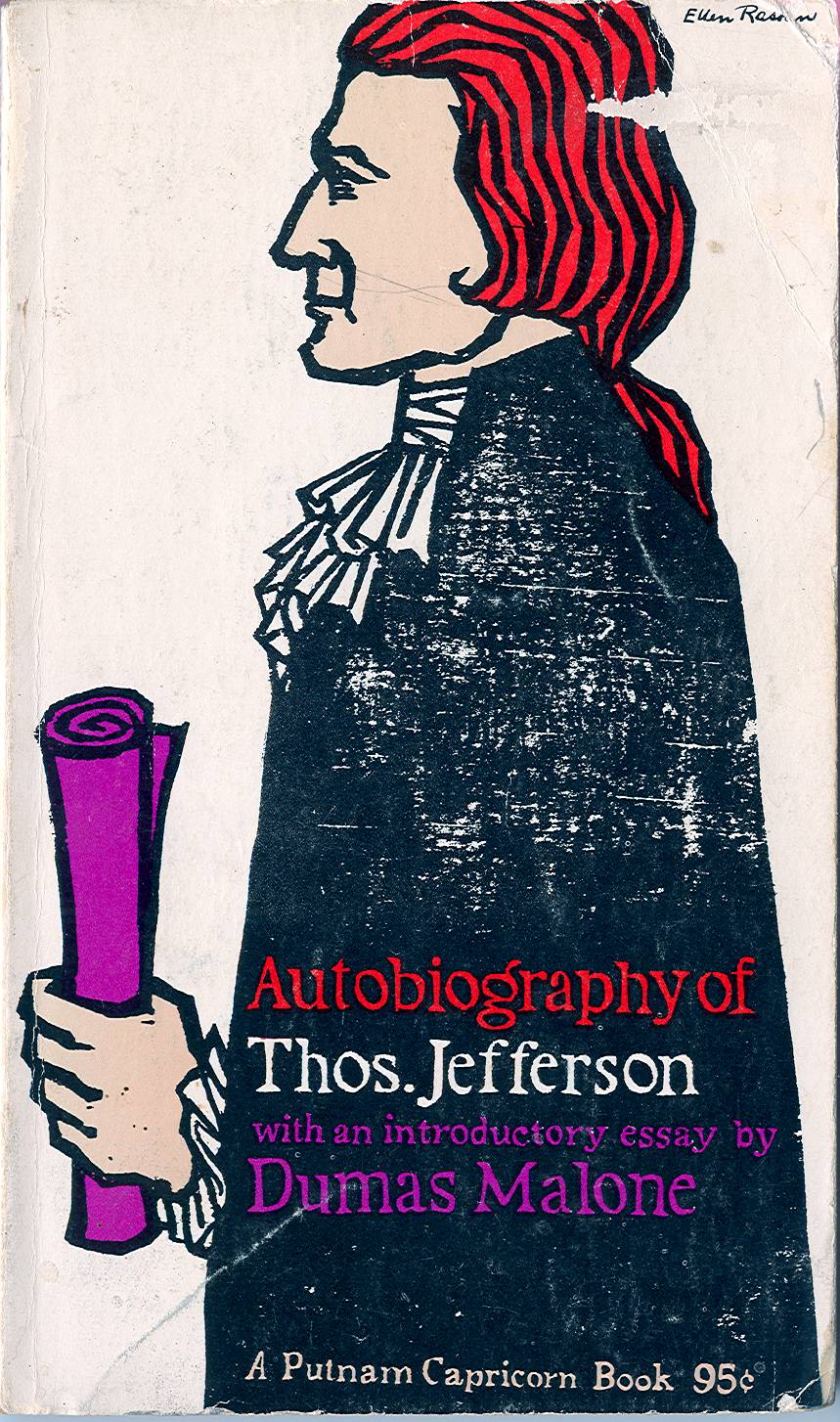
What ultimately brought me to this well-known quotation was my reading of a small and fascinating book, Autobiography of Thos. Jefferson. I bought this book, apparently second hand, many years ago and something told me I was prepared now to read it.
There has been so much written about this great statesman, political philosopher, diplomat, inventor, amateur scientist, farmer, slaveholder and opponent of slavery, I can do no more than to refer you to others, and to offer some quotations.
 One thing he did not say, and I now correct myself on having misquoted him, is: “That government is best which governs least.” It was Henry Thoreau, who paraphrased the motto of The United States Magazine and Democratic Review: “The best government is that which governs least.”
Despite hundreds of volumes written by others about him, Jefferson’s own recounting of his life takes but 100 pages in this small paperback. He starts it thus: “At the age of 77, I begin to make some memoranda, and state some recollections of dates and facts considering myself, for my own more ready reference, and for the information of my family.”
I found it interesting that Jefferson served both in the legislature of the Virginia Commonwealth and as Governor of the successor State of Virginia. While a delegate to the legislature, he was chosen by his fellows to be on a “committee of correspondence” which met with other such committees in the other colonies to discuss their common interests including grievances against the British King and parliament. Much of Jefferson’s work in this realm, before the Declaration of Independence (July 4, 1776), was as a lawyer in devising correct political positions with respect to the home country, even as he and others opposed many elements of Great Britain’s rule.
His biography dwelt for a while on his work in the development of Virginia’s constitution, adopted June 12, 1776, which served as a template for much of what was devised and written for the U.S. Constitution, ratified June 21, 1788. This caused me to go to the Internet to find more information on this, which I present below.
A Bill of Rights is what the people are entitled to against every government, and what no just government should refuse, or rest on inference.

Map: The Louisiana Purchase during Jefferson’s administration
- That all men are by nature equally free and independent, and have certain inherent rights, of which, when they enter into a state of society, they cannot, by any compact, deprive or divest their posterity; namely, the enjoyment of life and liberty, with the means of acquiring and possessing property, and pursuing and obtaining happiness and safety (Virginia Constitution, Bill of Rights, June 12, 1776).
- That all power is vested in, and consequently derived from, the people; that magistrates are their trustees and servants, and at all times amenable to them (Virginia Constitution, Bill of Rights, June 12, 1776).

Jefferson’s drawing of a macaroni machine and instructions for making pasta
- That government is, or ought to be, instituted for the common benefit, protection, and security, of the people, nation, or community; of all the various modes and forms of government that is best, which is capable of producing the greatest degree of happiness and safety, and is most effectually secured against the danger of maladministration; and that whenever any government shall be found inadequate or contrary to these purposes, a majority of the community hath an indubitable, unalienable, and indefeasible right, to reform, alter, or abolish it, in such manner as shall be judged most conducive to the publick weal (Virginia Constitution, Bill of Rights, June 12, 1776).
Question with boldness even the existence of a God; because, if there be one, he must more approve of the homage of reason, than that of blind-folded fear … I have recently been examining all the known superstitions of the world, and do not find in our particular superstition (Christianity) one redeeming feature. They are all alike founded on fables and mythology.
- That no free government, or the blessing of liberty, can be preserved to any people but by a firm adherence to justice, moderation, temperance, frugality, and virtue, and by frequent recurrence to fundamental principles (Virginia Constitution, Bill of Rights, June 12, 1776).
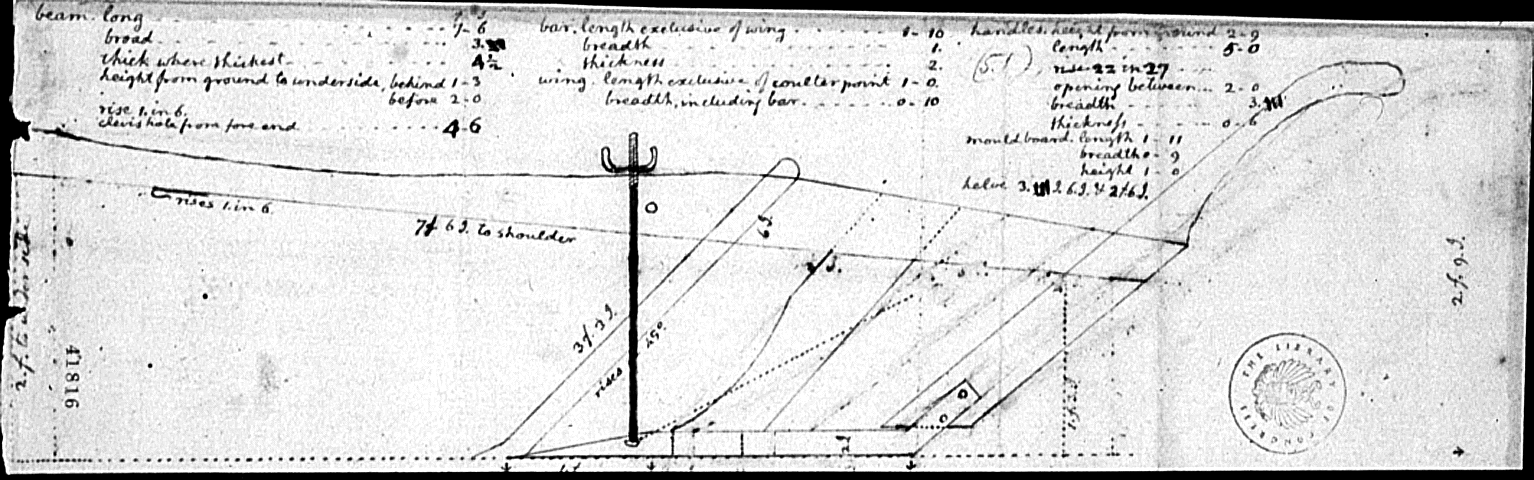
Jefferson’s design for a plow
- That religion, or the duty which we owe to our CREATOR, and the manner of discharging it, can be directed only by reason and conviction, not by force or violence; and therefore all men are equally entitled to the free exercise of religion, according to the dictates of conscience; and that it is the mutual duty of all to practice Christian forbearance, love, and charity, towards each other (Virginia Constitution, Bill of Rights, June 12, 1776).

The strongest reason for the people to retain the right to keep and bear arms is, as a last resort, to protect themselves against tyranny in government … The tree of liberty must be refreshed from time to time with the blood of patriots and tyrants.
In the final 17 years of his life, Jefferson’s major accomplishment was the founding (1819) of the University of Virginia at Charlottesville. He conceived it, planned it, designed it, and supervised both its construction and the hiring of faculty. The university was the last of three contributions by which Jefferson wished to be remembered; they constituted a trilogy of interrelated causes: freedom from Britain, freedom of conscience, and freedom maintained through education. On July 4, 1826, the 50th anniversary of the Declaration of Independence, Jefferson died at Monticello. (Source)
Educate and inform the whole mass of the people … They are the only sure reliance for the preservation of our liberty … Enlighten the people generally, and tyranny and oppressions of body and mind will vanish like evil spirits at the dawn of day.


![Places in Suffolk County mentioned in the book, along with the author's musings on their historical and literary connections to many parts of the world [Please click on the image]](https://pavellas.com/wp-content/uploads/2013/02/county-of-suffolk-travels.jpg)


![The Langoliers or Inevitable Entropy, by George Grie [Please click on the image]](https://pavellas.com/wp-content/uploads/2013/02/453d-langoliers-poster-1.jpg)
 The Pavellas Perspective