
Jean Sibelius of Finland
My father introduced me to the world of classical music. He said that listening to Beethoven (1770-1827), especially his ninth symphony, gave him the strength to bring him through the “Great Depression” of the 1930s and early 1940s.
He also introduced me to the music of Jean Sibelius (1865-1957) of Finland, whom he called “the Beethoven of the North.”

Ludwig van Beethoven and Jean Sibelius
In his early years, Sibelius was romantic and impressionable. In 1898, at age 33, he expressed the nationalistic feelings of Finns by composing Finlandia which has a special significance for the people of Finland. Finlandia was composed for presentations of historical photographs protesting against Russia’s domination of Finland. The music was for years suppressed in Finland and was allowed to be played only in other parts of the Russian empire, but under a different name. Abroad, Finlandia became widely popular as a piece of music; at home, it had primarily a political significance. To the Finns it now has the importance of a national anthem.
Sibelius wrote 7 symphonies, the last of which is considered by critics as his greatest. I am partial, however, to his 4th and 5th. His only violin concerto, also a favorite of mine, is a standard in the concert repertoire
Liinu Nurmi, a Finnish friend, says this about Sibelius’s violin concerto: “I think the mood of this piece has something to do with his living in Helsinki, the capital. He loved nature, however, and he was not comfortable composing in the city. So he built a house in the Åbo country-side which was his home for the rest of his long life.”
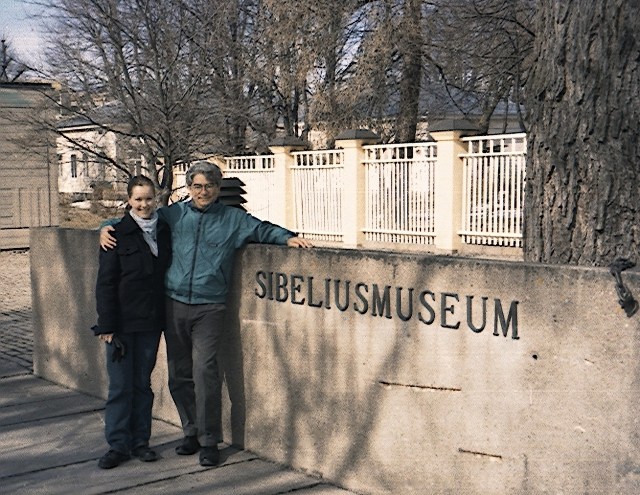
Liinu Nurmi with the author in Turku, Finland, in front of the Sibelius Museum, 1999
I met Liinu in 1994 when she was a Rotary exchange student, attending the local high school in Homer, Alaska. We kept in touch and, after my connecting with Eva in Sweden, Eva and I visited Liinu in the spring of 1999 when she was living and studying in Turku, a regular stop for the ferries from Stockholm. I was delighted, in addition to reuniting with Liinu, to find there happens to be a Sibelius Museum in Turku.
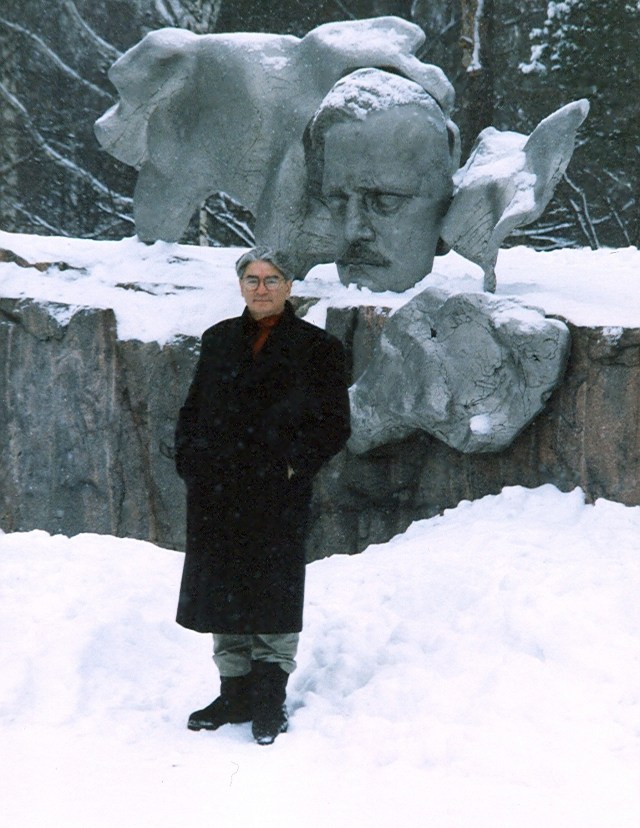
Although I didn’t move to Stockholm until July, 2002, I arranged with Eva to travel by ferry to Helsinki, at the turn of the millennium, with her and three of her children. Finland’s time zone is one hour earlier than Sweden’s so we celebrated the arrival of Year 2000 twice, as the captain maneuvered the ferry for us to legitimately do so. In Helsinki we visited the Sibelius Memorial Park, and I treasure this photo.
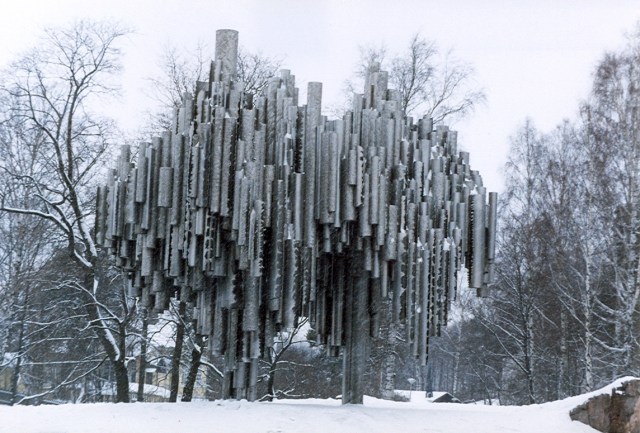
Another element of the park is this sculpture:
There are many other wonderfully soulful compositions by Sibelius who celebrated his country and The North by the writing of his music. Here are the names of some of these:
- The Karelia Suite, named after a province of Southern Finland.
- Valse Triste
- En Saga, based on an Icelandic saga
I believe you will find the music of Sibelius different and, even if it is somewhat melancholy as is typical of composers from Norden (The North), it will move you in very pleasant ways.
 The Pavellas Perspective