
I am ever more troubled by the hubris displayed by politicians, government officials, academicians (who, for the most part, conspicuously carry the label “intellectual“) and, more recently, barons of large financial institutions, both public and private. I assert this hubris has roots in scientism and secular humanism.
In ancient Greece, hubris referred to actions which, intentionally or not, shamed and humiliated the victim, and frequently the perpetrator as well. It was most evident in the public and private actions of the powerful and rich. The word was also used to describe actions of those who challenged the gods or their laws, especially in Greek tragedy, resulting in the protagonist’s downfall. (Emphasis added). Source
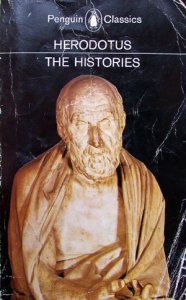
Daniel Mendelsohn identifies the Greek historian’s overarching theme in The Histories as ‘the seemingly inevitable movement from imperial hubris to catastrophic retribution’. (ashdenizen.blogspot.se)
In drama, we see an Oedipus, an Antigone, a Macbeth, a Lear, or a Cleopatra brought to doom by excessive pride—hubris—a belief that he or she is somehow above The Fates, or in control of destiny. (Source)
I first came across the word “scientism” sometime during the early 1960s in an article in the now defunct Saturday Review of Literature. The article revealed to me the source of my discomfort with many of the scientists-to-be with whom I then associated while attending the University of California. I later also read the excellent monograph Sin and Scientism, by Jacob Needleman. The glossary offered by the PBS website on “Faith and Reason”defines scientism thus:
Unlike the use of the scientific method as only one mode of reaching knowledge, scientism claims that science alone can render truth about the world and reality. Scientism’s single-minded adherence to only the empirical, or testable, makes it a strictly scientific worldview, in much the same way that a Protestant fundamentalism that rejects science can be seen as a strictly religious worldview. Scientism sees it necessary to do away with most, if not all, metaphysical, philosophical, and religious claims, as the truths they proclaim cannot be apprehended by the scientific method. In essence, scientism sees science as the absolute and only justifiable access to the truth. (Source)

Set from “Metropolis”, a 1927 film directed by Fritz Lang
Putting one’s faith in an entity labeled “science” (which is a method and a process, not a thing) seems inevitably to lead to secular humanism:
[S]ecular humanists do not rely upon gods or other supernatural forces to solve their problems or provide guidance for their conduct. They rely instead upon the application of reason, the lessons of history, and personal experience to form an ethical/moral foundation and to create meaning in life. Secular humanists look to the methodology of science as the most reliable source of information about what is factual or true about the universe we all share, acknowledging that new discoveries will always alter and expand our understanding of it and perhaps change our approach to ethical issues as well. In any case their cosmic outlook draws primarily from human experiences and scientific knowledge. [Source]

The Sophist Protagoras, c. 490 – 420 BC
The foregoing thoughts have been burbling in my brain for many years, and they crystallized into the words you see by my reading, only a few hours ago: “A God-Shaped Hole at the Heart of Our Being//An interview with evolutionary theologian John F. Haught,” by Amy Edelstein, at this website. What is missing from scientism and secular humanism, in my view, is a sense of the transcendent, the unknowable. Man is not “the measure of all things,” as the Sophist Protagoras asserted. This is as much as to say the universe was made in man’s image. From such a conceit comes Hubris and then destruction. We see it operating now, in full view.

 The Pavellas Perspective
Sir —
Please, if you would, offer a method of discovering truth aside from the application of scientific reasoning to the observable universe.
Yours, in curiosity,
V.
LikeLike
Dear V.,
Please define “truth” for me. It seems to me a rather abstract thing, not at all concrete and, of course, a human invention.
Best wishes,
Ron
LikeLike
I apologise for responding so late. I have attempted to come up with a definition of truth which is suitably concrete, concise, and relavent to the common conception.
– Truth is a measure of the consistency of a concept to the assumed state of the universe, i.e. the sum of all that exists.
This may be as simple as asking “does this thing exist”, and indeed this is the gist of most definitions you will find in dictionaries.
I hope this is concrete enough for you to work with.
V.
LikeLike
No apologies necessary. I’m grateful for your presenting further thoughts on the subject.
I get that you are treating ‘truth’ in the same manner that I have treated ‘reality.’
Best wishes…
LikeLike
No apologies necessary. I’m grateful for your presenting further thoughts on the subject.
I get that you are treating ‘truth’ in the same manner that I have treated ‘reality,’ in searching for a definition. I wrote about ‘reality’ here: http://wordsafew.com/2010/02/24/get-real-what-is-%E2%80%98reality%E2%80%99-really/
Best wishes…
LikeLike
Pingback: Sheffner's Reading Blog » Blog Archive » Weston’s disease
Pingback: Intellectuals? Bah, humbug!
Pingback: ”…and let us take upon’s the mystery of things…” « The Pavellas Perspective
I can see that we are going to have many diverse viewpoints involved in the discussion at WordExpress Weekly. I’m looking forward to it.
LikeLike