
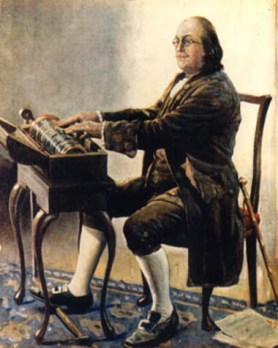
Benjamin Franklin playing the Glass Armonica
At the close of the Constitutional Convention of 1787 in Philadelphia, the Constitution of the United States having finally been adopted, Benjamin Franklin was asked, “Well, Doctor, what have we got a republic or a monarchy?” “A republic, if you can keep it,” he famously replied.
Have we kept it? Or is it something else now?
I offer here some bare facts and strong assertions. Let the discussion begin…
From republic, to empire, to… what?
According to George Friedman, the USA is now an empire, truly begun in the wake of World War Two. (Source).
Let’s look at the Roman Republic and how it evolved, and then imagine the possible implications in the continuing evolution of the USA.
First there was the Kingdom of Rome, beginning 2,770 years ago. It lasted 244 years, until the kingdom was overthrown by nobles representing the senate. The senate elected consuls for one-year terms to perform the executive functions of state. This arrangement lasted 482 years
The Roman Republic was the era of ancient Roman civilization beginning with the overthrow of the Roman Kingdom, traditionally dated to 509 BC, and ending in 27 BCE with the establishment of the Roman Empire. It was during this period that Rome’s control expanded from the city’s immediate surroundings to hegemony over the entire Mediterranean world. (Source)

The Murder of Julius Caesar
The republic ended upon the murder of Julius Caesar, and the subsequent ascension of Caesar’s nephew, Octavian, to assume the role of the first emperor.
The Roman Empire lasted 503 years, until the end of the reign of Romulus Augustulus 1,541 years ago, in 476 CE, displaced by the Byzantine Empire in centered in Constantinople (now Istanbul, Turkey).
To recap:
The Roman Kingdom lasted 244 years.
The Roman Republic lasted 482 years.
The Roman Empire lasted 503 years.
The Byzantine Empire, which replaced the Roman Empire, lasted 977 years, until it fell to the Ottoman Empire in 1453 CE.
The Ottoman Empire lasted for 465 years, until the end of World War One and the 1918 Armistice of Mudros.
How did Rome transform itself from a republic to an Empire?
- It exalted the executive function (from consul to emperor) over the senate function.
- It exalted the military function over the senate function and, occasionally, over the executive function.
What about the USA?
The USA was part of the British Empire, which began around 1500 CE.
- The USA was a republic for 169 years, from its founding in 1776, until the end of World War Two in 1945.
- The USA exerts military and economic and, therefore, political hegemony over much of the world, a trend starting with the Spanish-American War.
- The United State Senate has ceded more and more authority to the executive branch (president) than is provided for in the Constitution. (Source)
- The United States military is the largest and strongest in the world, and has been so since the Second World War. (Source)

How long will the USA last as an empire?
As shown above, the Roman Empire lasted around 500 years. During that time there were seventy-seven emperors. The length of their reigns varied (Source):
21 less than one year (usually assassinated or overthrown)
16 one to three years (often deposed or killed)
14 four to eight years (sometimes killed in battle or killed by elements of the Roman Army)
26 ten to forty years (sometimes died of natural causes)
This history shows us why Washington, D.C. announces so loudly and clearly that, upon the inauguration of each new president, there has been a peaceful transition of power. Such peacefulness is unusual in the history of such transitions in a mature government.
If such peaceful transitions remain the norm for changes in its government, then the USA can last a very long time, unless a stronger force from without successfully challenges it. So far, the primacy of the civilian executive over the military function has not been challenged by elements of the military or by either house of Congress.
Can the United States ever return to being a republic instead of an empire, given the world contains other large nations with nuclear weapons?
In that prior empires have lasted no more than around one thousand years, shall we have the same expectations for the USA?
React and discuss…
Reading list:
The Decline and Fall of the Roman Empire, by Edward Gibbon

 The Pavellas Perspective
…to a bunch of separate states.
LikeLike
LikeLike
I suspect the United States will eventually balkanize. But it is hard to predict the fault lines. Indiana has many aspects of the Upper South while Kentucky has many aspects of the Lower Midwest (something I speak of from personal experience, as Kentuckiana is where my mother’s family came from).
Similarly, Iowa easily could go many directions, but I suspect it would more likely fall in with what is typically considered Midwest, specifically the Upper Midwest as Iowa is mostly German and Scandinavian ancestry. When asked what is the Midwest, most people identify Iowa as the heart of the Heartland.
Balkanization could happen with smaller regions. Before the South, many New Englanders sought to secede from the Union. It’s good to keep in mind that many countries in Europe and elsewhere in the world are as small or smaller in size and population than many US states. But balkanization might more likely happen through broader divisions of large regions, such as along the old Civil War lines which were built on earlier cultural divisions going back to England (see The Cousins’ Wars by Kevin Phillips).
However it might happen, I don’t think it would necessarily be a bad thing. I’ve long thought that the United States is simply too large. A country this size can be an empire, but it never can be a democracy.
I might add that, as far as republics go, it simply means a government that isn’t a monarchy. And so you technically can have imperial republics. The Soviet Union and Maoist China were republics. Not being a monarchy is a low bar to reach. A democratic republic is a specific subset, but most American founders were largely unfamiliar with democracy and so they only knew how to speak of it through the language of republicanism. Some like Thomas Paine did talk about democracy directly, though.
In an America of alternative history, have you read Philip K. Dick’s The Man in the High Castle? Or have you watched the Amazon adaptation of it? It’s about a world where the Nazis and Japanese won, having split the United States with a neutral zone in between. It’s a fun exercise in imagination.
LikeLiked by 1 person
Others have hypothesized on balkanization, but I don’t see the FedGov allowing it. It could be a war between DC and the states/regions. Maybe Texas could lead the way by invoking whatever clauses in its treaty or contract with the USA may be relevant.
LikeLiked by 1 person
balkanization sounds like a word developed by socialist trying to devide the country. our existing problem is based on the lack of trust by our black population and needs to be delt with by our existing politicians. I believe that we are still a republic and change must be made by law.
LikeLike
You say “change must be made by law.” I don”t disagree with such a desire, but how can it be assured that it will be? With respect to “our black population”, you use a broad brush to make a sweeping generalization, including the assumption that “black” people are all alike in their perceptions and desires. In addition, some people you may consider to be “black” may not perceive themselves as having this adjective as their major identifier. I perceive a general lack of trust in various levels of government and in politicians by most people, regardless of their skin pigmentation. I perceive revolution as the least desirable way to change, so maybe we can agree on this point.
LikeLike
Also, we have a system where in many cases the powerful and privileged (politicians, police, plutocrats, etc) are above the law.
Look at who gets stopped and frisked by police. Look at which crimes get punished most harshly. Look at which criminals end up in prison and which go free. The legal system has become corrupted. Consider Trump pardoning criminals who might be witnesses of his own wrongdoing.
So, how do we make change by the law when the legal system is part of what needs to be changed? It’s similar to how do we create a democratic system through a political system when the country has become a banana republic?
If the American revolutionaries limited themselves to British law, they would have remained British citizens and there would now be no United States. Most of the American revolutionaries, now called American founders, didn’t want revolution either.
Thomas Paine and Benjamin Franklin, for example, sought democratic reform from within the system. But there was too much oppressive corruption , top-down control, and legal state violence. Democratic reform simply wasn’t possible. Yet no colonist saw revolution coming until it happened. It wasn’t desired or planned. It just happened.
LikeLiked by 1 person