I opened a book I hadn’t read in years, “The Tao of Physics” by Fritjof Capra.
After I read the initial pages I was moved to write this:
 I see the same words I read years ago
I understand more than I understood then
The years have been a good teacher
If I read this book ten years from now
Will I understand even more?
Or should I read another book?
Don’t seek an answer
Accept knowledge as it comes
The wise do not force
The third stanza is in the form of a haiku, but it is not a true haiku, something I regret, often, when writing in this form. The discipline of limiting a thought or impression to seventeen syllables is compelling to me, and I tend to forget that the essence of this form is to present ‘reality’ in an indirect, non-linear way. The above poem is too direct.
Here is what Capra writes. I have edited this passage only to eliminate words which I feel are not essential to the message:
Taoists use paradoxes in order to expose the inconsistencies arising from verbal communication and to show its limits. This has passed on to Chinese and Japanese Buddhists who have developed it further. It has reached its extreme in Zen Buddhism with the koans, riddles used by many Zen masters to transmit the teachings. In Japan, there is yet another mode of expressing philosophical views, extremely concise poetry used to point directly at the ‘suchness’ of reality. When a monk asked Fuketsu Ensho, ‘When speech and silence are both inadmissible, how can one pass without error?’ The monk replied:
I always remember Kiangsu in March—
The cry of partridge
The mass of fragrant flowersThis form of spiritual poetry has reached its perfection in the haiku, a classical Japanese verse of just seventeen syllables which is deeply influenced by Zen.
Leaves falling
lie on one another;
The rain beats the rain.When eastern mystics express their knowledge in words with the help of myths, symbols and poetic images, they are aware of the limitations imposed by language and linear thinking.
Here is a definition of the haiku form of poetry:
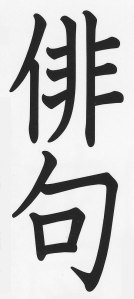
Haiku (俳句) is a very short form of Japanese poetry typically characterised by three qualities:
1. The juxtaposition of two images or ideas and a kireji (“cutting word”) between them, a kind of verbal punctuation mark which signals the moment of separation and colors the manner in which the juxtaposed elements are related.
2. Traditional haiku consist of 17 on (also known as morae), in three phrases of 5, 7 and 5.
3. A kigo (seasonal reference).There is a common, although relatively recent, perception that the images juxtaposed must be directly observed everyday objects or occurrences. (Source).
Upon completing my first reading of this book, I wrote this:
To be self-conscious,
The Universe created
Man, who now asks, ‘why?’
Again, this is not a true Haiku, but I review it here to observe, in public, my perceptions of some time ago.
I have many books, in English, about the history of haiku and its ancient masters, especially Basho, Buson, and Issa.
- Basho
 on a leafless bough
a crow is sitting—autumn
darkening now
- Buson
the evening breezes
the water splashes against
a blue heron’s shins
- Issa
“the peony was a big as this”
says the little girl
opening her arms
(Issa is noted for his humor and whimsy)
The nature of eastern spiritual or philosophical thought (or ‘way’ is probably better) is to avoid abstractions, focusing on ordinary everyday things. I wrote these some years ago:
hiking God’s garden
lavender, forget-me-nots
myriad green lives
moon’s full face follows
summer traveler through the hills
brown from sun’s long kiss
horseshit pile on path
reminder of plainspoken
one preceding me
These words speak more directly to me of reality than the millions of words uttered and written by the great philosophers. Yet, I still read them.
one’s contradictions
should be carried carefully
like a basket of eggs