
 Traversed by Ancient and Modern Empires
 Traversed by Ancient and Modern Empires
Here is about an area of the world that remains, for those of us oriented primarily toward North America and Europe, a historically complicated and geographically confusing mélange of ancient empires initially forged by warrior kings and their hordes on horseback, a parade of vast ‘-stans’ marching eastward that are little understood and imperfectly located, wide-ranging and centuries-long religious and cultural and commercial conflicts, and names that are difficult to be immediately grasped, much less to remember.
The stimulus for writing this overview comes from my reading of a fascinating book: The Black Sea: A History, by Charles King.
From The Black Sea.
…[W]riting the history of nations is…about silencing voices. It [draws] lines around people, excising connections among human communities and reading onto the messy past the lineaments of pure identities and immutable boundaries…This book asks the reader to listen to some of [the] still voices from the past. It is about how…the Black Sea has more often been a bridge than a barrier, linking religious communities, linguistic groups, empires and, later, nations and states into a region as real as any other in Europe or Eurasia. [p.12]
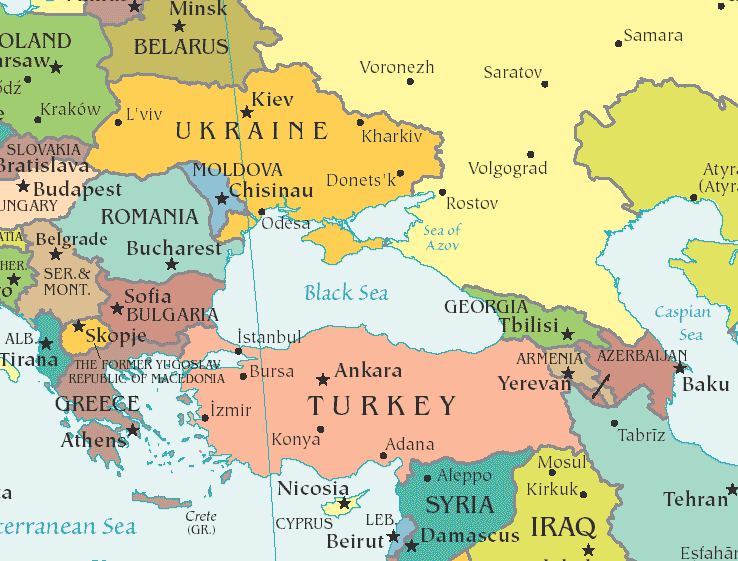
Area Surrounding The Black Sea (libcom.org)
From this beginning the book shows us the flow of history in the region of the Black Sea, sweeping from south to north and back, and similarly east to west, but mostly from the east. The Empires of the Middle East, up to and including the Ottoman Turks, pushed north to control the sea and its assets: seafood, ports, shipping lanes, peoples. Many people of the North and West, especially Imperial Russia, pushed back and sought to overtake lost areas. Over time, as western European countries exerted powerful diplomatic, commercial and military power, the lake became neutralized. Throughout all centuries there were recurring waves of conquerors, and continuing influxes of migrants, usually pastoral people fleeing the east.
But all this took millennia. The lands adjacent to the sea were populated and, in varying degrees, controlled by many empires. One can get an idea, and some direct perception, of the movement and, importantly, the admixture of peoples over time from this video:
To this day small and large ethnic and religious groupings of ancient peoples continue to exist throughout Europe and Asia in this region, even if their individual genetic heritages may have been infused with those of neighboring and invading tribes over the millennia. This is what makes the notion of country or nation so difficult in this area. Up until recently, for instance, to be “Greek” was not necessarily even to be ethnically or genetically Greek, but to belong to the Eastern Orthodox religion, no matter where one lived.

The geography and physical characteristics of the Sea and its tributaries are also important, of course. The image above shows the major rivers supplying the fresh water, the top layer of this great sea.
And, yes, you read it right that the top layer of the Black Sea is fresh, while the bottom (and dead) layer is colder salt water from the Mediterranean Sea, flowing through the Bosporus.
Another important feature of the sea is that is two or, perhaps, three seas in one.
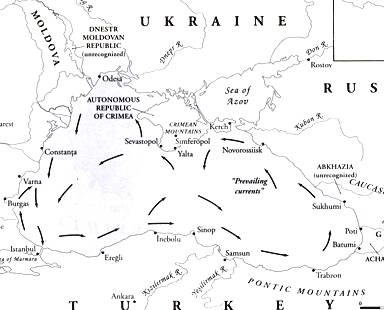
As you can see from the above, there are two counter-clockwise surface currents in the left and right portions of the lake which make navigation between them sometimes difficult. The Sea of Azov in the north is a smaller and distinct body, as well.
There are two types of sea currents in the Black Sea: the surface currents, caused by the cyclonic pattern of the winds, and the double currents in the Bosporus Strait and Kerch Strait, caused by the exchange of waters with adjacent seas. The surface currents form two closed circles. The width of the western circle, opposite the Danube Delta, reaches 100 km and decreases towards the south. The velocity of the current is about 0.5 km per hour. The width of the eastern circle varies between 50 and 100 km, and the velocity is 1 km per hour. Source
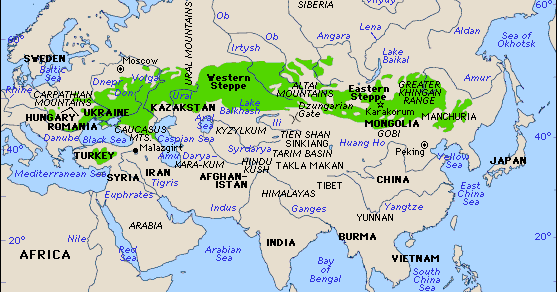
Eurasian Steppe (Prairie)
A salient aspect of the larger region within which the Black Sea is located, is a great prairie (above, in green) stretching from China through Southern Europe through which the “Golden Horde” and other eastern pastoral people gained access to the west . These prairies are called “steppes” and are celebrated in stories and music, presaging the “old west” legends of the prairie in North America.
The Black Sea: A History is rich in detail and overview. Here is a list of books, people and subjects for further study, including:
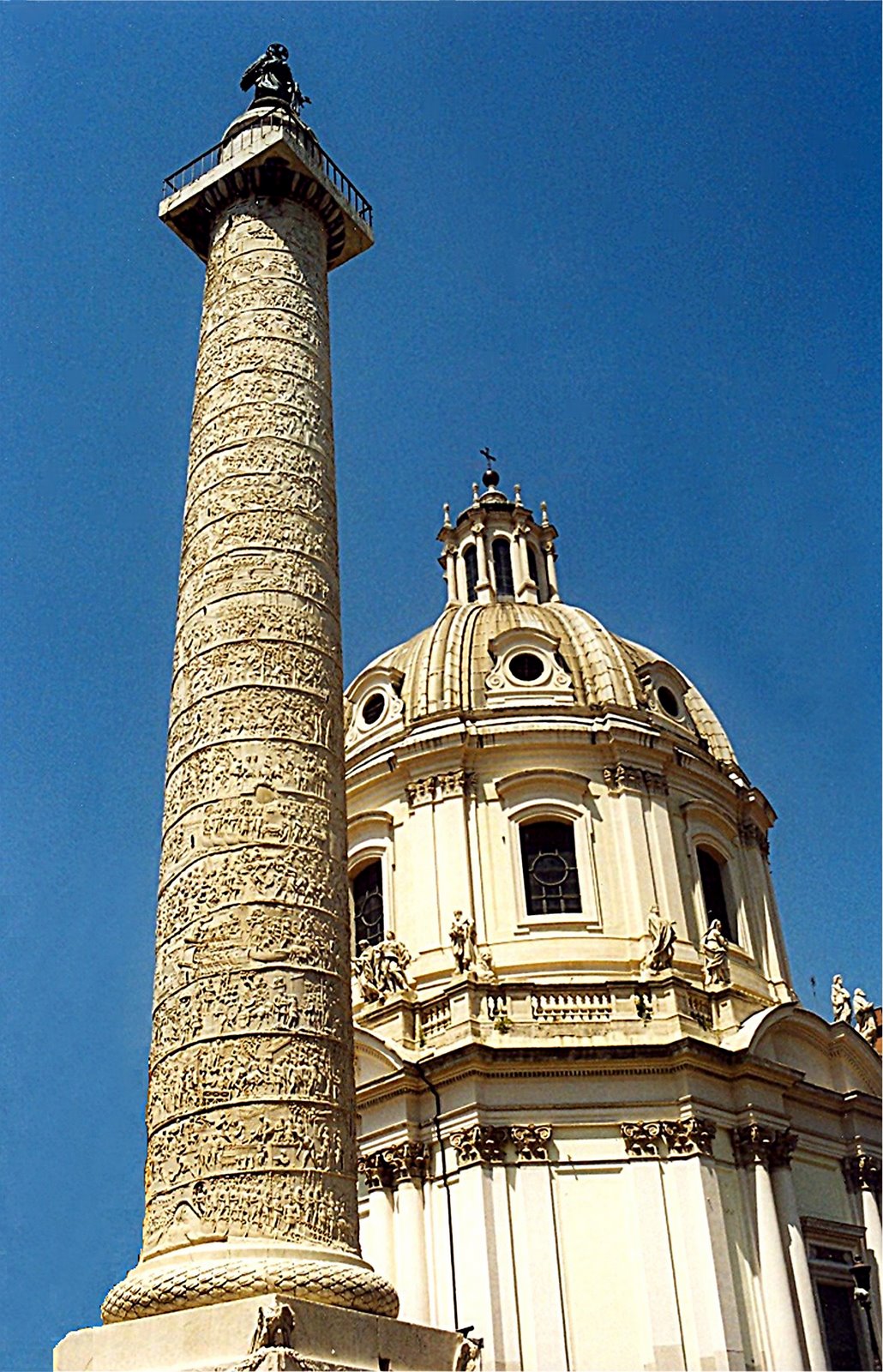
- Trajan’s Column (image to the right)
- Pompey the Great, Emperor of the Roman Republic
- City of Miletus in Anatolia
- Greek historian Herodotus
- Constantine VII
- The Travel of Anacharsis the Younger in Greece by Abbé Jean-Jacques Barthélemy
- Mithridates VI Eupator
- The Council of Nicea
- Fall of Constantinople
- Marco Polo
- Doge of Venice
- Volga-Don Canal
In addition, I have now gained an interest in looking also at the great salt water sea (or lake) to the east, The Caspian Sea, and a further look at the nature and history of the Steppes of Central Asia. What great dividends from the purchase of a single book! Many thanks, and my admiration of the author’s scholarship and writing skills, to Charles King.
 The Pavellas Perspective