
No, I don’t mean being well-dressed and -coiffed,
or never having violated any social code. What I mean is being true, as in:
This above all: to thine own self be true,
And it must follow, as the night the day,
Thou canst not then be false to any man.
Hamlet Act 1, scene 3, 78–82
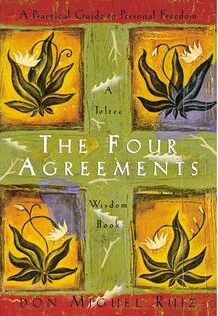 Why am I bringing this subject up here and now? A house guest, a young woman, left her book in our living room, forgetting to pack it for her trip back home to San Jose, California: The Four Agreements: A Practical Guide to Personal Freedom (A Toltec Wisdom Book) by don Miguel Ruiz. Despite it being a best-selling book in a realm I’m interested in, I hadn’t heard of it nor of don Miguel.
As I read through it, I was instantly familiar with the “Toltec” words and phrases. This is because I had read all the books of Carlos Castaneda, the first one being, The Teachings of Don Juan: A Yaqui Way of Knowledge. I had not known, or had since forgotten, that don Juan Matus, the Yaqui brujo who takes Carlos as his student, was inculcating him in ancient Toltec traditions. Now I am indelibly reminded.
One of the words and concepts I have retained from Castaneda’s books is that of “impeccability.” Paraphrasing don Juan Matus in Castaneda’s books (from memory), “a warrior must be impeccable; he must conduct himself with impeccability.” This word and concept is the first and “most important” of the “Four Agreements” which don Ruiz puts forth in his book. He states it thus: “Be Impeccable With Your Word.”
Impeccable comes from the Latin pecatus, and means “without sin.” A sin is anything you do which goes against yourself. Everything you feel or believe or say which goes against yourself is a sin. You go against yourself when you judge or blame yourself for anything. Being without sin is exactly the opposite. Being impeccable is not going against yourself. When you are impeccable, you take responsibility for your actions, but you do not judge or blame yourself…
Being impeccable with your word is not using the word against yourself… Being impeccable with your word is the correct use of your energy; it means to use your energy in the direction of truth and love for yourself…
Looking at everyday human interactions, imagine how many times we cast spells on each other with our word. Over time this interaction has become the worst form of black magic, and we call it gossip…
There is more, with plenty of advice on how to live correctly. Fundamentally, if one is true to oneself, one will not be false to others, just as in the advice cited above from Hamlet. The remaining three of the “Four Agreements” are: don’t take anything personally; don’t make assumptions; always do your best.

“The Wisdom of don Juan Matus”
Xreiazomai Community
Carlos Castaneda’s teacher, don Juan Matus, has much more to say about being impeccable, and carries it into extra-ordinary life, the life of a warrior and a sorcerer—but still within the same Toltec framework within which don Miguel Ruiz operates. Here are but a very few of the instructions and admonitions given by don Juan Matus to his student Carlos:
The basic difference between an ordinary man and a warrior is that a warrior takes everything as a challenge, while an ordinary man takes everything either as a blessing or as a curse. A warrior must be impeccable.
Impeccability is to do your best in whatever you’re engaged in. A warrior always makes sure that everything is in proper order, not because he believes that he is going to survive the ordeal he is about to undertake, but because that is part of his impeccable behavior.
Impeccability is nothing else but the proper use of energy.
Part of being impeccable for a warrior is never to hinder others with his thoughts. The hardest thing in the world is for a warrior to let others be. The lets them be and supports them in what they are; you trust them to be impeccable warriors themselves. If they are not then it’s your duty to be impeccable yourself and not say a word. Every effort to help on our part is an arbitrary act guided by our own self-interest alone.
The only freedom warriors have is to behave impeccably. A warrior is a prisoner of power; a prisoner who has one free choice: the choice to act either like an impeccable warrior, or to act like an ass. He cannot act in any other way but impeccably. To act like an ass would drain him and cause his demise.
The self-confidence of a warrior is not the self-confidence of the average man. The average man seeks certainty in the eyes of the onlooker and calls that self-confidence. The warrior seeks impeccability in his own eyes and calls that humbleness.
A warrior is never under siege. To be under siege implies that one has personal possessions that could be blockaded. A warrior has nothing in the world except his impeccability, and impeccability cannot be threatened.
A warrior cannot be helpless, or bewildered or frightened, not under any circumstances. For a warrior there is time only for his impeccability; everything else drains his power, impeccability replenishes it.
Don Juan’s lessons to Carlos include what it is to be a sorcerer, who must also be impeccable, but he or she will not be a “prisoner” of that impeccability. These lessons go far beyond what don Miguel presents in his small but valuable book on “The Four Agreements.”
It is pleasing to know that a friend of my granddaughter, she who left her book behind, is already studying in a realm which can lead her to be a warrior, or even a sorcerer. In Castaneda’s later books it is the women he meets who are the most powerful sorcerers.
“The Four Agreements” is a worthy primer for young people who may wish later to read more deeply into the Toltec tradition, as presented by Carlos Castaneda in his books.
—
A compilation of all don Juan Matus’s teachings to Carlos Castaneda can be viewed here, at the site of Rick Mace.


