
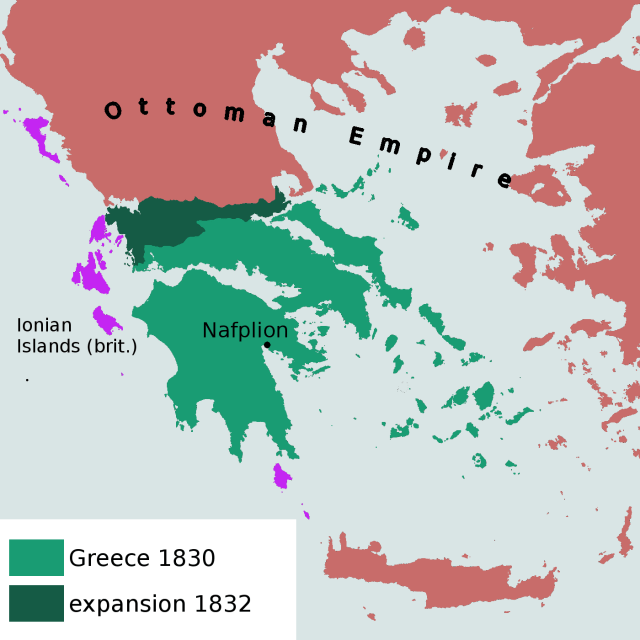
On February 3, 1830, the three Great Powers (The United Kingdom, The Kingdom of France and the Russian Empire) established Greece as an independent, sovereign state with the adoption of “The London Protocol.”
(Note: Unless otherwise indicated, all sources are from Wikipedia.)
Why was there not a “Hellenic Republic” or a “Kingdom of the Hellenes” before this late date? The short answer is that Greeks don’t like large governments. And, they tend not to be confined to any given locality or region:
The Greeks, also known as Hellenes, are an ‘archetypal diaspora people,’ since before the time of Homer and the Olympic Games, 3000 years ago. (Source)
The earliest Greeks settled the mainland now known as Greece, and then throughout the regions of the Mediterranean Sea and the Black Sea, Anatolia, Egypt, and beyond. They established towns and city-states. In many of the latter, they established centers of learning, worship, medicine, and law.
What unites the Greeks, then and now, are their language and their form of worship, originally of the Pantheon of Greek Gods, later the Greek branch of the Eastern Orthodox Church, and, overall, through their common history.
(As) the relationship between modern and ancient Greeks shows, ethnicities are constituted, not (necessarily) by lines of physical descent, but by the sense of continuity, shared memory and collective destiny, i.e. by lines of cultural affinity embodied in myths, memories, symbols and values retained by a given cultural unit of population. (Source)
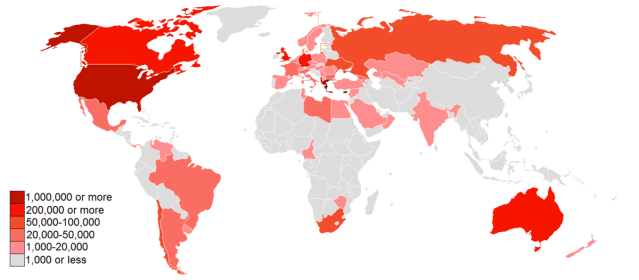
Map showing the countries with the largest (ethnic) Greek population around the world (Wikipedia)
Language
Hellenic, Greek-speaking migrants entered the Greek peninsula from the Caucasus sometime around 3500 BC. (Source)
So powerful was, and is, this language of the Hellenes, that it holds an important place in the history of the Western world and Christianity. The canon of ancient Greek literature includes the epic Homeric poems Iliad and Odyssey. It is also the language of many of the foundational texts in science, especially astronomy, mathematics and logic, and in Western philosophy, such as the Platonic dialogues and the works of Aristotle. The New Testament of the Bible was written in Koiné Greek.
During antiquity, Greek was a widely spoken lingua franca in the Mediterranean world, West Asia and many places beyond. It would eventually become the official parlance of the Byzantine Empire.
Mycenae, the first identifiable Greek settlement
Mycenaean Greeks first entered the historical (i.e., written) record c. 1600 BC. Among the centers of power that emerged, the most notable were those in the Peloponnese, Boeotia, Athens, and Thessaly. The most prominent site was Mycenae, in the Argolid of the Peloponnese, after which the culture of this era is named. Mycenaean settlements also appeared in Epirus, Macedonia, on islands in the Aegean Sea, on the coast of Asia Minor, the Levant, Cyprus, and Italy.
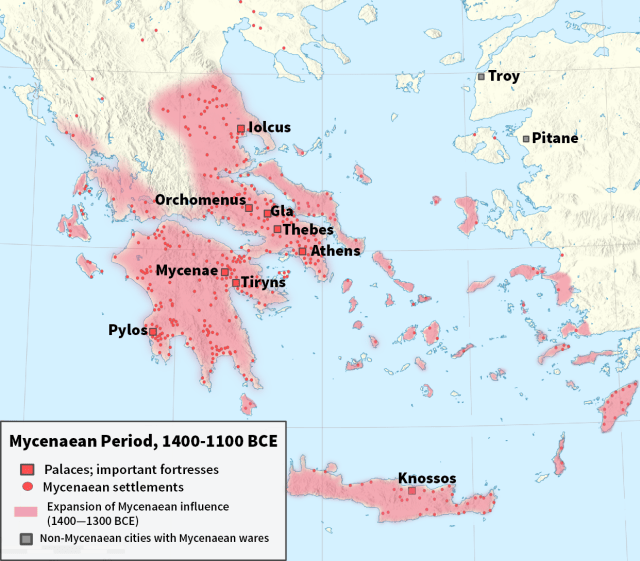
The Mycenaean civilization started to collapse from 1200 BC. Around 1100 BC, the palace centers and outlying settlements of the Mycenaeans’ highly organized culture began to be abandoned or destroyed, and by 1050 BC, the recognizable features of Mycenaean culture had disappeared.
According to Eric Cline, PhD, in his online presentation “1177 BC: The Year Civilization Collapsed,” the causes of this “collapse” were a series of cascading events, the effects of which compounded each other: droughts, famine, earthquakes, invaders, and rebellions.
The Homeric Age
After the Minoan (on the Island of Crete) and Mycenaean civilizations vanished Greece was home to illiterate tribal societies. Over time, the islands and coasts of Greece were visited by Phoenician merchants from Syria. Through their influence, the Greeks were reintroduced to literate civilization.
Life for the poorest Greeks remained relatively unchanged. There was still farming, weaving, metalworking and pottery but at a lower level of output and for local use in local styles. Some technical innovations were introduced around 1050 BC such as pottery technology that included a faster potter’s wheel for superior vase shapes, and the use of a compass to draw perfect circles and semicircles for decoration.
The smelting of iron was learned from Cyprus and the Levant and was exploited and improved upon by using local deposits of iron ore previously ignored by the Mycenaeans: edged weapons were now within reach of less elite warriors. From 1050, many small local iron industries appeared, and by 900, almost all weapons in grave goods were made of iron.
Movement from the Mainland
The distribution of the Ionic Greek dialect in historic times indicates early movement from the mainland of Greece to the Anatolian coast to such sites as Miletus, Ephesus, and Colophon, perhaps as early as 1000. In Cyprus, a colony of Euboean Greeks was established at Al Mina on the Syrian coast, and a reviving Aegean Greek network of exchange can be detected from 10th-century pottery found in Crete and at Samos, off the coast of Asia Minor. Cyprus was inhabited during this period by the first Greek settlements.
The beginnings of City-States
Greece during this period existed in independent regions organized by kinship groups and the oikoi or households, the origins of poleis.
Recovery
The economic recovery of Greece was well advanced by the beginning of the 8th century BC. Coastal regions of Greece were once again full participants in the commercial and cultural exchanges of the eastern and central Mediterranean, while communities developed which were governed by an elite group of aristocrats rather than by the single basileus or chieftain of earlier periods.
New Writing System
By the 8th century BC, a new alphabet system was adopted from the Phoenicians. The new alphabet quickly spread throughout the Mediterranean and was used to write not only the Greek language but also Phrygian and other languages in the eastern Mediterranean. As Greece sent out colonies west towards Sicily and Italy the influence of their new alphabet extended further.
So, “Greece” was recovering, soon to be a dominant force in the region and, via Alexander’s conquests, throughout the then known world. But now, “Greece” included Greeks not only on the mainland, but throughout the Mediterranean, Anatolia, and the Black Sea. Greece was still not a country or a nation but an identifiable cohesive people who lived, essentially, anywhere.
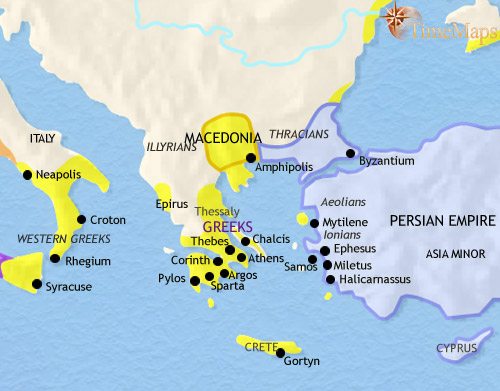
By 500 BCE, most Greek city-states had a republican form of government. Political life in these states was often unstable, and sometimes violent, but they allowed a degree of freedom unknown in other lands. This has given rise to dramatic intellectual achievements which Ancient Greek civilization one of the great civilizations of world history. (Emphasis added)
This unique orientation toward freedom arose from a view of the world that was different from all other peoples at the time.
What was most important for the Greeks was the contrast between Europe and Asia. Asia had the Persian and other empires where the emperor or head of state (and often also of religion) looked out from his palace in every direction, dividing up the various countries and people from and toward that central position.
The Greek world had no center. The perspective was determined from the point of view of someone well-traveled, who was not tied to any one location or ruler. The point of departure was the sea or, as Plato called it, the pond around which the Greek cities squatted like frogs—a universal element belonging to no one and everyone. (Source)
A few of these states became the first democracies in history; the largest of these being Athens, one of the most famous centers of culture in the ancient world. (Source)
The years after 500 BCE saw the Greek city-states, under the leadership of Athens and Sparta, put off an attempt by the mighty Persian Empire to conquer them. This struggle opened two centuries in which the civilization of ancient Greece reached its brilliant cultural peak, culminating in the philosophical achievements of Socrates, Plato, and Aristotle. These would lay much of the foundations for two thousand years of European thought. The cultural brilliance was accompanied by unceasing warfare, however, when led to the Greek city-states being eclipsed by new, larger powers.
To the north of Greece, the kingdom of Macedonia rose to prominence under Philip II (reigned 359-336 BCE) and even more so under his son, Alexander the Great (reigned 336-323 BCE), under whom it briefly controlled one of the largest empires the world has yet seen. Since then Macedonia has played its part as one of the leading kingdoms of the region, along with Egypt and Syria.
These kingdoms now overshadow the many small city-states of Greece. The classical age of ancient Greece is now over. However, Greek civilization continues to exert an enormous influence as the basis for the Hellenistic culture, which mingles Greek and local Asian/Egyptian elements and now stretches as far as India. (Source)
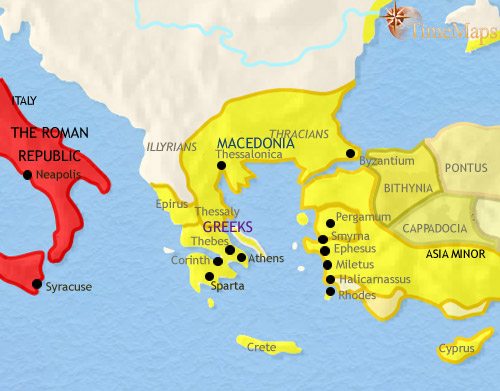
200 BC
The Greek city-states and the kingdom of Macedon were no match for the rising power of Rome, and by 146 BCE, after a series of wars, the Romans were in complete control of the region. The Roman occupation culminated in the destruction of the famous city of Corinth since resurrected as a Roman colony by Julius Caesar.
“Greece” and the Greeks would henceforth for 2000 years be slaves, vassals, or subjects under three consecutive Empires: Roman, Byzantine, and Ottoman. The city of Athens lost all its regional power but remained honored by the Romans as a center of culture and learning. Many wealthy Romans visited the city to complete their education. (Source)

750 AD
The Balkan Peninsula, including Greece, remained under Byzantine rule until the time of the emperor Heraclius (610-641). In the 7th century a new people, the Bulgars, arrived from central Asia and established themselves just north of the Carpathian Mountains, conquering the Slav tribes living there. They defeated a Byzantine army sent against them and were then recognized as a separate kingdom by the Byzantine emperor (681).
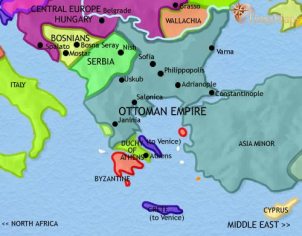
1453 AD
The northern Balkans were ravaged by the Mongols in the mid-13th century, with Hungary and Bulgaria being particularly hard hit. Then, in the 14th century, the Muslim power of the Ottoman Turks began spreading through the region. (Source)

1648 AD
After their capture of Constantinople in 1453, the Ottoman Turks progressively swallowed up all the Balkan lands and much of central Europe. The Christian population was allowed to practice its own religion in peace – except that, periodically, selected children are taken away to be converted to Islam and trained as Janissaries, the elite corps of the Ottoman army.

1960
The aftermath of World War 1 saw the map of the Balkans re-drawn. Most notably, Serbia, plus the South Slav territories of the former Austro-Hungarian empire, were united to form the kingdom of the Serbs, Croats and Slovenes, later called Yugoslavia. Because of the inability of the various national groups to work together, the king, Alexander I, established a dictatorship (1929).
The period of World War 2 saw all the countries of the region occupied by the Axis powers. Communist-led resistance movements sprang up, and, aided by the incoming Soviet forces, won control of most of the countries after the war. Bulgaria and Romania became members of the Warsaw Pact in 1955, whilst Albania and Yugoslavia, under its president Josip Tito, retained a much more independent stance. Greece is the only Balkan country not to have fallen under communist sway. Greece became a constitutional monarchy, and a member of NATO, but has since converted to a republic.
So, Greece had finally become a nation state, but its borders did not include a great many Greeks then living in Turkey, Cyprus, Crete, and elsewhere.
The stories of the Greeks in these countries deserve a much longer treatment than this medium will allow. I will merely say that after a century of horror and bloodshed, Crete was finally able to throw off the Turkish yoke and achieve union with Greece.
In Turkey, massacres and pogroms of Greeks, Armenians, and others, forced an exodus of the survivors to other countries, including Greece, although many Greeks remain in Turkey.
The island of Cyprus is populated by both Turks and Greeks, the great majority being Greek. There was a movement for “enosis” with Greece but the politics of the time prevailed to where Cyprus is now a country partitioned into Greek and Turkish sections, with a United Nations “buffer zone” between them.
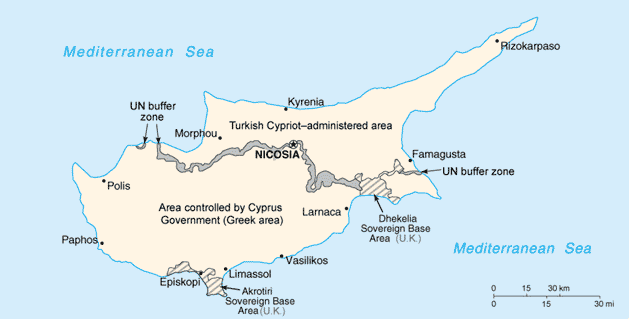
“A separation of the two main ethnic communities inhabiting the island (followed) the outbreak of communal strife in 1963. This separation was further solidified when a Greek military-junta-supported coup attempt prompted the Turkish intervention in July 1974 that gave the Turkish Cypriots de facto control in the north. Greek Cypriots control the only internationally recognized government on the island. On 15 November 1983, then Turkish Cypriot “President” Rauf DENKTAS declared independence and the formation of a “Turkish Republic of Northern Cyprus” (“TRNC”), which is recognized only by Turkey.” (Source)
Where is Greece? Is it solely the geographic area within the borders currently defining the Hellenic Republic?
Answers, please…
References:
A Concise History of Greece, by Robert Clegg
The Decline and Fall of the Ottoman Empire, by Alan Palmer
The Balkan Wars, by André Gerolymatos
A Culture of Freedom, by Christian Meier
Smaller maps and accompanying text (edited): TimeMaps.com
1177 BC: The Year Civilization Collapsed (Youtube Presentation by Eric Cline, PhD)
 The heading to this article won’t bear much scrutiny in its logical construction.
 The Pavellas Perspective