Putin’s return “a national catastrophe for Russia”

Those are the words Yevgeniya Albats wrote in her political journal, the Russian New Times Magazine, of which she is chief editor.

Yevgeniya Albats

My article today will recount the facts, opinions and assertions that Albats offered during a seminar at the Swedish Institute of International Affairs on 15 November 2011. After her presentation a three-person panel, described below, responded to her talk and to questions from the audience.

Vladimir Putin was in office as president of the Russian Federation 7 May 2000 – 7 May 2008. On 8 May 2000, the second day of his first four-year term, he issued a secret decree (ukase) which gave him control over the nation’s alcohol production, then the second largest industry in Russia. Thus began a series of moves which ultimately put into the hands of the president, the governmental apparatus reporting to him, and indirectly and privately through close associates and family, around 15% of the current gross domestic product (GDP) of the nation. The CIA’s 2010 estimate of Russia’s GDP is US$1.465 trillion, so if Albats’s assertion is close to correct, the annual revenues controlled, directly and indirectly, by Putin are around US$220 billion.

Albats presented a chart showing, among others, these additional industries under direct or indirect control: financial services, oil/petroleum, railroads and other transport, construction, metal production, energy, chemicals, media, telecoms, and sport. Most important is that all the industries serving the military are under state control. These are not all owned by the state. Others are  controlled through the state regulatory agencies and through ownership by Putin’s circle of associates, including family. (The three groups through which Putin exercises influence and control are discussed further below)

Vladimir Putin, Past president of Russia, Current Prime Minister, and… future President?

The Russian Duma, equivalent to the lower house in a bicameral legislature, has been made powerless to control the cash flow of state run enterprises. One result of this concentration of control and resultant power is that Putin and his inner circle have become extremely wealthy.

Putin’s presidency ended, per the Russian Constitution, after he completed his second term. His hand-picked successor, Dmitry Medvedev, appointed Putin as Prime Minster (formally, Chairman of the Government of the Russian Federation) which position he still occupies.

In September of this year, President Medvedev announced he had decided not to run for a second term, and put forth Mr. Putin as his choice for the next president in the election to be held on 4 March 2012. Mr. Putin announced his intention to stand for President on 24 September.

This announcement, which serves notice that Putin will, in fact, become the president via the next national election has dismayed many people inside and outside Russia, not the least of whom is the speaker at this conference, Yevgeniya Albats. She refuses to use the term “election” in her news magazine saying “the word ‘election’ implies ‘choice’, but there is effectively no choice in Russia today”.

In the British news magazine The Economist, writer E.L. states “… Mr Putin, a former KGB officer, remade Russian politics in his own image after coming to power. He harassed and jailed opponents and confiscated their energy and media assets; he created a political system in which important elections always go the authorities’ way. The upcoming ones will be no exception…” (Source: The return of the man who never left, Sep 24th 2011).

Neil Buckley of The (UK) Financial Times reported from Moscow “… Mr. Putin is coming back for a third presidential term, Russia’s intellectual and business elites, at least, are no longer sure this is a good thing. Debates at last week’s annual Valdai Discussion Club, a Putin initiative dating from 2004 that brings together top foreign and domestic specialists on Russia, revealed deep unease… (Excerpted from Rising unease over Putin’s return, 16 November 2011).

How does Putin gain and maintain control of the state apparatus and assets? Through three groups of people:

Siloviki (described below); members of a housing cooperative of which he is a founding member (Ozero); and, his extended family.

The Siloviki

Silovik is a Russian word for politicians from the security or military services, often the officers of the former KGB, the FSB, the Federal Narcotics Control Service and military or other security services who came into power. It can also refer to security-service personnel from any country or nationality. (Source).

“… The most commonly encountered description of the siloviki, a group of current and former Intelligence officers from Putin’s hometown of St. Petersburg who wield immense power within the Kremlin and control key sectors of the Russian economy, is both incomplete and misleading. The siloviki clan’s core members—Igor Sechin, deputy head of the presidential administration; Viktor Ivanov, an adviser to the president; and Nikolai Patrushev, director of the Federal Security Service (FSB)—more or less fit this profile. Surrounding these powerbrokers, however, is a network of individuals who do not. Associates of Sechin, Ivanov, and Patrushev hold top positions not only in the Kremlin and government ministries, but also in the second tier of the bureaucracy, state-owned enterprises, and private companies…” (excerpted from The Siloviki in Putin’s Russia: Who They Are and What They Want, by Ian Bremmer and Samuel Charap).

Putin's History in the KGB

Ozero

Ozero is a co-operative society allegedly instituted on November 10, 1996 by Vladimir Smirnov (head), Vladimir Putin, Vladimir Yakunin, Andrei Fursenko, Sergey Fursenko, Yury Kovalchuk, Viktor Myachin, and Nikolay Shamalov. The society united their dachas in Solovyovka, Priozersky District of Leningrad Oblast, which is located on the eastern shore of the Komsomolskoye lake on the Karelian Isthmus near Saint Petersburg. (Source)

I speculate that one or both of these compounds on the southeastern shore of Lake Komsomolskoye is “The Ozero”. Click on the picture for greater detail.

By now, its shareholders have assumed top positions in Russian government and business. As of 2008, Vladimir Putin is the Prime Minister of the Russian Federation, Vladimir Yakunin is the Head of Russian Railways, Andrei Fursenko is the Minister of Education and Science of the Russian Federation, Sergey Fursenko is a brother of Andrei Fursenko, the Director-General of Lentransgaz and the President of the Football Club Zenit (St. Petersburg), Yury Kovalchuk is the Head of the Board of Directors and a major shareholder of the Russia bank, Viktor Myachin is its former Director General (1995-1998, 1999-2004), Nikolay Shamalov and Vladimir Smirnov are prominent businessmen. (Source).

Putin’s Extended Family

Yevgeniya Albats did not dwell on this group, merely mentioning that “nephews” and others hold middle or higher level positions in the state government. The Internet does not quickly offer insight into Putin’s family, except for this from Wikipedia:

On 28 July 1983 Putin married Kaliningrad-born Lyudmila Shkrebneva, at that time an undergraduate student of the Spanish branch of the Philology Department of the Leningrad State University and a former Aeroflot flight attendant. They have two daughters, Mariya Putina (born 28 April 1985 in St. Petersburg) and Yekaterina Putina (born 31 August 1986 in Dresden). The daughters grew up in East Germany and attended the German School in Moscow until his appointment as Prime Minister. After that they studied international economics at the Finance Academy in Moscow. Vladimir’s cousin Igor Putin is a director of Master Bank.

Other methods of control are open to see. On 28 December 2004, the Los Angeles Times Wire Reports stated that “President Vladimir V. Putin set rules for naming Russia’s regional governors after pushing through a law that abolished their direct election. Putin signed the decree that gives the presidential chief of staff the task of drawing up and submitting lists of gubernatorial candidates to the president.” (Source: Putin Signs Decree on Naming of Governors).

Russian Federation

Click on the images to view them more clearly

regions russia1

All the people who surround or are connected with Putin depend on him, in varying degrees, for maintaining their positions and lifestyle. Thus they have an interest in him staying in power. As Albats put it, “ it’s hard to break his spell over them” because they will lose power if he leaves the stage. And, by the nature of how he has gained power, he has trapped himself into continuing to do what he has been doing. He and his apparent stooge, Medvedev, have talked about reform, but little has been done in this regard.

Meanwhile, according to Albats: 2000 former business leaders are in labor camps and jails; 80% of all the top dogs in government are ex-KGB employees; the 83 regions keep only 30% of the taxes they collect and must send 70% to the Kremlin. The President of the Russian Federation is the effective ruler of every subordinate political jurisdiction.

In addition, Putin’s bullying of, and alleged murders of, independent commentators and journalists is notorious:

“The murder of Russian journalist Anna Politkovskaya in October 2006 shocked the world. ‘Yet for every Anna, there have been many less widely known journalists killed for their work across Russia,’ says the International Federation of Journalists (IFJ) in a groundbreaking report on the 313 Russian journalists killed since 1993.” (Source)

Russian human rights activists place flowers at a portrait of slain Russian journalist Anna Politkovskaya in Moscow on October 7, 2009 during a rally on the third anniversary of her death at the hands of an unknown gunman. (Source: http://www.lecourrierderussie.com/2011/08/25/)

Boris Nemtsov, former deputy prime minister of Russia and current opposition leader, suggested in a 2011 interview that only those in Ozero really support Putin any more: “Everyone is unhappy with Putin, save perhaps his closest friends, members of the so-called Ozero dacha cooperative […] In only a few years these fellows turned from medium-sized entrepreneurs into dollar billionaires. For example, the Kovalchuk brothers have seized power over Gazprom; the KGB veteran Gennady Timchenko is now a trader who controls 40 percent of all crude oil exports; Putin’s former (martial arts) coaches, the Rotenberg brothers, continue to get lucrative contracts, and there are a few more people like this.” (Source).

In concluding her formal remarks, Yevgeniya Albats said these things (from my written notes):

Despite everything she has “hope”, but this is in her nature. People are getting sick and tired of seeing the same old faces in positions of power on TV and elsewhere. Rural people are offended by Putin’s “coming back”. Young people are angry at Putin’s announced return and are wondering whether to leave Russia. Only 36% of the people have access to the Internet, but as more come on line they will be able to connect with others who are dissatisfied with the regime.

The program ended with remarks from a panel of experts:

· Lena Jonson, Head of the Russia Research Program at the Swedish Institute of International Affairs

· Carolina Vendil Pallin, Head of the Russia Research Programme at the Swedish Defence Research Agency

· Torbjörn Becker, Director, Stockholm Institute of Transition Economics

· The moderator was Nathalie Besèr, Advisor to the Swedish Institute of International Affairs

Lena Jonson addressed the issue of Russian stagnation because its closed system is resistant to change. She asked Albats her opinion on the likely source of the possible collapse of the Putin regime. Albats responded by saying that there will likely be a confrontation over control of resources, especially form the trade unions, and, there are signs of cleavages inside the elite groups. There are no institutional avenues to accommodate necessary change, therefore action in the street such as currently in Tunisia and Egypt becomes more likely.

Carolina Vendil Pallin focused on the writings of the elite, especially through blogs. She sees that these elite feel “humiliated” by Putin’s actions and style of governance. She sees that growing Internet accdess wil play an important role in creating necessary change. (Personal Note: the Samizdat in the Soviet Union and European communist eastern states played a similar role).

Albats agreed and said that the PR of the Kremlin is out of synch with the rest of society. She said that Putin is aware of this but seems powerless to bridge the gap. He has tried shallow things such as trying to appear more youthful, through plastic surgery and public display of his athleticism, but these are not working. More than anything, there is loss of confidence in public institutions, especially the judiciary.

This could all lead to a collapse of the state, “which would be dangerous to other people, including you guys” (indicating the audience of, mostly, Swedes.

Torbjörn Becker pointed out that Russia looks “relatively OK economically” and still has general political support as a result. Albats agreed that economic times were (relatively) good in Russia right now, but Putin will not reform. She cited others who have heard Putin say that once you start reform, there is no way back, and he (Putin) used Mikhail Gorbachev (the last head of state of the Soviet Union) as an example as what he did not want to do. The growing middle class will put pressure on the current system to reform. The Russian economy has improved due mostly from the rise in the market price of crude oil. The grass roots issue is not economic, but one of representation.

Some final remarks by Yevgeniya Albats in response questions from the audience’s questions:

Putin sees the West as Russia’s enemy, especially the USA.

Putin wants to re-create the Imperial Empire, but it is not possible because of resistance in the “Stans” (Kazakhstan, Kyrgyzstan, Tajikistan, Turkmenistan, Uzbekistan).

Despite her native optimism, Yevgeniya Albats is afraid that Russia has lost its opportunity to change peacefully.

Posted in Russia | Tagged , , , , , , , , , , | 10 Comments

States of the United States vs. the Federal Government


From before the adoption of the US Constitution in 1787, there has been strenuous argument, sometimes bordering on the violent, between those who wanted a strong central government and those who saw the individual states as the primary locus of governmental power—except for those 18 specific powers granted to the two houses of the federal government, as enumerated in the Constitution.

(Former President) Jefferson… maintained that the national and state governments were ‘as independent, in fact, as different nations,’ and that the function of one was foreign and that of the other was domestic. President Madison still declared that Congress could not build a road or clear a watercourse; while Congress believed itself authorized to do both, and in that belief passed a law which Madison vetoed. (Source).

Why am I bringing this up 224 years after the adoption of our Constitution? Hasn’t the primacy of the Federal government in almost all matters been settled? Perhaps not. See these recent headlines, and the articles under the links:

Sitting Supreme Court Justices, 2011

After the successful Declaration of Independence from Great Britain by the Continental Congress in 1776, eleven years passed before the delegates from the 13 former colonies, now “states”, adopted the US Constitution. The USA was governed during these eleven years by a series of Continental Congresses, each with a presiding officer, or “President”, under the rules of governance as contained in The Articles of Confederation and Perpetual Union Between The States.

Many of the delegates from the new states were dissatisfied with the Articles. In May, 1787, a remarkable group of men began publishing a series of 85 pseudonymous monographs in the New York press, under the general heading of The Federalist. These are now famously known as The Federalist Papers. The authors, Alexander Hamilton, John Jay and James Madison, advanced their criticisms and recommendations for improvement in the Articles that were “adequate to the exigencies of government and the preservation of the Union”.

Fearing a return to British-style despotism, some other people, mostly from Virginia, started publishing responses to the Federalist articles, now known as the Anti-Federalist Papers. Led by Patrick Henry of Virginia, Anti-Federalists worried that the position of president in the proposed constitution would lead to a monarchy. Jefferson was sympathetic to the Anti-Federalists.

The Federalists won public support and the Constitution was passed, along with ten amendments, the 9th and 10th of which were advanced by those with Anti-Federalist sentiments.

Ninth Amendment: “The enumeration in the Constitution, of certain rights, shall not be construed to deny or disparage others retained by the people.”

Tenth Amendment: “The powers not delegated to theUnited Statesby the Constitution, nor prohibited by it to the States, are reserved to the States respectively, or to the people.”

Source: chogger.com

George Washington wanted a strong central government but he recognized there was danger in appearing as a monarch. During his eight years as the first president, famously saying his title should be “Mr. President”, he said and did as little as possible and deferred where and when possible to the houses of Congress. He did institute the system of departmental “secretaries” in a “Cabinet”, to which he delegated almost completely, including Alexander Hamilton as Secretary of the Treasury and Thomas Jefferson as Secretary of State.

As members of Washington’s cabinet Jefferson and Alexander Hamilton argued over national fiscal policy, especially the funding of the debts of the war. Jefferson later compared Hamilton and the Federalists with “Royalism”, and stated the “Hamiltonians were panting after…crowns, coronets and mitres.” Due to their opposition to Hamilton, Jefferson and James Madison founded and led the Democratic-Republican Party… Jefferson’s political actions, and his attempt to undermine Hamilton, nearly led George Washington to dismiss Jefferson from his cabinet. Though Jefferson left the cabinet voluntarily, Washington never forgave him, and never spoke to him again.” (Source)

Shortly before Washington’s Vice President and successor left his presidential office, John Adams appointed John Marshall, a Federalist, to be Chief Justice of the Supreme Court, intending that Marshall should provide a check against the “Jacobin” (i.e., revolutionary) and “democratic” (used as a term of opprobrium by Federalists) tendencies of the incoming President Jefferson. Marshall served 35 years and did indeed perform this function:

The Marshall Courtmade several important decisions relating to federalism, affecting the balance of power between the federal government and the states during the early years of the republic. In particular, he repeatedly confirmed the supremacy of federal law over state law, and supported an expansive reading of the enumerated powers. (Source).
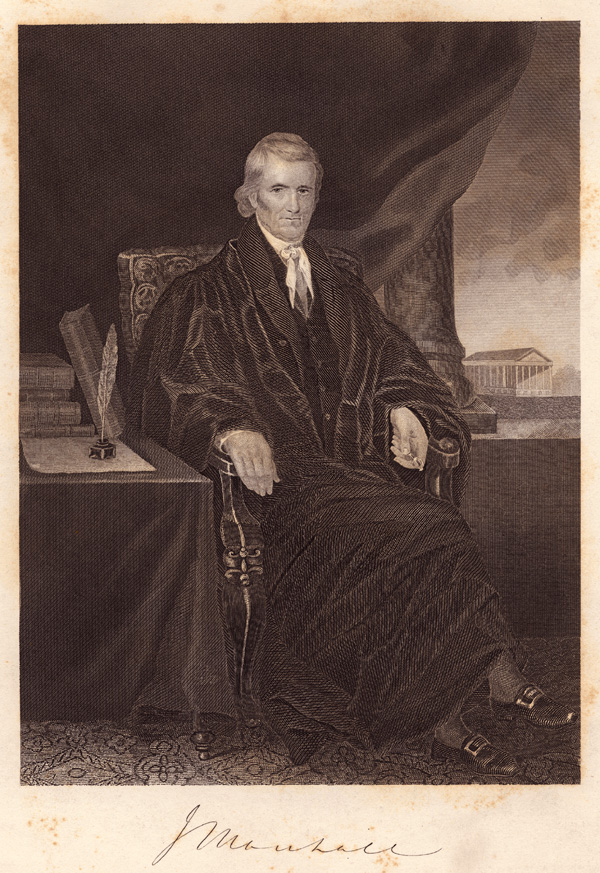
Chief Supreme Court Justice John Marshall, 1801-1835

There still is much argument within and without the courts whether states can effectively nullify any given federal statute. We may well see this decided, again, by the sitting Supreme Court within a few years as the state actions quoted above, and others, are played out in the courts.

How do these states presume to “nullify” existing, or even future, federal legislation? Where does this notion of “nullification” come from? From resolutions, written by Jefferson and Madison, and adopted by two states: the Virginia Resolution of 1798, and the Kentucky Resolution of 1799 wherein the states said they deemed the Alien and Sedition Acts unconstitutional and would not recognize them, or any other unconstitutional law, as binding on the states or their citizens. The issue was never brought to a head and the four Acts either were repealed or expired during Jefferson’s administration.

There have been several other important attempts by states (and the Cherokee Nation) to nullify federal laws, but these have either been made moot by changing circumstances or have been denied by the Supreme Court.

It should be noted that the primacy of the federal government was greatly strengthened through the prosecution and eventual result of the “war between the states”.

A broader view of the relationship between the center of government and the people, from comments by a friend and correspondent, Jay Michlin of San Mateo, California:

An even more interesting question is not just about states versus Washington, D.C., but also about the competing virtues of individual and local liberty versus all forms of centralized governance.

These include questions regarding when individuals should retain autonomy, with neither guidance nor coercion from any governing entity, whether city, state or federal. It includes matters about which cities or towns ought to retain jurisdiction, without interference from state governments. And it includes states rights versus the federal government too.

At one extreme, Jefferson had little trust in governments. He wanted whatever government may be necessary to be as close as possible to citizens, and as much as possible under their control. We denote this with the term “Jeffersonian democracy“. The loose association of states under the Articles of Confederation enacted this concept and was ultimately seen as a failure.

Hamilton saw no way to allow the country to succeed as a loose federation without a potent central government. Yet he too understood the risks of ceding too much power to any government, and he further understood that it would be an exceedingly hard sell to a population fresh from revolution against governance by an unaccountable entity at a great distance—London. He, Jay and Madison wrote The Federalist Papers as a series to sell the idea of a more powerful central government, and more important, to allay citizens’ fears that it would become a tyranny enslaving them.

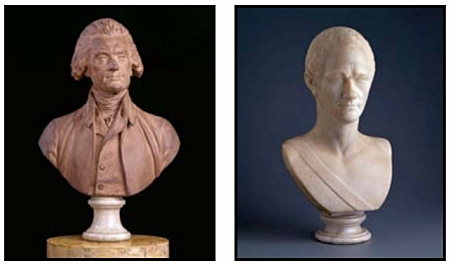
Busts of Jefferson and Hamilton, which Jefferson placed on opposite sides of the entrance hall at Monticello. This arrangement, he told visitors, showed them “opposed in death as in life”. (mahg/ashland/edu)

The Bill of Rights was a political compromise along this order. Hamiltonians rightly said that no such bill was needed since the body of the Constitution rigorously enumerated the powers of the central government. But Jeffersonians didn’t trust a central government and insisted that rights be explicitly spelled out, even if redundant.

As we now know from the vantage point of more than 200 years, the Hamiltonians were right in theory, but the Jeffersonians were right in practice. And this underscores the remarkable gift the Founders gave us in the Constitution. It began with rigorous theory based on studies of governments from ancient times, to-date, then overlaid and strengthened these with brilliant insights into human nature, as the millennia have also taught us.

The Founders understood that the allocation of central authority versus local autonomy would forever be a tense and contentious matter, with each side vying for power. They knew they could not enshrine a division for time immemorial, and they perceived that the resolution would inevitably be political. So they gave us a framework by which each generation could make prudent decisions, with checks and balances to constrain either extreme from wresting definitive control.

Other societies have regularly suffered the same tensions, and usually resolved them by wars of one sort or another. The genius of our Founders is to have bequeathed us a system where we fight the battles politically and rhetorically and, therefore, peacefully.
Ending Summary and Comment

The question remains: how much power must and should the central government retain and exercise to fulfill the ideals of the Declaration of Independence and the purposes of U.S. Constitution; and, how much power should be retained by the states to assure the liberties of people residing within each of them—all 50?

The Federalists (later, Republicans) didn’t trust the people and even used the word “democracy” and its derivatives disparagingly. The Anti-Federalists (later, the Democratic-Republicans and, still later, the Democrats) didn’t trust a strong central government, feeling it would lead to the despotism they fought against in order to be free of Great Britain and its hierarchies of power: king, church, aristocracy.

Current day Democrats have been successful in directing more power to the federal government in the name of “fairness” and other abstractions aimed at leveling social and economic disparities among classes of people.

Most elements of the current Republican Party, especially the Libertarian wing, see great danger in the power that has accrued to Washington, D.C. in the past Century.

The historical ironies presented here are worth contemplating. As Mr. Michlin points out, the amazing flexibility of our system allows for such shifts of political perspectives.

For example, without a strong central government would we have had the necessary attention paid to the inequities of “Jim Crow” in most of the southern states?

On the other hand, how far must and should the central government protect us from ourselves in matters of diet and behavior, for instance, without infantilizing the citizenry?

How do you see it?
 

Posted in Government & Politics | Tagged , , , , , , , , , , | Leave a comment