This is the law propounded by “Leo,” the “servant” to “H.H.” in the short novel, The Journey to the East, by Hermann Hesse. (It should be noted that “Leo” is loved by animals, as well as by his fellow humans). This is one of the books I occasionally re-read to my continuing edification and pleasure. Almost all of Hesse’s works fall into this category.
Here is the passage in full regarding this “law:”
 I (‘H.H.’) asked the servant Leo why it was that artists sometimes appeared half-alive, while their creations seemed so irrefutably alive. Leo looked at me, surprised at my question. Then he released the poodle he was holding in his arms and said: “It is just the same with mothers. When they have borne their children and given them their milk and beauty and strength, they themselves become insignificant and no one asks about them any more.”
‘But that is sad,’ I said, without really thinking very much about it.
‘I do not think it is more sad than all other things,’ said Leo. ‘Perhaps it is sad and yet also beautiful. The law ordains it should be so.’
‘The law?’ I asked curiously. ‘Which law is that, Leo?’
‘It is the law of service. He who wishes to live long must serve, but he who wishes to rule does not live long.’
‘Then why do so many strive to rule?’
‘Because they do not understand. There are few who are born to be masters; they remain happy and healthy. But all the others who have only become masters through endeavour, end in nothing.’

Timothy Leary, 1920-1996
The “Journey” this story nominally chronicles is a mystical one, through time and earthly space, populated with historical figures and events. This edition’s “Introductory Chapter” by Timothy Leary of LSD fame (Turn on, Tune in, Drop Out), although quite useful as a review and commentary on much of Hesse’s work, is somewhat spoiled by a clumsy attempt to imply Hesse might have used psychedelic drugs to achieve certain states depicted in some of Hesse’s writings. It seems clear to me Leary used this Introduction as a vehicle for his endless proselytizing for the asserted “spiritual” benefits of ingesting the drug.
 I am, reminded, however, of the statement attributed to “Don Juan Matus” in Journey to Ixtlan by Carlos Castaneda, that hallucinogenic drugs were used primarily in the early stages of training because Carlos was, “really dumb,” and needed to be shocked out of his normal reality in order to accept that there may be more to the world than meets the eye. Once the reality of magic became accepted in Carlos, drug use stopped. The lion’s share of a sorcerer’s development, it was explained, could only be achieved with the clearest and most sober frames of mind. (Source). I am inclined to believe that if, indeed, Hesse achieved the transcendental states he so vividly describes, he did it through the exercise of eastern or other disciplines he is known to have studied. (A compilation of all don Juan Matus’s teachings to Carlos Castaneda can be viewed here, at the site of Rick Mace.)
Here is more to consider from The Journey to the East:
The whole of world history portrays humanity’s most powerful and senseless desire—the desire to forget. Does not each generation, by means of suppression, concealment and ridicule, efface what the previous generation considered most important? Have we not just had the experience that a long, horrible, monstrous war* has been forgotten, distorted and dismissed by every nation? And nor that they have had a short respite, are not the same nations trying to recall by means of exciting war novels what they themselves caused and endured a few years ago? [*The Great War, later call World War I, or the war to end all wars].
After the first world war, Hesse moved from his home in Germany to Switzerland and remained there, becoming a citizen. He was terribly affected by the war, as was another writer of the time, Thomas Mann, evident in the latter’s novel The Magic Mountain.
“H.H.” meets a writer who is writing about the Great War, just concluded. Here is what the writer tells him:
I finally wrote my war-book and…it is now read and discussed a great deal. But do you know, I do not think that ten books like it, each one ten times better and more vivid than mine, could convey any real picture of the war to the most serious reader, if he had not himself experienced the war.
Here is more that touches on how “history” is interpreted and presented:
I imagine that every historian…when he he begins to record the events of some period…wishes to portray them sincerely. Where is the center of events, the common standpoint around which they revolve and which gives them cohesion? In order for something like cohesion, something like causality, that some kind of meaning might be revealed and that it can in some way be told, the historian must invent units, a hero, a nation, an idea, and he must allow to happen to this invented unit what has in reality happened to the nameless.
 The above notwithstanding, Hesse quotes himself, through his character “H.H.” from his (Hesse’s) novel Siddhartha, thus: “Words do not express thoughts very well; everything becomes immediately a little different, a little distorted, a little foolish. And yet it also pleases me and seems right that what is of value and wisdom to one man seems nonsense to another.” (The character “Siddhartha,” in the book of the same name, was a holy man who achieved enlightenment).
The book ends quietly, playing a recurrent theme: “…the creations of poetry (are) more vivid and real than the poets themselves.”
I wonder if the artists and others that serve us best are those that live longest? If so, does Hesse imply corporeal life as the measure? Or is the proper measure how long the “servants” live within the nervous systems of those that follow, no matter how many decades, centuries and millennia may ensue from the end of their physical lives? Many musicians (e.g., Chopin, Schubert, Mozart) lived less than 40 years, but who is to say they are not still living within us?
59.339619
17.988321


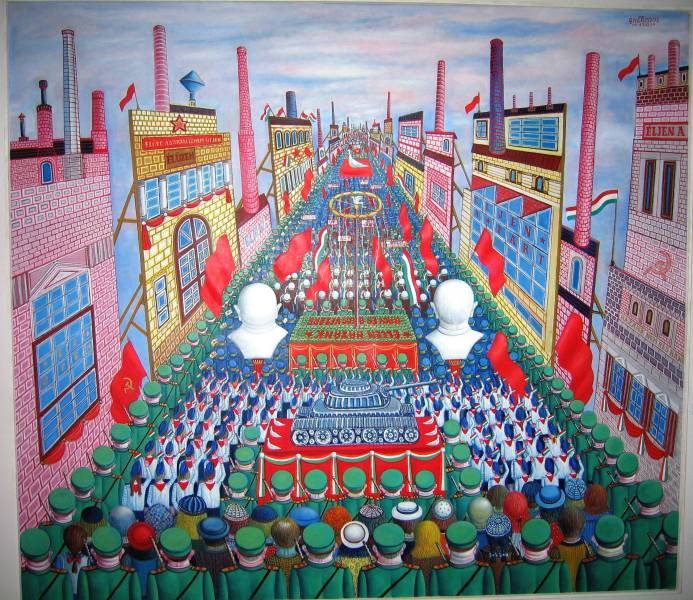 Upon leaving the exhibit to re-enter the lobby where the book and gift store is located, I saw a large wall exhibit showing the chronologies of Samizdat in the five countries mentioned in the quoted passage, above: the former USSR, Czechoslovakia, Poland, Hungary and the German Democratic Republic (East Germany).


