A Child’s “Pure Unclouded Brow”

The quote in the title is from the poem that is the preface to Lewis Carroll’s Through the Looking Glass, and What Alice found There, the sequel to Alice’s Adventures in Wonderland.

I was around 11 years old when my father read the first several lines of the poem to me, but I laughed at the phrase “Child of the pure unclouded brow,” thinking it a joke of some type, along the lines of the humorous poems I read in the first book, such as “You Are Old Father William,” which I mostly understood and thoroughly enjoyed. I finally understood the phrase and my father’s reason for reading it to me upon later observing the wonderments of the world through my own children’s eyes.

What brought the poem to mind was my reading of the preface to Nine-Headed Dragon River, Zen Journals 1969-1982, by Peter Matthiessen. I had read the book around 15 years ago but lost it in transit to Stockholm when I moved here from San Jose, California. I kept the lost book in the back of my mind and found the opportunity to replace it by coming upon another copy while browsing the shelves of BookBuyers during a recent visit to the San Jose area.

I offer, for this week’s column and without further comment, an excerpt from the preface to Matthiessen’s book in juxtaposition with Lewis Carroll’s full poem.

Zen has been called “the religion before religion,” which is to say that anyone can practice, including those committed to another faith. And the phrase evokes that natural religion of our early childhood, when heaven and a splendorous earth were one. But soon the child’s clear eye is clouded over by ideas and opinions, preconceptions and abstractions. Simple free being becomes encrusted with the burdensome armor of the ego. Not until years later does an instinct come that a vital sense of mystery has been withdrawn. The sun glints through the pines, and the heart is pierced in a moment of beauty and strange pain, like a memory of paradise.After that day, at the bottom of each breath, there is a hollow place that is filled with longing. We become seekers without knowing that we seek, and at first, we long for something “greater” than ourselves, something apart and far away. It is not childhood, for childhood is not a truly enlightened state. Yet to seek one’s own true nature is, as one Zen master has said, “a way to lead you to your long-lost home.” Child of the pure unclouded brow
And dreaming eyes of wonder!
Though time be fleet, and I and thou
Are half a life asunder,
Thy loving smile will surely hail
The love-gift of a fairy-tale. I have not seen thy sunny face,
Nor heard thy silver laughter;
No thought of me shall find a place
In thy young life’s hereafter –
Enough that now thou wilt not fail
To listen to my fairy-tale. A tale begun in other days,
When summer suns were glowing –
A simple chime, that served to time
The rhythm of our rowing –
Whose echoes live in memory yet,
Though envious years would say ‘forget’. Come, hearken then, ere voice of dread,
With bitter tidings laden,
Shall summon to unwelcome bed
A melancholy maiden!
We are but older children, dear,
Who fret to find our bedtime near.’ Without, the frost, the blinding snow,
The storm-wind’s moody madness-
Within, the firelight’s ruddy glow,
And childhood’s nest of gladness.
The magic words shall hold thee fast:
Thou shalt not heed the raving blast.
And though the shadow of a sigh
May tremble through the story,
For ‘happy summer days’ gone by,
And vanish’d summer glory –
It shall not touch with breath of bale
The pleasance of our fairy-tale.
Posted in Books & Literature, Church & Religion, Philosophy & Psychology | Tagged , , , , , , | Leave a comment

Get Real: What is ‘Reality,’ Really?

This is a question often discussed among people, especially during their formative years and during some parts of their formal education—or over a libation at one’s favorite watering hole.

Great thinkers have propounded their ideas on this subject, some of whom I quote immediately below, after which I will proffer my formulaic creation and solicit your ideas and arguments.

“One of the most basic realities is the definition of reality. All of the rest of philosophy depends upon it. Therefore, philosophy hasn’t gotten to the starting point until reality is defined properly. Of course, it never is.”— Gary Novak

“Reality: • noun (pl. realities) 1 the state of things as they actually exist, as opposed to an idealistic or notional idea of them. 2 a thing that is actually experienced or seen. 3 the quality of being lifelike. 4 the state or quality of having existence or substance.”—Compact Oxford English Dictionary of Current English, Oxford University Press, 2005.

“Reality is merely an illusion, albeit a very persistent one.”—Albert Einstein

“Not only is the universe stranger than we imagine, it is stranger than we can imagine.”—Arthur Eddington
I report; you decide

I report; you decide

“Reality is not protected or defended by laws, proclamations, ukases, cannons and armadas. Reality is that which is sprouting all the time out of death and disintegration.”—Henry Miller

“I’m not crazy about reality, but it’s still the only place to get a decent meal.”—Groucho Marx

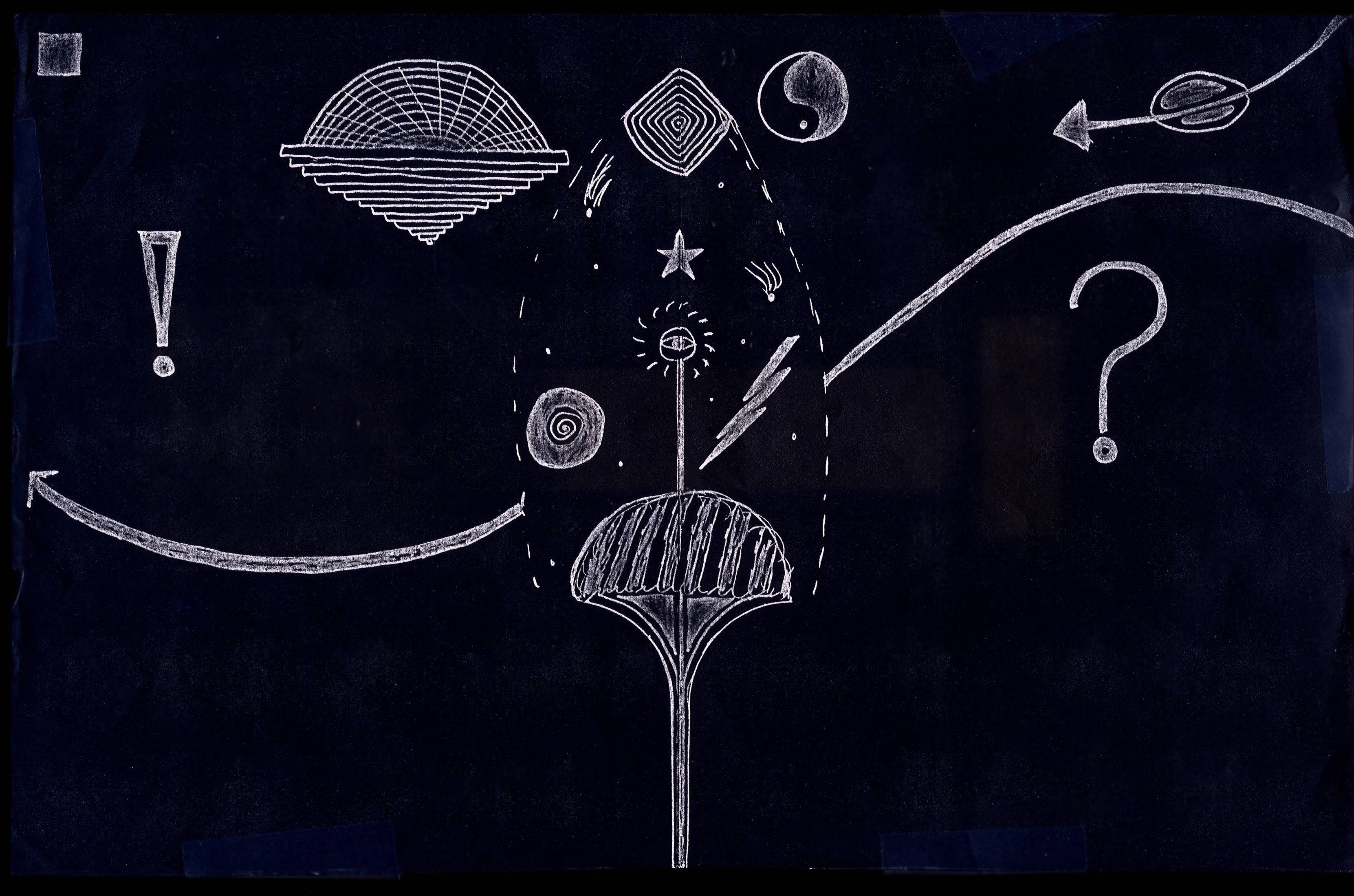
Now I expose the formula I have created for myself:
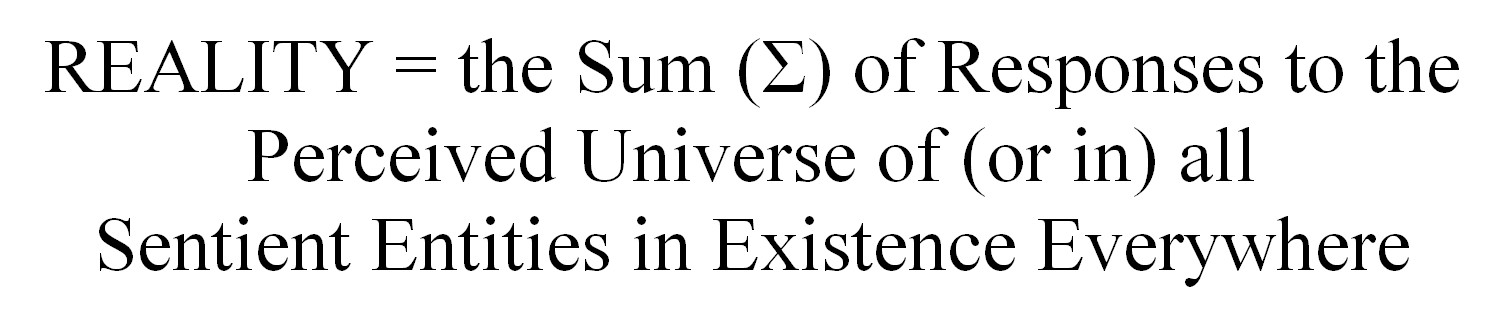
reality

Measurers of things such as (some) physicists, engineers and accountants will argue there is an objective universe which constitutes reality, but one can’t get outside the universe to view it “objectively”. Therefore, we must rely on philosophers and other thinkers, including ourselves, to think it through, to use our intuition, to trust a revelation, or all of these.

I stand by my formula, above.

What say you?

Responses will appear under “Comments,” below.

ADDENDUM

Immediately after I published this article I came across a discussion of “reality” which buttresses, I feel, what I have written above. I am re-reading Nine-Headed Dragon River: Zen Journals, by Peter Matthiessen. I recommend you read the journal entry of October 9, 1973 in Chapter 7, which includes this passage:

The mystical perception (which is only “mystical” if reality is limited to what can be measured by the intellect and sense) is remarkably consistent in all ages and places, East and West, a point that has not been ignored by modern science. The physicist seeks to understand reality, while the mystic is trained to experience it directly.

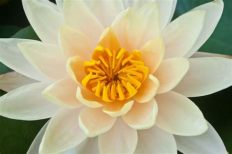
All are nothing but flowers
In a flowering universe
—Soen-Roshi
 

Posted in Essays | Tagged , , , , , , , , , | 3 Comments