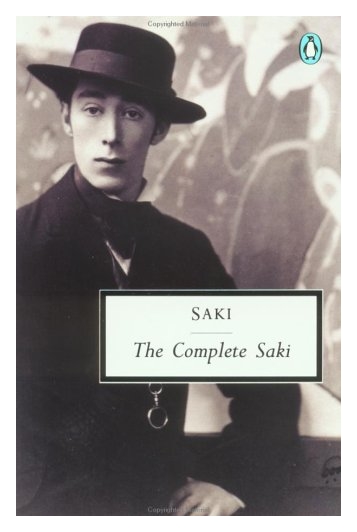
Within the last few years I have been buying and reading collections of short stories, from Anton Chekhov (1860-1904) to the present, trying to learn the trade from the masters. I remembered recently that as a youngster I enjoyed reading the short stories of “Saki“, as H.H. Munro (1870-1916) pen-named himself. So, I ordered and received The Complete Saki and currently am tasting the pleasures of my youth with a more mature palate.
Here is a review of Saki’s work by A. Woodley:
Saki has more twists in his tales, and injects his stories with more wickedness and biting satire than any short story writer before or since him and is truly the master of succinct, and highly descriptive writing.
He used a couple of wickedly engaging and attractive main characters for a couple of his collections – these were Clovis and Reginald. To illustrate their essential characters take this quote from ‘The Innocence of the Reginald’ the following discussion takes place when talking of a painting;
“Youth,” said the other, “Should suggest innocence.”
“But never act on the suggestion…” [replied Reginald]
The stories are marvelously un-PC – written before the First World War and probably indicative of a lost age when the British roamed country houses for most the year visiting one another and being grand. Saki, with his wicked pen and sharp wit dissects them beautifully. As there are no stories much longer than a few pages you don’t have to commit yourself to a great deal of reading, but once you start reading he is very hard to put down again.The entry in Wikipedia on Saki states: “He was influenced by Oscar Wilde, Lewis Carroll, and Kipling, and himself influenced A. A. Milne, Noël Coward, and P. G. Wodehouse.”
In reviewing, mentally, the various books and films by Britons about the Victorian Era British upper class that are so wickedly funny, I asked myself what the source of the reader’s pleasure might be in reading about these ridiculous and ridiculed people. I believe the source of our pleasure is in seeing how absolutely useless these caricatured people are, who nonetheless voice the opinion of their being superior to people who are useful. We know that they are not superior, no matter how materially superior their circumstances.
Rarely does a character in this genre ever “work,” unless sitting on a board of directors or having a nominal position in an inherited business.
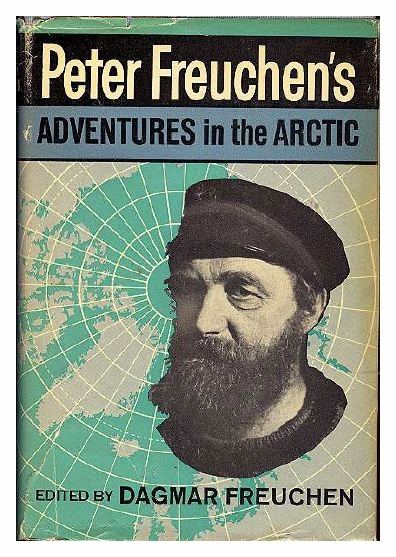 Life has taught me that we have a need to be, or at least to feel, useful to others, however this may manifest itself. An extreme example, from our citified and “civilized” point of view, is the self-abandonment of the female Inupiat who stays behind, to die, on a trek across Greenland because her teeth had become useless in chewing on seal hides in order to soften them. I remember this example from reading, as a youth, Adventures in the Arctic by Peter Freuchen.
Remaining useful, after a lifetime of schooling, employment and helping to nurture five children, is now the major consideration in my life. I am “retired,” although I prefer to say I am no longer an employee. I do work, at my own pace and in my own way on my own projects, including being a house-husband to my still-employed wife and being a reasonably good step-father to her daughter who lives with us. I find ways to be useful in small ways to others of my family and friends, even sometimes to the point of being a bit annoying. It’s important to know where the boundaries are.
This blog helps me feel useful. It is in my nature to imbibe information and impressions of the world through reading and direct experience. But this is of no use unless I can transform it all into words that may entertain, even inform, at least a few others.
My mother provides, perhaps, the ultimate example of usefulness. She continued to be useful until shortly before her death at age 90, simply by offering love, compassion and understanding to her family.
Stay useful, keep loving.

Artemis Pavellas, née Pagonis, at around age 60