
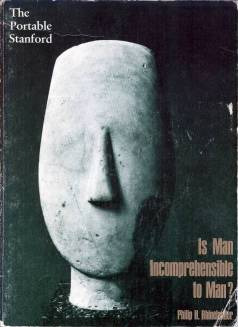
 The book is Is Man Incomprehensible to Man? by Philip H. Rhinelander. Rhinelander was a popular teacher, an eminent scholar and occasional leader in various educational enterprises at Stanford University, where he worked from 1956 until retirement. He died in 1987.
Why did I find the book so compelling? I will start by quoting from his biography in Wikipedia: “In 1974, Dr. Rhinelander published the well received book, Is Man Incomprehensible to Man?, in which he covered contemporary philosophical concepts with consummate skill and clarity. This book, although no longer well known, is still relevant in the modern philosophical arena, and serves as an excellent introduction for those interested in the intersection of philosophy and the humanities.”
For me, what Professor Rhinelander has at least accomplished with this small book is to make major schools of modern philosophy more comprehensible and usefully comparable.
But my main fascination with the book is its discussion of the question in its title and, by my inference, directly related questions:
- Is man incomprehensible to man? (If so, please show evidence of this)
- Is man comprehensible to man? (If so, please show evidence of this)
- By “man” does Professor Rhinelander mean “all men” (i.e. all people), or will “comprehension” be sufficient if it is possessed by philosophers, religious leaders, political leaders and other elites?
Questions number 1. and number 2. are quickly resolved, but other questions arise as a result, which I will show further below. The answer to the main question is: man is (currently) incomprehensible to man.
A little background before we get to the remaining question and the new questions.
The source of the book’s title appears to be from words written by Albert Camus, as seen opposite the title page of the book:
If men cannot refer to a common value,
Recognized by all as existing in each one,
Then man is incomprehensible to man.
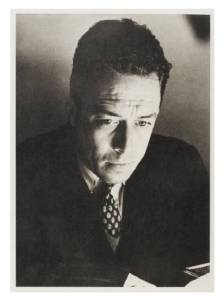
Albert Camus (1913- 1960)
Major topics discussed in the book include:
- The use of metaphor about man
- Man’s place in the world and in Nature
- The debasement of language and its importance
- Classical views of man
- Modern views of man: voluntarism, determinism and materialism
- Man as inventor
- Man’s search for meaning
The philosophers and thinkers whom Prof. Rhinelander favors, and whom he cites to support his arguments, include:
- Gabriel Marcel (1889-1973) whom the author refers to throughout the book and whose assertions he uses as the basis for many of his own. He was a philosopher, drama critic, playwright and musician.
- Alfred North Whitehead (1861-1947) who wrote on algebra, logic, foundations of mathematics, philosophy of science, physics, metaphysics, and education. He co-authored the epochal Principia Mathematica with Bertrand Russell (1872-1970).
- Karl Jaspers (1883-1969) who had a strong influence on modern theology, psychiatry and philosophy.
Here are others with whom he importantly disagrees:
- Marshall McLuhan (1911-1980) who is most famous for saying and writing upon “the medium is the message.” He was a professor of English literature, a literary critic, a rhetorician, and a communications theorist. McLuhan’s work is viewed as one of the cornerstones of the study of media theory.
- B.F. Skinner (1904-1990), an American psychologist, author, inventor, advocate for social reform and poet. He is famous for inventing “operant conditioning.”
- Herbert Marcuse (1898-1979). He was a German-Jewish philosopher, political theorist and sociologist, and a member of the Frankfurt School, a school of neo-Marxist critical theory, social research, and philosophy. His best known works are Eros and Civilization, One-Dimensional Man and The Aesthetic Dimension.
Now to the question and the argument.
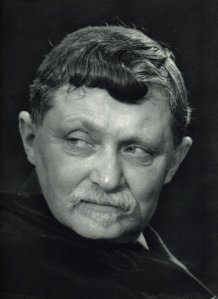
Gabriel Marcel (1889-1973)
If man is not incomprehensible to man, where may we find the comprehension? The answer to this question seems relatively easy. In that there are myriad philosophers, theologians, psychologists and scholars of every stripe and interest who have sometimes widely varying answers to the question of ‘What is Man?,’ one can say with some confidence that there is no consensus or “common value,” as Albert Camus looks for, quoted above.
So, why is man not comprehensible to Man? Or, a better question, perhaps, is: how can man (we) become comprehensible to man (each other)?
To answer this question, here is an excerpt from the book:
Vast amounts of new information have accumulated, especially in recent decades, from biology, biochemistry, biophysics, physiology, psychology, anthropology, sociology, economics, history, and various other sources. Yet an increase in information has not brought an increase in understanding. On the contrary, the more we know about man, the more mysterious he seems to become.
A number of writers have pointed out that one characteristic of our times is that man has become more problematical to himself than in any other age. We have several different conceptions and models of man, more or less carefully articulated, each reflecting a different perspective and a particular range of interests, but the multiplicity of disciplines and the variety of approaches have tended to prevent the emergence of any single conception of human nature sufficiently comprehensive and sufficiently flexible to provide a unifying focus.

“The Thinker,” by August Rodin (1840 – 1917)
A fundamental assertion of Professor Rhinelander in this book is that “only confusion can result if we talk about ‘man’ or ‘the nature of man’ without specifying what assumptions we are making and what we mean by such terms.”
Some people will say that man is fundamentally “good,” others will say he is fundamentally “bad,” yet others will say he is neither or both. Some scholars say that a child is a blank slate upon which his environment, starting with parents, stamps its template upon him (please accept that the masculine noun includes all people); others will say that heredity determines all; and yet others will posit a ratio of “Nurture” to “Nature” to be assigned.
Other questions about man on which there is no consensus include the question of free will: does man have it, or does he not? Some will argue in favor of determinism, other will favor free will. Yet others will say either one or the other, depending on circumstances.
Most people are unaware of the assumptions coloring their perceptions of the world and of man. This is why Prof. Rhinelander considers philosophy so important; the study of philosophy helps to reveal our assumptions (or, at least, that we all have operating assumptions) and allows us to test them against others and the objective world—if there is an objective world, and if we can perceive it objectively (some will argue on either side of these questions).
Now, how might Professor Rhinelander answer my second question at the top of this page: how can Man become comprehensible to Man?; that is, how can we become comprehensible to each other? Here are excerpts from the final few pages of Is Man Incomprehensible to Man?:
It is my belief that a unifying focus may be found if we stress man’s capacity for inventiveness, recognizing that such inventiveness is displayed not merely in man’s arts and crafts, but also in his ability to establish complex symbol systems, to make and modify social systems, and to build elaborate normative systems to guide his own behavior. The root of of man’s inventiveness seems to lie in his capacity—evidently correlated with his highly developed brain—to envisage possibilities beyond the actuality of immediate experience. Human knowledge, including scientific knowledge, reflects this capacity and depends on it.
Detail from Mona Lisa by Leonardo da Vinci
After these words Professor Rhinelander elaborates on the nature of “the scientific enterprise,” concluding that “…the ideal of scientific neutrality is itself, like all other ideals, a human invention. And like other human ideals, it is subject to abuse if its character and function are misconceived.”
Upon offering this cautionary about imputing neutrality to “the scientific enterprise,” the author finally lists four views of man that may lead to the “unifying focus” he says is needed, as the essential first step, for man to understand man.
- Use our (“man’s”) inherent inventiveness to engage in metaphysical inquiry into the nature and coherence of our underlying preconceptions about the world, about the foundations of human knowledge, and about man himself. “We must direct our primary attention to the assumptions and patterns of analysis that we bring to all our acts of knowing and judging.”
- “(We must) recognize the immense importance of imagination in all human activities—imagination in the sense of the ability to construct hypotheses and ideals that go beyond what has actually been observed.”
- We must see the supposed gap between scientific activities and humanistic activities in a new light. “The familiar distinction between facts and values (should be) seen to rest on an act of abstraction that we ourselves make.”
- Accepting the above three imperatives as a model “allows us to do justice to man’s persistent search for meaning, a need that has long been recognized by artists and writers…”
(T)he search for meaning can produce evil as well as good. As Dostoevsky’s Grand Inquisitor pointed out: the hunger for meaning and order may become so great as to drive men to sacrifice freedom in order to escape from the burden of bewildered frustration it can cause.…I am convinced that an essential part of the remedy (to this potential evil) lies in the preservation of what Marcel calls the philosophic spirit…
Thus an understanding of man leads us necessarily to metaphysical and historical inquiry. From these we learn to live for an openness, honesty and simplicity in our human relationships and against forces of fanaticism that threaten to debase or destroy the dignity of man. This inner attitude should manifest itself in all our actions. We still profit from the legacy of Plato and Aristotle that intellectual understanding is fundamental to man and that all wise human action depends on it.
If I were a professor having just presented all the above to a class of students, I would ask them (and I do ask you, the reader): “what assumptions about human nature and the world does Professor Rhinelander have which color his perceptions and, therefore, his advice to us?”
I wish I could have been able to engage Prof. Rhinelander in a discussion about the various “types” of normal, healthy people that are found historically (by Socrates and Aristotle, for instance) and recently (by C.G. Jung and G.I. Gurdjieff, for example) throughout the world. There are “types” who are quite comfortable with abstractions and philosophical inquiry, and other types who are quite impatient with them, and even dismissive of them. I dare to say there are many more of the latter than of the former.
In order for Professor Rhinelander’s admirable ideals to be realized, countless millions of people must be willing and able to significantly change their perceived views of man and the world. I offer three examples, only, and without invidious implication, of those who must alter their views to some significant degree: those who believe, and “know” in their deepest selves, that Jesus Christ, or the Prophet Mohamed, or The Buddha have correctly propounded the way we are as humans and the way we ought to live.

When all Christians, all Muslims, all Buddhists and other believers, and non-believers, agree on the nature of man and his proper place in the universe, then we will have effectively reached the ideals that Professor Rhinelander shows us in his admirable book.

 The Pavellas Perspective