
Gurdjieff, Ouspensky and Others
The last name of George Ivanovich Gurdjieff was a household word in my father’s family, along with that of Gurdjieff’s major disciple, Peter Demianovich Ouspensky. I remember hearing these two strange sounding names from the mid-1940s when I was around age seven. Ouspensky died in 1947 and Gurdjieff in 1949, but their teachings remain important to a significant number of seekers and much has been written by their students, and students of these students, about them, especially Gurdjieff.
During my twenties, when I was hungry for glimpses of deeper structure and meaning in life, I began reading Gurdjieff the philosopher and psychologist, and Ouspensky the cosmologist and major explainer of Gurdjieff. I may not have pursued these writings so early and diligently had not their names been imprinted in me. I later read other explainers and interpreters of both these men because their writing is dense and, in Gurdjieff’s case, his written English is almost impenetrable to most readers.
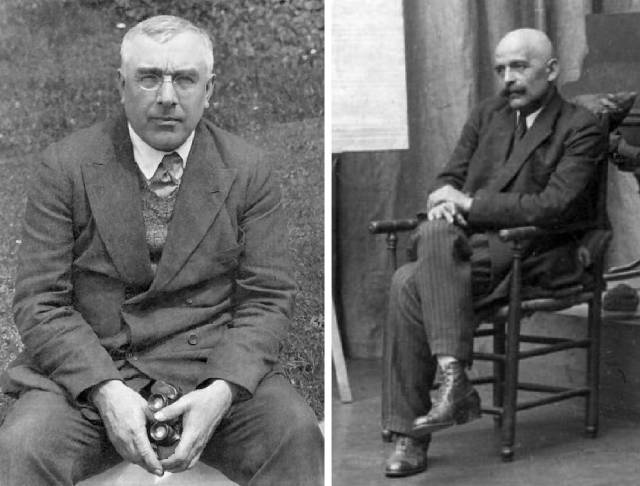
Left, P.D. Ouspensky; right, G.I. Gurdjieff
By the time I was in my forties I had collected a large number of books about Gurdjieff and “the work,” as his legacy is known to his students, and a few by Ouspensky who was less prolific and had less of a following. I also had, and still have some, books by Rafael Lefort, Olga Arkadievna de Hartmann, Kathleen Speeth, John G. Bennett and Robert de Ropp which are, at least in part, pertinent to “the work”. And, to make even more clear what these two teachers taught I have their biographies by Colin W. Wilson.
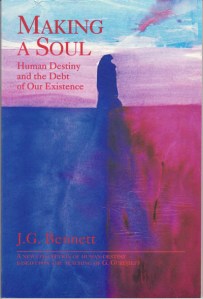 In recent weeks I have been rereading books I have had with me for many years, some of which I will now give away, having now read them a sufficient number of times. This is how I am ‘taking leave’ of these teachers.
The previous article in this journal was written as a result of such a rereading. More recently I have reread Making a Soul by John G. Bennett, adapted from a series of lectures, including extensive responses to questions from the audience, in London, 1954, expounding upon critical elements of the writing and teaching of Gurdjieff.
Sitting in the quiet early morning of a Swedish late spring, with the sun’s light about to stream into my window at 4:15 AM, I ask myself what I have learned from Gurdjieff and all his interpreters. The one thing I will remember is that we are, most of us, most of the time ‘asleep.’ The subtitle of Colin Wilson’s biography of Gurdjieff is The War Against Sleep. Another thing I will remember is that Gurdjieff and his followers asked good questions about the nature of man and his place in the universe. Finally, I am grateful for his having introduced me to ways of thinking and being in other parts of the world.
What I cannot now accept in his teachings is the metaphor of man as a machine. He and Ouspensky and all who followed them are steeped in the atmosphere of science and mathematics which bloomed in the first half of the 20th Century. The appeal to logic, reason and science in all these writings, no matter how much there may be an acknowledgment of a force ‘higher’ than man, is, in my view, like trying to put a previously living organism back to together after having dissected it.

John G. Bennett
Also, in Bennett’s Making of a Soul, he makes such, to me, unacceptable statements as “…the fundamental principle of all science, which is the continuity and self-consistency of the natural order”, and “…everything in the universe is built upon one common pattern.” I have an aversion to the use of the noun ‘science’ as if it were an independent agent causing things to happen or containing things that we try to discover. There is a scientific method that enables us to learn things about the universe and to make useful tools with this knowledge, but which is provisional and according to current theories, subject to revision.
Gurdjieff, Ouspensky, Bennett, de Ropp and others often present linear and planar diagrams in the manner of organizational charts and systems analyses to buttress their arguments of how man and the rest of the universe are constructed and how they relate to each other. These are inevitably hierarchical in nature, where Man is higher than all other living things on earth and subordinate to unseen and variously named forces higher than him.
Bennett, however, asks a critical question: “Who am I that can say ‘my body?'” This is precisely a question asked by others whose perceptions are influenced by Zen Buddhism and by those who perceive man as part of a vibrant and dynamic whole, not separate, not ‘outside’ of himself looking at himself.
 The Enneagram is part of an ancient method of describing personality types, not dissimilar from the modern Myers-Briggs Type Indicator, based in Jungian psychology and widely used in organizations for team building and by others for self- and mutual understanding. Some scholars have asserted a relationship between the two methods.
Although fascinating and instructive, the adoption by Gurdjieff, then by others, of pieces of other cultures in The Caucasus, where Gurdjieff was born, and from parts of Western Asia such as Sufi dancing and The Enneagram, makes a kind of stew that requires endless interpretation for understanding.
I can now release many of the books in this realm of inquiry for others to read. I will keep some books because of their literary and historical value, and to remind me of these former teachers who have now become friends with whom I have some respectful differences of opinion.
Books to be released:
- Beelzebub’s Tales to His Grandson: All and Everything: 1st Series, by Gurdjieff
- The Herald of Coming Good, by Gurdjieff
- A New Model of the Universe, by Ouspensky
- The Fourth Way, by Ouspensky
- In Search of the Miraculous, by Ouspensky
- The Master Game: Pathways to Higher Consciousness , by de Ropp
- Warrior’s Way: A Twentieth Century Odyssey, by de Ropp
- Making a Soul: Human Destiny and the Debt of Our Existence, by BennettI will keep these books:
- Meetings With Remarkable Men, by Gurdjieff. This was translated from the Russian by A. R. Orage and is a quite readable adventure story.
- The Teachers of Gurdjieff, by Rafael Lefort, generally believed to be an alias for Idries Shah.
- The Gurdjieff Work by Kathleen Speeth. I once had a tape of Dr. Speeth discussing Gurdjieff. I was greatly impressed by the clarity of her speech and her presentation of “the work.”
- G.I. Gurdjieff: The War Against Sleep, Colin Wilson
- The Strange Life of P.D.Ouspensky, by Colin Wilson
I urge the reader to read the reviews underneath the links to these books for even more, and very interesting commentary.
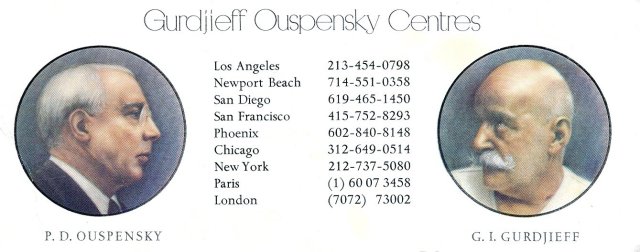
As I retrieved and set aside these books for their proper distribution beyond my library, I came across this bookmark of unknown date, so I don’t know if the telephone numbers are current.


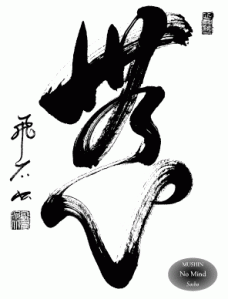 The ‘retired’ Nicholas Hel has a female companion, as well, who is a gently compelling character. In the spirit of shibumi I will say little more here. I will now put away my old friend, having drunk from his pages sufficiently, and, without yearning, anticipate the day when it will seem as natural as the rain to deliver it into the hands of a young visitor to my home.
 The Pavellas Perspective