“… a last glimpse of the land now being lost for ever”

… Thus ends The Rings of Saturn by W.G. Sebald, one of the three books I present today. The others are: Thesiger by Michael Asher; and The Search for Sana by Richard Zimler, the latter having been recently discussed in the book-circle I belong to.

I had made a promise to myself, and a bold statement to a fellow reader in the group, that I would find a common theme among these seemingly disparate books, my having chosen them for different reasons. I intrepidly assert the title of this blog provides the connection among the books.

3books
The Rings of Saturn

The introductory page before the table of contents has two quotations, one by Joseph Conrad, in French (Conrad is mentioned much in this book and occasionally in Thesiger), and one from Brockhaus Encyclopedia, as follows:

“The rings of Saturn consist of ice crystals and probably meteorite particles describing circular orbits around the planet’s equator. In all likelihood these are fragments of a former moon that was too close to the planet and was destroyed by its tidal effect (→ Roche limit)”

The County of Suffolk, as located in the country of England

The County of Suffolk, as located in the country of England

Such a beginning certainly presages the coming apart of things, as this singular book does provide evidence for, at least in The County of Suffolk, England.

The author takes us on a journey through his county, starting in Norwich on a train to the coast bordering the North Sea, and thence generally along the coast on foot, sometimes dangerously. Later, having walked inland, he visits a friend, a writer and teacher, who lives in a house the author once lived in. He takes a taxi back to a previously visited town to think and write, as he had been doing all along this journey, then he traveled back home.

Places in Suffolk County mentioned in the book, along with the author's musings on their historical and literary connections to many parts of the world [Please click on the image]

Places in Suffolk County mentioned in the book, along with the author’s musings on their historical and literary connections to many parts of the world [Please click on the image]

What, you may be asking, assuming you have read this far, is so interesting about all this?

As the caption of the image immediately above implies, the author uses his travels to expose thoughts and memories stimulated by the places and people he visits. This section of England, or Great Britain in the larger picture, has had great forests, great industry (including the manufacture of silk), great homes and hotels, great resorts and, last, great airfields─staging areas for Great Britain’s execution of its role in the Second World War. All are gone.

A former silk mill, now a museum, in Derbyshire, a county in the East Midlands

A former silk mill, now a museum, in Derbyshire, a county in the East Midlands

Not only are all these things and events gone, they have left a poisonous residue, killing the vast herring industry once centered here, among other insults. Nature has had a role in eating away at the vulnerable coastline, toppling cliffs and and structures built upon them..

As I read through this compelling book, I was taken on imaginary trips, accompanied by great detail, to: China, via an exposition on the origin of silk and its resultant world trade; The Enlightenment and many of its famous characters–the writers Gustav Flaubert, Algernon Swinburne, Edward Fitzgerald (The Rubaiyat of Omar Khayyam), Joseph Conrad, Sir Thomas Browne, and Jorge Luis Borges, the latter’s short story Tlön, Uqbar, Orbis Tertius being given much discussion.

Tlon Uqbar Orbis Tertius by Borges

Tlon Uqbar Orbis Tertius by Borges

In the “Tlön”story, an encyclopedia article about a mysterious country called Uqbar is the first indication of Orbis Tertius, a massive conspiracy of intellectuals to imagine (and thereby create) a world: Tlön. According to … a key tenet of the (several) philosophical schools of Tlön … the future exists only in the shape of our present apprehensions and hopes, and the past merely as memory. In a different view, the world and everything now living in it was created only moments ago, with its complete but illusory pre-history. A third school of thought…describes our earth as a cul-de-sac in the great city of God, a dark cave crowded with incomprehensible images, or a hazy aura surrounding a better sun. The advocates (in ‘Tlön’) of a fourth philosophy maintain that time has run its course and that this life is no more than a fading refection of an event beyond recall. We simply do not know how many of its possible mutations the world may have already gone through, or how much time, always assuming that it exists, remains. (Emphasis added).

What has destroyed all that the author reminds us of, as the gravity of Jupiter has destroyed its former satellites, is, I believe, the Second World War. He was a German boy during the war, and later a life-long resident of England.

And, the destroyer is also time, assuming it exists beyond the conceit of man.

Thesiger
Similarly, in Thesiger, a biography of the renown mid-20th century explorer Wilfrid Thesiger, the book ends with several quoted observations of the subject:

There is nothing to be cheerful about. Everything is wrong…There can be no future. It’s inconceivable that there could be any human beings on the planet in a hundred years’ time … Not only transport but the interference with nature, you’ve got pollution and the threat to the ozone belt which means the heating up of the earth and the melting of the poles and half the world going under water.

Wilfrid Thesiger

Wilfrid Thesiger

Thesiger was born in Ethiopia in 1910.His father served there in the British diplomatic corps. Thesiger returned to Ethiopia as a young man to explore and hunt, and then traveled extensively in many parts of the Arabian Peninsula, and also in Iraq and Afghanistan. Thesiger was given to hyperbole with native English speakers, spending most of his life having lived among and traveling with, by foot and camel, the native peoples of the mostly “untouched” lands he preferred to “civilization”.

A hundred years ago there were no cars…Well in a hundred years what are we going to have? It won’t be long before the Chinese will be demanding cars─you can’t put all that pollution into the air and get away with it…I don’t think development can be checked and that’s why I think we’re heading for disaster─it’s just a matter of guessing whether it’s fifty years or 100 years. I see absolutely no hope for the human species.

As with his predecessor T.E. Lawrence, whom Thesiger admired, he eschewed the intimate company of women, and sex altogether. He did like the company of young men who traveled with him as a sort of tribe, as did Lawrence. Thesiger’s biographer interviewed him and followed in his footsteps to talk with many of the people Thesiger had traveled with, lending great credibility to Asher’s portrait of the great explorer.

Thesiger saw civilization and, more precisely, its mechanization and industries, as the ruin of natural man, epitomized by the Bedu of the desert.

I cannot stand the lush green of the English countryside…Green should be a patch of cultivation, perhaps just a fig-tree, in contrast to an expanse of desert; then it becomes valuable.

The Empty Quarter of the Arabian Peninsula

The Empty Quarter of the Arabian Peninsula

Thesiger was the last person to travel to theretofore inaccessible places by foot and animal transport. He mourned the advent of the automobile. Wilfrid Thesiger died in 2003 at age 93 in England, having been forced to live there the last few years of his life because of ill health. He heart was, undoubtedly, in northern Kenya where he had last lived for many years, quite simply, among the native peoples there.

The Search for Sana

This is a complicated onion of a book. Just as you think you see the story whole, another layer peels off and you re-think what you may already have concluded about its trajectory. There are passages where you are not sure the characters are who they present themselves to be, and, in some cases, they aren’t. It would be a disservice to the author and to your enjoyment of the book for me to reveal too much more, specifically, about it.

How, then, to tie it in to the theme of this blog?

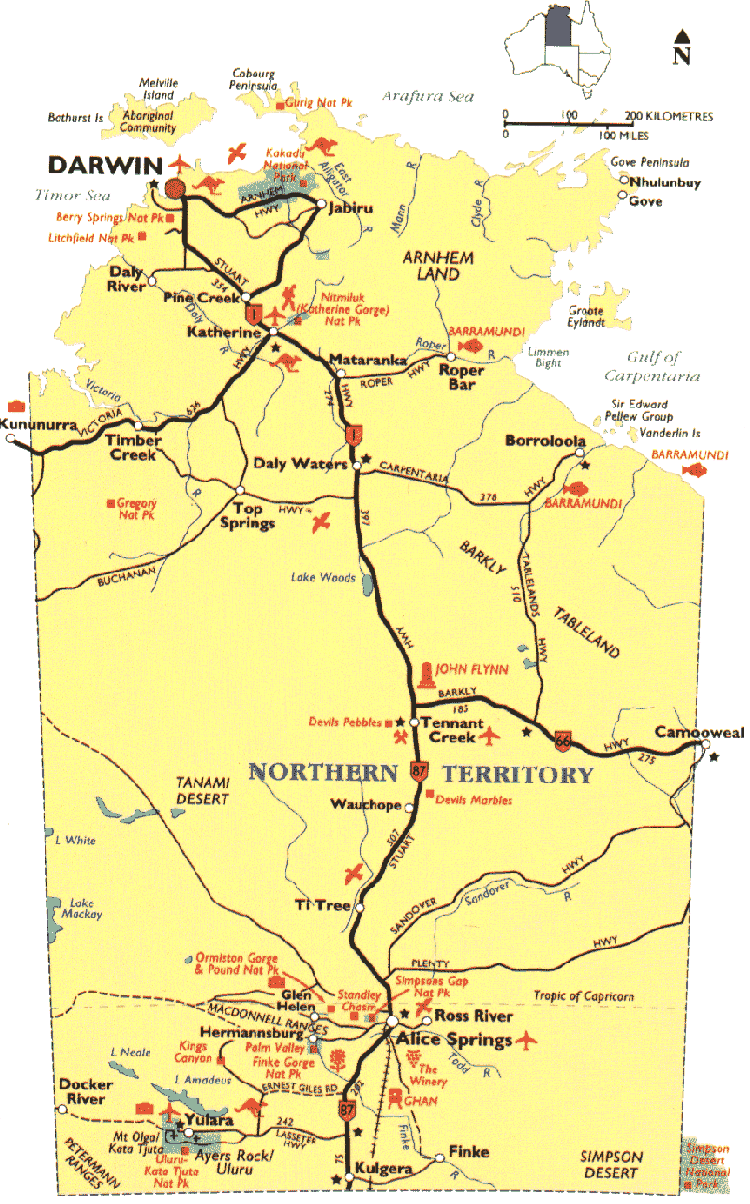
Palestine-IsraelIt will not spoil your reading of the book for me to say the core of the story resides in a town in what is now Israel, where both Arabs and Jews live, although the action takes place in many places around the world: first, Australia, then, not in order, Brazil, Italy, England, New York and other places.

The main characters (other than the narrator who appears to be the author himself) are two girls, one an Arab and one a Jew, who are soul-sisters growing up in a small place in Israel. The trajectory of their lives, together and apart, provide the basis for the story.

Overlying the rest of the story is the constant theme of conflict between Arab and Jew, between Palestinian and Israeli, within and without the territory of Palestine/Israel.

This conflict, without editorializing by the author/narrator except through the different viewpoints of his characters, is destroying the land and its peoples and generally poisoning the social and political atmosphere of the earth. This may seem a commonplace and non-extraordinary thing to say, but it is presented pungently by the author and, I feel, ties in to the theme of this article.


The Langoliers or Inevitable Entropy, by George Grie [Please click on the image]

The Langoliers or Inevitable Entropy, by George Grie [Please click on the image]

These three books are presenting the inevitability of decay, enhanced (I paraphrase Thesiger) by too many humans occupying too little space.

Perhaps it is a simple matter of seeing entropy in action through what these books present. But this concept is insufficient. What these books present, each in its own way, is man’s role in his and his world’s undoing.


Posted in Geography, History | Tagged , , , , , , , , , | 5 Comments

Friedrich Nietzsche on God, Christianity, The Enlightenment, Rationality, Science, Truth, and Especially About Words & Language

In my early years I associated Nietzsche’s name with the phrase “God is dead,” but I didn’t know if he was supposed to be celebrating this assertion or decrying it, or something else entirely. In the early 1980s, when having a philosophical conversation with my late, former father-in-law, Joseph Patrick Cogan, Sr., he declared I was speaking like Nietzsche! This both flummoxed and intrigued me, but I didn’t immediately follow through, being so deep into my former career.

About a year ago, I happened across a little book: Nietzsche and Postmodernism by Dave Robinson, published by “Icon Books.” As I continue to re-read it I am brought back, by Nietzsche’s assertions, to the lessons of Alan Watts, a one-time Anglican priest and great teacher of Eastern ways, especially The Tao, Buddhism and Buddhism’s evolution to Zen. According to the author, Dave Robinson, Nietzsche said:

Friedrich Nietzsche, 1844 – 1900

Human language has no coherent correspondence with the ‘real’ world. Language can never be ‘literal’ in the sense that it can describe the reality of the world to us. All language is inevitably metaphorical. Social and intellectual life depends on common consent, and this gives birth to a shared consensual reality in which concepts such as “knowledge” and “truth” inevitably emerge. These concepts are then reinforced by language. Such limited human ‘truths’ make social life possible. Unfortunately, they can also lead to a futile hunt for spurious and illusory metaphysical ‘truths’ that don’t exist.

  • Logic and classification both originate from our need to control and dominate the world. The undoubted usefulness of logic hypnotizes human beings into believing they can use it to obtain transcendent or scientific truths. Logic is a very useful survival tool, but that is all it is.
  • Words are useful to us because (they can) simplify and ‘freeze’ the chaos and complexities of our surroundings, but that is all they can do.

“Words, as is well known, are the great foes of reality.”—Joseph Conrad

“Words are, of course, the most powerful drug used by mankind.”—Rudyard Kipling

“Words are dwarfs, but examples are giants.”—Swiss-German Proverb.

As an aspiring writer I have bemoaned the inability of words to describe the totality and essence of the reality I perceive. I reckon this is why we need art, poetry and music—none is necessarily “logical.” Back to Dave Robinson’s translated and interpreted words of Nietzsche:

Friedrich Nietzsche

Not only will our grammar control the ways in which our thoughts are organized but, more drastically, it will determine what sorts of thoughts it is possible for us to have. So the subject-predicate grammar we think with (causes us to) impose a subject-object framework onto the world and this encourages us to believe, for example, that there is an ‘ego’ or and ‘I’ that exists as a transcendent Cartesian entity somehow inside us, separate from our physical existence.

Here is Alan Watts on this very topic:

  • Ego is a social institution with no physical reality. The ego is simply your symbol of yourself.
  • The most strongly enforced of all known taboos is the taboo against knowing who or what you really are behind the mask of your apparently separate, independent, and isolated ego. (Emphasis added).
  • Trying to define yourself is like trying to bite your own teeth, or see the back of your head.

Another author who address this “subject-object” problem is Robert Pirsig, in his Zen and the Art of Motorcycle Maintenance:

Robert Pirsig

I think that if we are going to reform the world, and make it a better place to live in, the way to do it is not with talk about relationships of a political nature, which are inevitably dualistic, full of subjects and objects and their relationship to one another; or with programs full of things for other people to do. I think that kind of approach starts at the end and presumes the end is the beginning. Programs of a political nature are important end products of social quality that can be effective only if the underlying structure of social values is right. The social values are right only if individual values are right. The place to improve the world is first within one’s own heart and head and hands, and then work outward from there. Other people can talk about how to expand the destiny of mankind. I just want to talk about how to fix a motorcycle. I think that what I have to say has more lasting value.
Where both Nietzsche and Watts also coincide is in showing that human faculties such as rationality and logic cannot take us out of our human state in order that we may view ourselves ‘outside of ourselves’, that is, ‘objectively.’ Therefore the ‘truth’ we perceive is a human truth, not a universal truth. (The words in this paragraph are mine; I welcome argument). Finally, I commend his succinct and well-documented summary for your reading. Here are just some headings of his many very brief chapters to give you the flavor:

  • Nietzsche the Prophet
  • Nietzsche and the Collapse of Christianity
  • The Problem of Logic
  • The Demolition of Science
  • Belief in the Self
  • The Genealogy of Morals
  • Christian Values and Nihilism
  • Eternal Return
  • Nietzsche and Postmodernist Feminism

    Is this enough for you to chew on?
Posted in Books & Literature, Church & Religion, Philosophy & Psychology, Science & the Sciences | Tagged , , , , , , , | 2 Comments