
Eva and have friends who have moved from Sweden to Malta, and with whom we recently stayed for several days. I was familiar with attributions commonly connected to the name Malta: Maltese Cross, Maltese Falcon, Knights of Malta. But my knowledge before visiting this country of 316 square kilometers was so poor that I imagined it to be just another little place where northern people go to relax and sun themselves. How wrong I was.
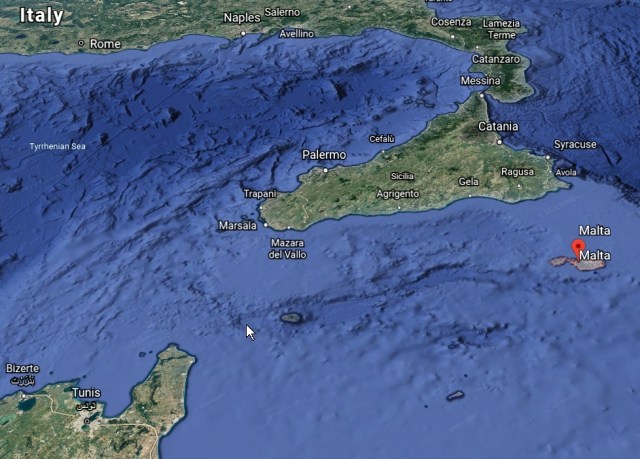
From Google Earth
The land that is now Malta, Gozo and Comino emerged from beneath the seas around fifteen million years ago. The land was then a southern extension of the Euro-Asian continental mass, bridging Sicily and Malta to what is now Tunisia. The land bridge subsided some fifteen thousand years ago leaving this three-island archipelago.
 It was left uninhabited for thousand of years. The original inhabitants of the Maltese islands probably crossed over by sea from Sicily, which lies 58 miles to the north, sometime before 5000 BC. The temple builders were farmers who grew cereals and raised domestic livestock. They worshipped a Mediterranean mother goddess, uniquely large statues of which are found on Malta.
Phoenicia was an ancient civilization centered along the coast of modern day Lebanon, Syria and Israel. Phoenician civilization was a maritime trading culture that spread across the Mediterranean between the period of 1200 BC to 900 BC, including to the three islands that now comprise The Republic of Malta.
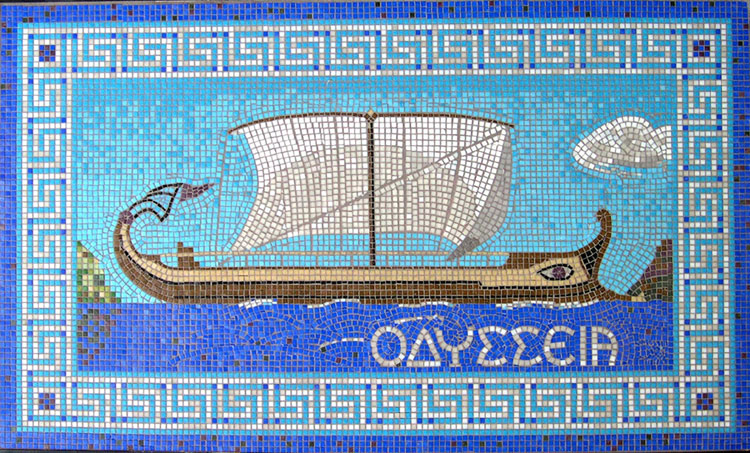 Mosaic of a Phoenician Trading Ship
The timeline of major events in Malta’s history:
- The Neolithic Period, 5000–4100 BC
- The Temple Period, 4100–2500 BC
- The Bronze Age, 2500–700 BC
- Phoenicians and Carthaginians, 700–218 BC
- Romans, 218 BC–535 AD
- Byzantines, 535-870
- Arabs, 870–1127
- European Domination, 1127-1530
- Knights of St. John, 1530–1798
- French, 1798-1800
- British, 1800-1964
- Member of the British Commonwealth, 1964-1974
- Independent Republic, 1974
- Member, European Union, 2003
- Currency changed to the Euro, 2008
The Internet has unlimited information about the nature of the periods outlined above, and anything else you wish to know. I will not repeat too much more of what I have found there and in books available about the country. In going to a favorite reference source, the World Factbook of the CIA, I see that Malta is in the top ten out of 221 countries in having a low infant death rate (0.38%), along with Norway, Finland, France, Iceland, Hong Kong, Japan, Sweden, and the leader, Singapore.
 Prehistoric Temple at Mnajdr, Malta, predating the monuments at Stonehenge by many centuries
Malta, even with only slightly more than 400,000 residents, is also in the top ten countries with the highest population density: Macau, Monaco, Hong Kong, Singapore, Gibraltar, Gaza Strip, Holy See, Bermuda, and Malta at 1,192.5 people per square kilometer.
Our friends live a short bus ride from The city’s capital, Valletta, a fortress where the church of St. John resides. The foundation stone of Valletta was laid by the Grandmaster of the Order of Saint John, Jean Parisot de la Valette, on 28 March 1566; The Order (which was the long-time ruler of the city and the island) decided to found a new city just after the end of the Siege of Malta by Ottoman Turks in 1565. Here is a view of the port from The fortress walls:

Again from the CIA’s World Factbook, the major industries of Malta are tourism, electronics, ship building and repair, construction, food and beverages, pharmaceuticals, footwear, clothing, and tobacco.
In that Malta’s great value to the world has been primarily its strategic location, it is not surprising to see that it is a world-class port.
- Merchant marine, total: 1,281 ships.
- foreign-owned: 1,197 (Austria 1, Azerbaijan 3, Bangladesh 3, Belgium 10, Bulgaria 15, Canada 15, China 13, Croatia 12, Cyprus 15, Denmark 10, Estonia 7, France 4, Germany 67, Greece 448, Hong Kong 1, Iceland 7, India 3, Iran 24, Israel 21, Italy 45, Japan 3, South Korea 3, Latvia 36, Lebanon 12, Libya 3, Monaco 1, Netherlands 3, Norway 71, Pakistan 2, Poland 25, Portugal 3, Romania 10, Russia 66, Slovenia 3, Spain 1, Sweden 1, Switzerland 22, Syria 4, Turkey 143, Ukraine 28, UAE 10, UK 12, US 11)
- There is so much more to say about Malta: the influence of Catholicism in its very many churches and chapels; and, the heroism of the Maltese people in the various sieges and invasions over the centuries, including especially their role in World War 2. Please go to the Internet to read about their fabulous history and incredible bravery. Here are some places to begin:
- Sacred Destinations
- New York Times
- Wikipedia
 The book is

 The Pavellas Perspective