Where are you on the Autism Disorder Spectrum?

On 6 December I bought a book at San Francisco International Airport (SFO) for my 15-hour flight to Arlanda International Airport (ARN) in Stockholm:
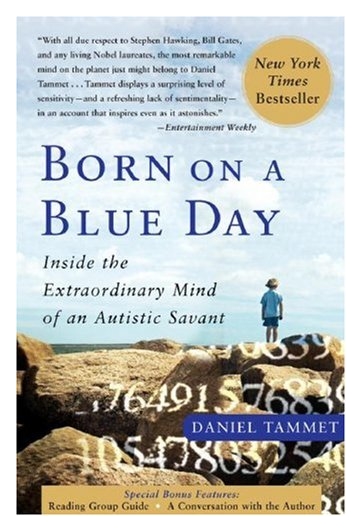
bbornonbluedayI devoured Born On a Blue Day quickly. I recommend it unreservedly.

The author is a 27-year-old man with Asperger Syndrome (AS) an anomalous neurological condition within the autism disorder spectrum, “characterized by difficulties in social interaction and by restricted and stereotyped interests and activities. AS is distinguished from the other Autism spectrum disorders (ASDs) in having no general delay in language or cognitive development” (from an authoritative source found on the Internet).

Further information on the book can be seen underneath the link to the book, above.

I want to talk here about how I saw some parallels in the social and other development of the author and me, and how it leads me to speculate that perhaps we all are somewhere on the spectrum between incomplete and imperfect, and full and perfect, neurological development.
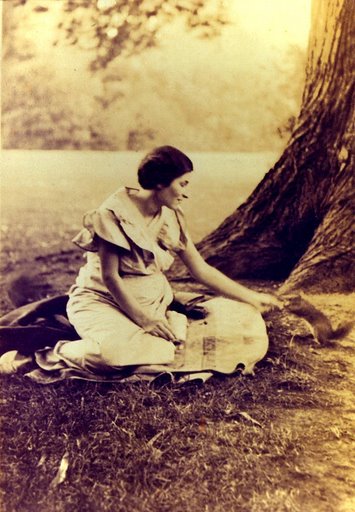
Artemis Pavellas, pregnant with Ron Pavellas, San Francisco, 1936

Artemis Pavellas, pregnant with Ron Pavellas, San Francisco, 1936

I have been interested in the brain, my brain, since around age seven when I felt I had a mission to “perfect the self.” Memory is a slippery thing, so I will hedge a bit to say I certainly had this very phrase as an imperative when around 12. This mission faded away, gradually, to disappear somewhere in my 30s or 40s.

I now expand upon my own perceived development in response to certain items the author recites in his own circumstances.

From the beginning, I was very good in math and puzzles, but began to lose interest in such pursuits when in my late 20s. I was a “serious” baby and child, according to my mother; she was concerned about it but I was allowed to be myself. As she later told me, Mom wondered what was “going on inside of my little head”. I didn’t talk about what she felt was surely going on in there.

My Myers-Briggs Type Indicator (MBTI) “type” is INTJ, described, in part, as “very analytical … more comfortable working alone than with other people, and not usually as sociable as others … tend(s) to be very pragmatic and logical …, often with an individualistic bent and a low tolerance for spin or rampant emotionalism….”

So I naturally have as my favorite Star Trek characters, Messrs. Spock & Data.
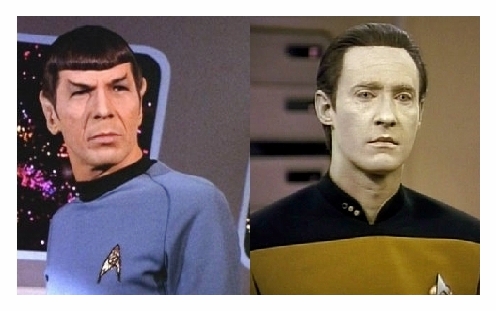
Mr. Spock /// Mr. Data

Mr. Spock /// Mr. Data

Another one of my characteristics, similar to one of Tammet’s, is that of disliking being interrupted while developing and expressing a thought. I very often hesitate to begin what I think is an interesting, possibly useful, exposition knowing I will, in 99% of cases, be interrupted. There are few (what I call) polite conversations anymore, where a person can speak until done, then give over to others. There seems just not enough time.

While not extremely obsessive, I am a neatnik and find the disorder of others quite irritating to the point of sometimes leaving the scene. My own apparent disorder in things around my home office, for instance, is organized in my way. Shared spaces in my home are usually orderly or I make them so.

Perhaps the most interesting, to me at least, is this shared characteristic: I need people to “make sense.” As an INTJ, “… this sometimes results in a peculiar naiveté,… expecting inexhaustible reasonability and directness” in a relationship.

But enough about me. How about you?

This book has many other wonderful attributes. Among them is that it is cleanly and clearly written. It makes sense. It has at least two love stories: between the author and his family, especially his parents; and, between him and his life partner (he is homosexual).

Above all, the author’s story is a lesson on how any of us, with our quirks, peculiarities and possible deficiencies compared to the norm, are valuable as humans. All we need is love to bring it all out.
casablanca1024

Posted in Books & Literature, Philosophy & Psychology | Tagged , , , , , , | 7 Comments

The Obscure Minstrel Man Who Influenced Musicians You Have Listened To

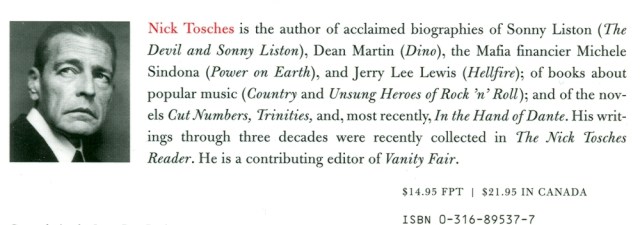
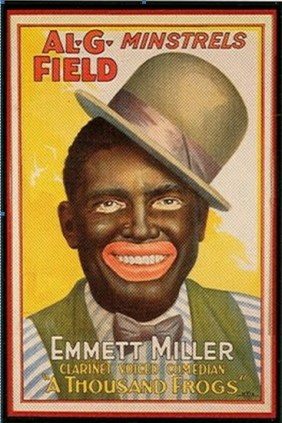
ScreenHunter_144 Jul. 03 10.01I have just read Where the Dead Voices Gather, by Nick Tosches. This extraordinary book is, among many other tangential subjects, a historical-cultural travelogue through the popular music of the years 1850-1980, using as a focal point an obscure blackface minstrel man of the 1920s and 1930s.

The book is nominally about Emmett Miller who influenced others we know about, but who himself has vanished from the scene ignominiously. In the book is much about minstrelsy, vaudeville, ragtime, jazz, blues, and a bit into and beyond the big band era. He leaps forward upon occasion to connect with, among others, Bob Dylan who has matured well from an ordinary beginning, according to the author. He dislikes Elvis Presley, thus vindicating my own opinion and endearing him to me on this account alone.

So much is said, and so peculiarly and well, in this very literary and historical work that I can only provide glimpses here, through excerpts, quotations and excursions into places that Tosches took me.

nicktosches

2518786_0

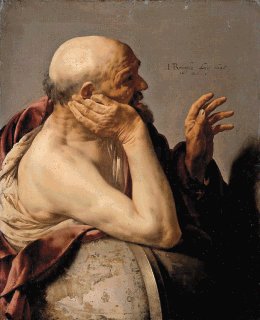
Heraclitus, 535 – 475 B.C.

Tosches digs deep into the archetypes of mankind to show parallels and direct connections between the music and poetry in the era of his subject, to the ancients of Greece and cultures and myths before Greece, often quoting in the original Greek (with translation). Could you imagine before now picking up a book on, let us say, old-timey jazz and getting quotations from, as an example, Heraclitus, a renown pre-Socratic philosopher?

By cosmic rule, as day yields night, so winter summer, war peace, plenty famine. All things change. Air penetrates the lump of myrrh, until the joining bodies die and rise again in smoke called incense. Everything flows and nothing is left unchanged.

Men do not know how that which is drawn in different directions harmonises with itself. The harmonious structure of the world depends upon opposite tension like that of the bow and the lyre.

This universe, which is the same for all, has not been made by any god or man, but it always has been, is, and will be an ever-living fire, kindling itself by regular measures and going out by regular measures.

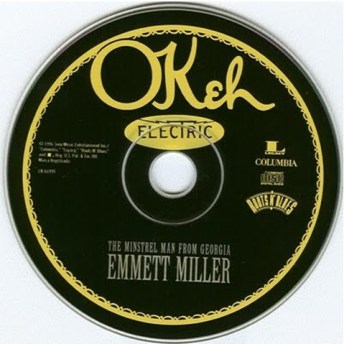
These alone are worth the price of admission. Because of my reading of this book I have acquired the only set of recordings, restored, of Emmett Miller:


ScreenHunter_146 Jul. 03 10.11

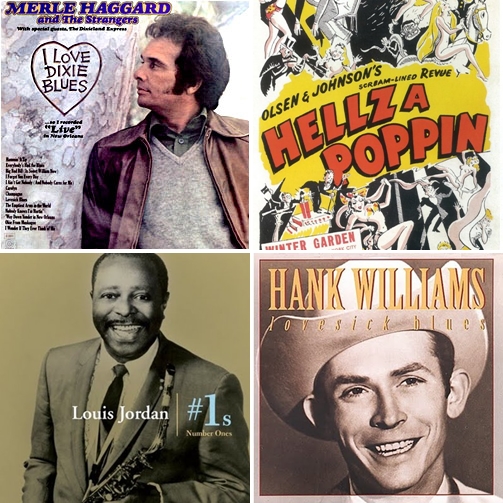
In addition I now have garnered the following recordings of artists who were influenced by Emmett Miller:


Dead Voices

◘ CD Album “I Love Dixie Blues,” by Merle Haggard
“Hellzapoppin”, DVD of the 1941 movie, produced by Olson & Johnson comedy and variety team.
◘ CD of Louis Jordan’s “#1 Hits”.
◘ CD of Hank Williams’s “Lovesick Blues”.

There are others items I will order after I calm down, but the above are all part of my own past. Every one of these artists and performers were dear to me in ways I could not then understand; perhaps I now understand, at least somewhat.

Tosches mentions Plotinus who spoke of the discipline meant to detach the soul from material things and to enable it to attain to spiritual ecstasy, “the flight of the Alone to the Alone.” That Soul, then, in us, will in its nature stand apart from all that can cause any of the evils which man does or suffer. [From the Enneads]

Another ancient philosopher whom Tosches quotes: Empedocles: “The blood around men’s hearts is their thought.”

The others whose music was influenced by Emmett Miller, and whose works I will pursue:

This image of Blind Willie Johnson (garnered from the Internet) is particularly charming to me because the artist is Robert Crumb, my favorite “underground” cartoonist of the 1960s and 1970s.

Jerry Lee Lewis: especially his rendition of “Alabama Jubilee.” (Tosches wrote a book on Lewis)
Jimmie Rodgers: “The Songs of Jimmie Rodgers: A Tribute,” performed by various artists.
Bob Dylan’s “Highway 61 Revisited” and “Blonde on Blonde,” both later works.
Lefty Frizzell: (1928–1975) an American country music singer and songwriter of the 1950s and a leading exponent of the Honky-tonk style of country music. His relaxed style of singing was a major influence on later stars Merle Haggard and Willie Nelson. (From Wikipedia).
John Mellencamp: In the “Tribute” album, above, John Mellencamp’s performance of Jimmie Rodgers’s “Gambling Bar Room Blues is “…the most startling evocation of that ageless power…” of the …”underground current that has nourished black music as well as white.” (Tosches).
The The, a musical group; their 1994 album “Hanky Panky,” an album made up entirely of Hank Williams covers.
George Jones: “Jones first hit the charts in 1955 with ‘Why, Baby, Why.’ He celebrated his 50th Anniversary as a recording artist in 2004 with the release of a 3-CD set entitled George Jones 50 Years Of Hits which featured one hit for each year of his career. He sings country music, accompanied by his guitar.
Fats Domino: a classic R&B and rock and roll singer, songwriter and pianist.
Eddie Lang: an American jazz guitarist, considered by many to be the finest of his era, and to be the greatest rhythm player of all time.
Lonnie Johnson: Johnson (1899-1970) was a pioneering Blues and Jazz guitarist and banjoist.
Wynonie Harris: (1915-1969), an American blues shouter and rhythm and blues singer. His “Good Rockin’ Tonight” is “one of the birth cries of Rock & Roll.” (Tosches).
Blind Lemon Jefferson: (1893–1929) was an influential blues singer and guitarist from Texas. He was one of the most popular blues singers of the 1920s. My friend from Berkeley High School in the early 1950s, Carl Dukatz, played songs by Jefferson and by Elizabeth Cotton, among others, on his slide guitar at the “Blind Lemon” bar and restaurant on San Pablo Avenue. (I hear from an unverified source that Carl played at least one set with The Grateful Dead)
Furry Lewis: (1893-1981) a blues guitarist from Memphis. He was one of the first of the old-time blues musicians of the 1920s to be brought out of retirement and given a new lease of recording life by the folk blues revival of the 1960s.
Al Bernard: (1888-1949) a recording artist from the vaudeville era. He was also one of the most famous blackface performers from the days of the minstrel shows. His work has been reappraised by music historians who feel links exist between the minstrel show styles and western swing music. He was a contemporary of Emmett Miller, the subject of Tosches’s book.

Get the book! Get the music!

Posted in Books & Literature, Music & Musicians, Philosophy & Psychology | Tagged , , , , , , , , | 3 Comments