
Six years ago I read an article by a person whose “world changed” at a young age by the event of “9/11” in Six New York City. My reading of her well-written memoir initiated a memory search for that moment in my life when the perception of the world may have changed — that is, to have shaken me loose from the unexamined feelings of comfort and safety that childhood, for some, allows.
After pondering, I found that my awakening was gradual, with punctuated moments of fear, despair, horror and, in the case of “9/11,” anger.
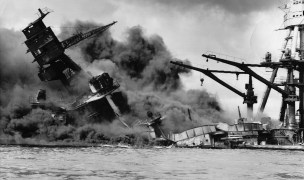 I was one month away from becoming age five when the Japanese Air Force bombed Pearl Harbor, Honolulu, Hawaii on December 7, 1941. I don’t have a memory of the actual day of the invasion. What I have is the memory, subsequently developed, of all the pictures and commentary since that time. It didn’t affect me at age five — this was just the way the world was.
Uncle Harry was a block warden for the times when ‘blackouts’ were called by the civil defense organization. He was to assure that we and the neighbors had pulled down their blackout curtains and shades so that no light could be seen by possible invaders from off the coast of San Francisco. These were the times the whole family, seven of us would gather by candlelight in the living room to listen to news on the radio, or to music on the big Victrola. I imagined Japanese planes and submarines searching, searching, but finding nothing because we were so good at hiding. It wasn’t scary.
Then the war was over, and I was eight years old. My dad got a job in Manhattan with his cousin, a printer, and found a railroad flat in Brooklyn for us, a few blocks from the docks. Mom, sister Diane, and I followed later to arrive by train on New Year’s Day, 1946. I learned to live with fear and uncertainty in this neighborhood, more and more as I grew toward adolescence. I never knew when one of several local bullies would decide to beat me up.
 When I got to junior high school, we learned how to act when the sirens went off, signaling a nuclear bomb attack from the Soviet Union. These felt weird, and I always felt that such preparations were useless because everything would be wiped out anyway.
Toward the end of the 1940s, many people from Puerto Rico started arriving in New York’s boroughs, including Brooklyn. One summer day a car full of Puerto Rican immigrants was circling around 48th Street, looking for a destination, the occupants being unfamiliar with the neighborhood. They had interrupted the stickball game of the older guys too many times, so they stopped the car, bounced on it, rolled it, and beat up the guys in the car, using pipes and other things as clubs. I ran away to our tenement up the street, feeling as if I had been beaten up.
Soon after this we moved back to San Francisco and, later, to Berkeley. We felt safe again.
Until, ten years later, October, 1962. This is when the world changed for me: the Cuban Missile Crisis. I was living in Berkeley, attending the University. I often awoke, sweating, having dreamed a nuke had exploded over the whole Bay Area.
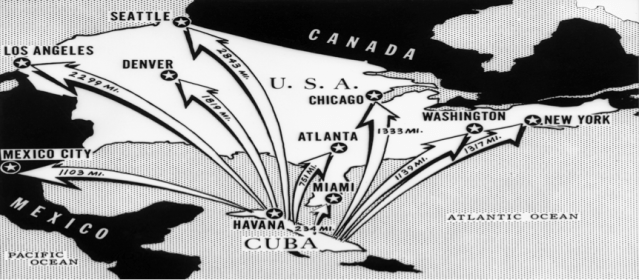
Source: theedge.com.hk
Then, in 1963 President John F. Kennedy was assassinated and began a horrible period of uncertainty and anger and disbelief in the authorities which the ‘Warren Commission’ could not quite damp down.
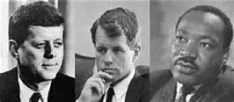 The civil rights leader Martin Luther King, Jr. was assassinated, then Senator Robert Kennedy was gunned down within months of each other in 1968. I didn’t care that much for the Kennedy brothers or family, but upon “Bobby’s” death I felt America was coming apart.
Then came the horrors of the Vietnam War, in which I was too old to directly participate, but I saw and felt the havoc it wrought on the young people and their elders.
 I was present, in 1964–1965, at the ‘Free Speech Movement’ on the Berkeley campus, which began as a righteous protest and devolved into a battle between well-organized radicals and the State. It was warfare on campus and, in my mind, began the destruction of universities everywhere in the USA.
Time passes, wounds are layered over while one continues to do what humans tend to do, make families, go to work to support them, try to enjoy life occasionally. The horrors are buried, then… 9/11.
Then the COVID-19 pandemic.
And now, the threat of nuclear weapons by Russia and the destruction of the Nord Stream gas pipeline.
What will be the new or revised vision of the world young people will carry with them into the future? And, how will their new vision cause them to shape the world for succeeding generations?
 The title was not important to me, but I later saw that it is entitled

